If you’ve ever paused mid-sentence wondering whether to write “bad rap” or “bad rep,” you’re in good company. These two phrases sound almost identical when spoken out loud, which is exactly why so many writers — including professional ones — mix them up in emails, articles, and social posts.
Here’s the short version: “bad rap” is the historically correct and widely accepted phrase, while “bad rep” is a casual variant that has crept into everyday speech. Both are used to describe a negative reputation, but they come from completely different roots, and knowing the difference will make your writing sound sharper and more credible.
Let’s break it all down — the meaning, the origin, the common mistakes, and exactly when to use each one.
Bad Rap vs Bad Rep – The Real Answer
In plain terms:
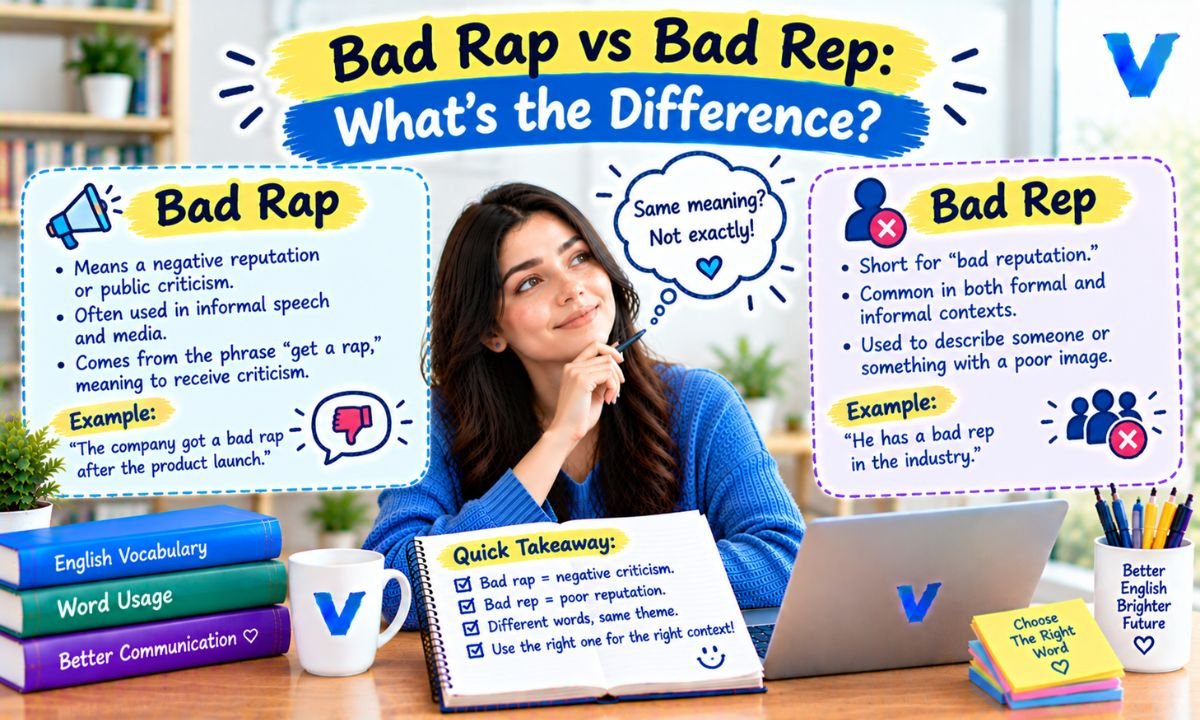
- Bad rap = an unfair, undeserved, or unjust reputation or criticism. It implies someone is being blamed or judged too harshly.
- Bad rep = shorthand for “bad reputation.” It’s informal and doesn’t necessarily imply the reputation is unfair — just that it’s negative.
So while the two phrases overlap in meaning, they aren’t perfect twins. “Bad rap” carries a built-in sense of injustice. “Bad rep” is more neutral — it just states that someone’s image has taken a hit, deserved or not.
In formal writing — articles, business communication, journalism, essays — “bad rap” is the phrase you want. “Bad rep,” while understandable and common in casual speech, is generally treated as the less standard option.
Read More:Master’s Student vs Masters Student vs MS Student: A Complete Guide
What “Bad Rap” Actually Means (Not Music)
This is the point where a lot of people get tripped up: “bad rap” has nothing to do with rap music.
When someone says a person or thing “got a bad rap,” they mean that person or thing was unfairly criticized, blamed, or judged. The word “rap” here functions as a noun meaning an accusation, criticism, or blame — not the musical genre.
A few real-world uses:
- “The neighborhood gets a bad rap, but it’s actually quite safe.”
- “Sharks have a bad rap in movies, even though attacks are extremely rare.”
- “Broccoli gets a bad rap for tasting bland — it’s all in how you cook it.”
Notice the pattern: in each case, the negative reputation is being described as undeserved. That’s the core nuance “bad rap” carries that “bad rep” doesn’t automatically imply.
Read More:“Impatient” vs. “Inpatient”: Meaning, Examples & Common Usage
Where “Bad Rap” Comes From (Real Origin)
The phrase has deep roots in American legal and street slang, not music.
Here’s the traceable history:
- In the 18th century, “rap” was already used in English to mean a rebuke or punishment — as in “a rap on the knuckles.”
- By the 19th century, American slang had turned “rap” into a term for a prison sentence or criminal charge — think phrases like “beat the rap” (avoid conviction) or “take the rap” (accept blame for something).
- This criminal-justice sense directly produced “rap sheet” — a person’s arrest record.
- From there, “bad rap” and its cousin “bum rap” evolved to mean an unfair charge or an undeserved negative reputation, extending the idea beyond literal courtrooms into everyday judgment.
So a “bad rap” is something you get hit with — like an accusation — even when you don’t deserve it.
Bad Rap Origin Lyrics Meaning
It’s worth clearing up a common point of confusion: rap music and the phrase “bad rap” share a word, but not a lineage. Rap music’s name comes from a separate 20th-century meaning of “rap” — to talk, chat, or engage in rhythmic wordplay — which by the 1970s evolved into “rapping” as a performance style and eventually gave us the genre “rap music.”
The “bad rap” idiom, on the other hand, comes from the older legal/criminal slang sense of “rap” as a charge or blow. They’re two branches from the same root word, but they grew in completely different directions. So when someone searches for “bad rap origin lyrics meaning,” the honest answer is: there isn’t one. The idiom predates hip-hop by decades and has nothing to do with song lyrics.
Why Some People Think It’s “Bad Rep”
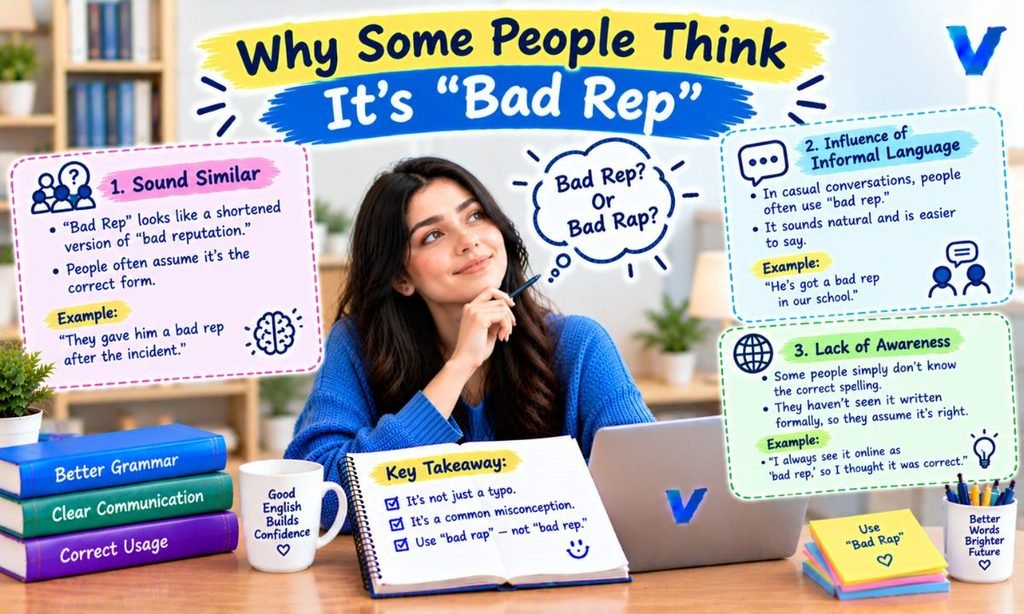
The confusion is understandable. “Rep” is a genuine, common shortening of “reputation” — you’ll hear it constantly in phrases like “he’s got a good rep” or “protect your rep.” Because “rap” and “rep” are one vowel apart and sound nearly the same in fast speech, people naturally assume “bad rep” is simply the shortened, modern version of “bad reputation,” and that it should be interchangeable with “bad rap.”
It’s a logical mistake — “rep” is a real word with a real meaning that fits the context. But historically, “bad rap” came first, and dictionaries and style guides still treat “bad rap” as the standard idiom, with “bad rep” as an informal variant that hasn’t fully earned the same status in edited writing.
The “Bad Wrap” Mistake
There’s a second, even more common error: “bad wrap.”
This one is a straightforward spelling mistake caused by a homophone. “Wrap” (as in wrapping paper, a sandwich wrap, or a “wrap party”) has nothing to do with reputation or blame. Writing “she got a bad wrap” is simply incorrect — unless you’re literally talking about a poorly assembled burrito.
| Phrase | Correct? | Meaning |
| Bad rap | ✅ Yes (standard) | Unfair blame or undeserved negative reputation |
| Bad rep | ⚠️ Informal | Shortened “bad reputation,” casual usage |
| Bad wrap | ❌ No | Spelling error; “wrap” refers to food or packaging |
Bad Rap vs Bad Rep Reddit
Search Reddit threads on this topic and you’ll find plenty of native speakers arguing both sides — some insist they grew up hearing “bad rep,” others swear by “bad rap.” This mirrors what dictionaries note: the phrase spread mostly through spoken language, so regional and generational variation is real. But when threads get fact-checked with sources like Merriam-Webster, the consensus lands the same way every time: “bad rap” is the original and standard form, and “bad rep,” while common in casual conversation, is considered a variant rather than the “correct” version in formal writing.
How to Use “Bad Rap” Correctly (With Examples)
Use “bad rap” when you want to communicate that a person, place, or thing is being judged unfairly. Here are some clean examples:
- “Gluten-free diets get a bad rap for being restrictive, but there are plenty of tasty options.”
- “The city has a bad rap for crime, even though statistics show it’s improved a lot.”
- “He’s had a bad rap since high school, but people change.”
- “Pit bulls get an undeserved bad rap in the media.”
- “Remote work got a bad rap early on for being unproductive.”
Quick Rule of Thumb
- If the criticism feels unjust or exaggerated → use bad rap.
- If you’re simply describing someone’s general public image → “bad rep” is acceptable in casual writing, but “poor reputation” or “negative reputation” is safer for formal contexts.
Pop Culture and Real Media Examples

You’ll spot “bad rap” constantly in journalism, entertainment writing, and everyday media commentary:
- Documentaries and news segments often note that sharks “get a bad rap” thanks to how they’re portrayed in film.
- Food writers frequently say vegetables like broccoli or foods like carbs “get a bad rap” despite being healthy.
- Entertainment journalists describe misunderstood public figures as having “gotten a bad rap” from tabloids.
- Even Cambridge Dictionary uses examples like a lake’s smell giving it “a bad rap,” and a controversial TV show getting “a bad rap” in the papers.
This consistent usage across professional media is strong evidence that “bad rap” remains the phrase editors and publications trust.
Why Getting This Right Matters
This might seem like a small grammar quirk, but word choice like this actually affects how your writing is perceived.
Here’s why:
- Credibility – Using the standard idiom signals attention to detail, especially in professional or academic writing.
- Clarity – “Bad rap” instantly communicates unfairness; “bad rep” is more ambiguous about whether the reputation is deserved.
- Consistency – Style guides, dictionaries, and edited publications overwhelmingly favor “bad rap,” so matching that standard keeps your writing aligned with expected norms.
- Avoiding embarrassment – Mixing up “bad rap” and “bad wrap” in a business email or published article is the kind of error that sticks out and undermines your message.
Quick Language Check Tools
If you’re not sure which phrase fits, a few quick habits help:
- Say it slowly. “Rap” ends in a hard “p” sound tied to blame; “rep” is tied to reputation.
- Run it through a grammar checker like Grammarly or the Hemingway App — most flag “bad wrap” instantly.
- Search the exact phrase in quotes on a dictionary site (Merriam-Webster, Cambridge) to confirm usage.
- Read it back in context — if you mean “unfairly judged,” lean toward “bad rap.”
Bad Rap or Bad Rep Synonym
If you want to sidestep the debate entirely, there are solid alternatives depending on what you mean:
- For “bad rap” (unfair judgment): undeserved criticism, unjust blame, bum rap, unfair reputation
- For “bad rep” (general negative image): poor reputation, negative image, tarnished name, bad name
Case Study: How “Bad Rap” Beat the Mistakes
Look at any long-running English usage debate, and you’ll notice a pattern: the version rooted in a real historical origin tends to win out over time, even when a competing phrase sounds equally plausible.
That’s exactly what happened here. “Bad rap” has centuries of traceable lineage through legal slang, “rap sheets,” and phrases like “beat the rap.” “Bad rep,” by contrast, only gained traction because “rep” happens to be a convenient, modern shorthand for “reputation.” Dictionaries like Merriam-Webster have explicitly noted that “bad rep” has historically been treated as a spelling variation of “bad rap” rather than its own distinct idiom — though it has seen enough real-world usage over time to be documented.
The takeaway: when two phrases compete, the one with a clear historical trail — and consistent use in edited publications — tends to become the “correct” default, which is exactly the position “bad rap” holds today.
Is Language Changing Here—or Is This One Settled?
Language does evolve, and plenty of “incorrect” phrases eventually become accepted through sheer popular usage. But this particular case looks more settled than shifting.
“Bad rap” continues to dominate in journalism, dictionaries, and edited publications. “Bad rep” survives mainly in casual speech, texting, and informal social media posts — it hasn’t displaced “bad rap” in professional or academic writing, and there’s little sign that it will. So while you’ll keep hearing “bad rep” in conversation, it’s safe to treat “bad rap” as the standard for anything you write that needs to look polished.
Easy Memory Trick
Here’s a simple way to lock in the difference for good:
Think of a rap sheet — a criminal record. A “bad rap” is like being falsely accused, just like an unfair entry on a rap sheet. “Rep,” on the other hand, is just short for reputation — no built-in sense of unfairness at all.
If the situation involves someone being blamed unfairly, go with rap. If you’re simply talking about someone’s general image, “reputation” (or casually, “rep”) works — but stick to “bad rap” for polished writing.
Summary of Key Points
- “Bad rap” means an unfair or undeserved negative reputation or criticism.
- “Bad rep” is an informal shorthand for “bad reputation” and is less standard in formal writing.
- “Bad wrap” is simply a spelling mistake — never correct.
- “Bad rap” traces back to 18th–19th century legal slang tied to “rap sheet” and “beat the rap.”
- Rap music’s name comes from a completely different, unrelated meaning of “rap” (to talk or chat).
- Dictionaries and edited publications consistently favor “bad rap” over “bad rep.”
- When in doubt, ask yourself: is this reputation deserved or not? If not, “bad rap” is your phrase.
Bad Rap in a Sentence
- “Instant noodles get a bad rap, but some brands are surprisingly nutritious.”
- “The old bridge has a bad rap for being unsafe, though it passed every recent inspection.”
FAQs
Q:What does rap mean in slang?
In slang, “rap” can mean an accusation, criminal charge, or blame — as in “rap sheet” or “beat the rap.” It’s separate from “rap” as in rap music, which means rhythmic spoken lyrics.
Q:What is another word for “bad rap”?
Common alternatives include “bum rap,” “unfair reputation,” “undeserved criticism,” and “unjust blame.”
Q:Where did the phrase “bad rap” come from?
It comes from 18th- and 19th-century legal and criminal slang, where “rap” meant a charge or punishment, closely linked to terms like “rap sheet” and “beat the rap.”
Q:What is the opposite of rep?
There isn’t a true single-word opposite of “rep,” but phrases like “poor reputation” or “bad name” express the negative side, while “good rep” expresses the positive side.
Q:What is a rep person?
“Rep” as applied to a person usually refers to their reputation — how others perceive their character, reliability, or public image, not their profession or role.
Conclusion
At the end of the day, “bad rap” and “bad rep” aren’t identical twins — they’re close relatives with different family histories. “Bad rap” carries the weight of unfair judgment and has centuries of documented use behind it, making it the safer, more credible choice for formal writing. “Bad rep” works fine in casual conversation, but it’s the informal cousin, not the standard.
And whatever you do, leave “bad wrap” for sandwiches.
Next time you’re writing about someone or something getting unfairly judged, you’ll know exactly which phrase carries the right meaning — and the history to back it up.










2 thoughts on “Bad Rap vs Bad Rep: What’s the Difference?”