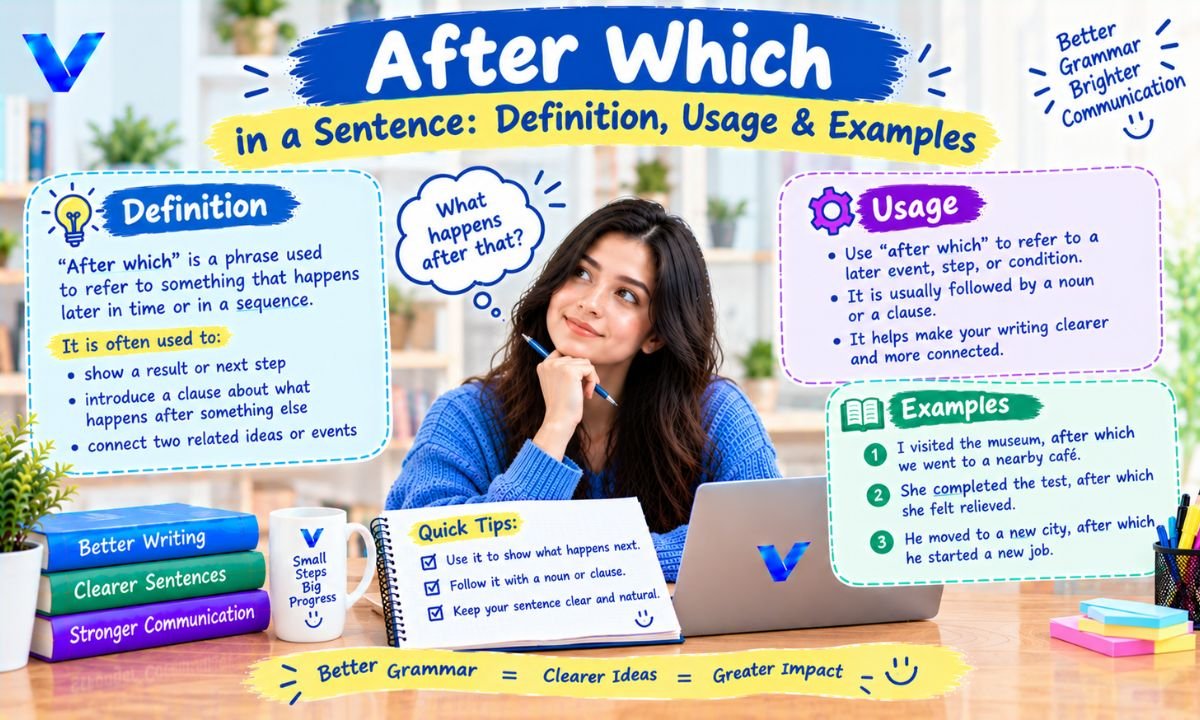
If you’ve ever paused mid-sentence wondering whether “after which” fits, you’re not alone. This small phrase shows up constantly in news articles, business reports, and academic writing, yet many writers avoid it simply because they’re unsure how to punctuate it or where it belongs. This guide breaks down exactly what “after which” means, how it works grammatically, when to use it, and when a simpler word will serve you better.
By the end, you’ll be able to use “after which” confidently — and know exactly when to reach for an alternative instead.
What Does “After Which” Mean?
“After which” means “following that event” or “and then.” It links two actions in a single sentence, showing that the second action happens immediately after the first one already mentioned.
For example:
The team finished the presentation, after which the client asked several questions.
Here, “after which” points back to the presentation and tells the reader that the questions came next. It’s a compact way to connect two related events without starting a brand-new sentence or repeating words like “then” or “after that” over and over.
Grammatically, “after which” is a relative phrase. The word “which” refers back to something already stated earlier in the sentence, while “after” adds the time relationship between the two events.
Read More: Wonder vs Wander: Meaning, Difference, and How to Use Them Correctly
Why “After Which” Confuses Writers
Many writers hesitate to use “after which” because:
- They’re unsure whether a comma comes before it.
- They mix it up with “after that,” “afterward,” and “then.”
- They try to use it to start a new sentence, which creates a fragment.
- They don’t know what “which” is actually referring back to.
- Non-native English speakers often haven’t seen it explained clearly, only used in dense academic or legal text.
Once you understand the underlying grammar, though, these issues disappear. Let’s break it down.
Read More:Anyone Else vs Someone Else vs Everyone Else: Meaning, Differences
How “After Which” Works in Grammar
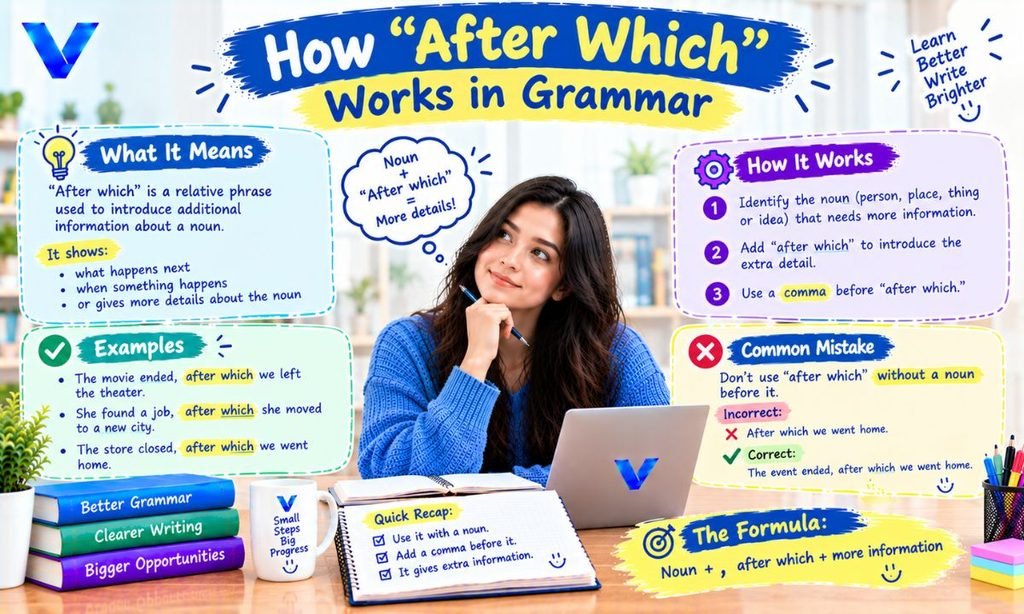
“After which” functions as a connector phrase that introduces a relative clause. That clause adds information about what happened after the action or event already described.
Key Grammar Rules
- A comma usually comes before “after which.” It typically follows a complete independent clause.
- “Which” must refer to a specific noun or event mentioned earlier — never leave it vague.
- It cannot start a new sentence in standard formal grammar, since it depends on the clause before it. (More on the rare exception below.)
- The clause after “after which” needs a subject and verb. Just like any other clause, it can’t stand alone as a phrase.
- Keep the timeline logical. The event before “after which” must happen first; the event after it happens second.
Example With Explanation
She completed her certification, after which she was promoted to team lead.
- First event: She completed her certification.
- Second event (introduced by “after which”): She was promoted.
- What “which” refers to: the act of completing the certification.
This structure lets you combine two related sentences into one smooth, professional-sounding statement.
“After Which” in a Sentence
Here are a few more natural examples:
- The chef plated the dessert, after which the waiters served it immediately.
- We signed the contract, after which both parties received a copy.
- The storm passed by midnight, after which the roads were cleared.
- He apologized sincerely, after which she accepted and they moved on.
Correct Sentence Structure for “After Which”
The safest and most common structure looks like this:
[Independent clause], after which [subject + verb + rest of clause].
| Structure Element | Example |
| Independent clause | The meeting ended |
| Comma | , |
| “After which” | after which |
| New subject + verb | the manager sent |
| Rest of clause | a follow-up email |
Put together: “The meeting ended, after which the manager sent a follow-up email.”
“After Which” Synonym
If “after which” feels too formal or repetitive in your writing, here are natural alternatives:
- Then
- After that
- Following that
- Afterward / Afterwards
- Subsequently
- Thereafter
- Next
How to Use “After Which” Step by Step
- Identify two related actions that happen in sequence.
- Write the first action as a complete sentence or clause.
- Add a comma, then insert “after which.”
- Add a new subject and verb describing the second action.
- Check the timeline — make sure the second action genuinely happens after the first.
- Read it aloud to confirm it flows naturally and isn’t overly stiff for your context.
Real-Life Examples of “After Which”

- In the office: “She reviewed the budget, after which she approved the new hires.”
- In storytelling: “The hero crossed the bridge, after which the village came into view.”
- In legal writing: “The tenant must vacate by the 30th, after which the lease is void.”
- In news reporting: “Firefighters contained the blaze, after which investigators began their review.”
- In academic writing: “Researchers collected the samples, after which the data was analyzed.”
“After Which” vs. Similar Time Expressions
“After Which” vs. “After That”
“After which” connects two clauses within the same sentence and refers back to a specific noun or event. “After that” usually starts a new sentence and refers more loosely to the previous idea.
Correct: We finished dinner, after which we watched a movie. Also correct: We finished dinner. After that, we watched a movie.
“After Which” vs. “Afterward / Afterwards”
“Afterward” is an adverb that stands on its own and doesn’t need to grammatically link back to a noun. “After which” is tied directly to the clause before it.
She finished the race. Afterward, she celebrated with friends. She finished the race, after which she celebrated with friends.
“After Which” vs. “Then”
“Then” is more casual and conversational. “After which” sounds more formal and polished, and is better suited to professional or academic writing.
After Which vs After That (Quick Comparison Table)
| Feature | After Which | After That |
| Sentence position | Mid-sentence, joins two clauses | Usually starts a new sentence |
| Formality | More formal | Neutral/casual |
| Refers to | A specific noun or clause | The previous idea generally |
| Common in | Reports, essays, legal writing | Everyday speech, casual writing |
After Which vs After That Quiz
Try picking the better option:
- He locked the door, ______ he left for work. (after which / after that)
- We ate lunch. ______, we went for a walk. (After which / After that)
(Answers: 1. after which, 2. After that)
When You Should Use “After Which”
- Writing formal reports, essays, or business documents
- Connecting two closely related actions in one sentence
- Avoiding repetitive use of “then” or “after that”
- Writing legal, academic, or journalistic content where precision matters
When You Should Avoid “After Which”
- Casual conversation or texting
- Dialogue meant to sound natural and spoken
- Short, punchy sentences where simplicity works better
- When the connection between the two events isn’t a clear time sequence
Common Mistakes With “After Which”
| Mistake | Incorrect Example | Corrected Example |
| Starting a sentence with it alone | “After which he left.” | “He finished the call, after which he left.” |
| Missing comma | “He finished his work after which he left.” | “He finished his work, after which he left.” |
| Vague reference | “Things happened, after which it changed.” | “The vote was counted, after which the results changed.” |
| Wrong time order | “He went home, after which he finished his work.” | “He finished his work, after which he went home.” |
| Adding an extra “that” | “She called, after which that I replied.” | “She called, after which I replied.” |
Can “After Which” Start a Sentence?
Technically, it’s rare and generally discouraged in formal writing because “which” needs something to refer back to. If the previous sentence provides clear context, some writers use it for stylistic emphasis, but it’s safer to keep “after which” attached to the clause it refers to.
Is “After Which” Formal?
Yes. “After which” leans formal and is most common in academic writing, legal documents, business reports, and journalism. In casual speech, “then” or “after that” is far more natural.
Using “After Which” in Spoken English
While grammatically fine to say aloud, “after which” is rarely used in everyday conversation. Native speakers tend to say “then” or “and after that” instead, saving “after which” for writing where precision and formality matter more.
Synonyms and Alternatives to “After Which”
- Then
- After that
- Afterward
- Subsequently
- Following that
- Thereafter
- Next
Choosing the right one depends on tone: use “subsequently” or “thereafter” for formal writing, and “then” or “after that” for everyday communication.
How to Avoid Awkward Sentences
- Don’t overuse “after which” — reserve it for moments where sequence truly matters.
- Keep the clause after it short and clear.
- Make sure “which” has an obvious, specific reference point.
- Read your sentence aloud; if it sounds clunky, try “then” or split it into two sentences.
Practice Exercises
Fill in the Blank
- The plane landed, ______ passengers began to disembark.
- She finished her thesis, ______ she celebrated with friends.
- The fire alarm rang, ______ everyone evacuated the building.
- He signed the form, ______ he handed it back to the clerk.
Correct Answers
- after which
- after which
- after which
- after which
FAQs
Q:What is after which means?
“After which” means “following that” — it connects an action to the event that happens right after it in the same sentence.
Q:What is another way to say “after which”?
You can use “then,” “after that,” “afterward,” “subsequently,” or “thereafter” depending on formality.
Q:Do you put a comma after which?
No — the comma goes before “after which,” not after it. Example: “She left, after which he arrived.”
Q:When to use after which in a sentence?
Use it when two events happen in sequence and you want to link them formally within one sentence, especially in writing.
Q:How to correctly use which?
Use “which” to refer back to a specific noun, action, or clause already mentioned — never to something vague or unstated.
Conclusion
“After which” is a simple but powerful connector once you understand its structure: a comma, a clear reference point, and a second clause describing what happened next. It’s best suited for formal writing like reports, essays, and professional communication, while everyday speech usually calls for “then” or “after that.” With the rules, examples, and practice above, you now have everything you need to use “after which” correctly — and to know exactly when a simpler alternative works better.










2 thoughts on “After Which in a Sentence: Definition, Usage & Examples”