If you’ve ever paused mid-sentence wondering whether to write “does anyone else agree” or “does someone else agree,” you’re dealing with one of English’s sneakiest grammar puzzles. These three phrases look almost identical, share the same little word “else,” and yet each one sends a completely different message.
Get them mixed up, and your sentence can sound confusing, overly broad, or just plain wrong. Get them right, and your writing instantly feels sharper and more natural — whether you’re emailing a coworker, texting a friend, or writing an essay.
This guide breaks down the grammar, meaning, and real-world usage of anyone else, someone else, and everyone else, so you never have to second-guess yourself again.
The Grammar Behind Indefinite Pronouns + Else
Before comparing the three phrases, it helps to understand the building blocks they’re made from: indefinite pronouns and the word “else.”
What Are Indefinite Pronouns?
An indefinite pronoun refers to a person, thing, or amount without naming it specifically. Words like anyone, someone, everyone, nobody, and something don’t point to a particular individual — they leave the identity open or general.
- Anyone – any person, unspecified
- Someone – one unspecified person
- Everyone – all people in a group
All three are grammatically singular, which matters later when we talk about verb agreement.
Read More:After Which in a Sentence: Definition, Usage & Examples
Why “Else” Always Comes After the Pronoun
In English, “else” attaches directly after the indefinite pronoun, never before it. We say “someone else,” not “else someone.” This word order is fixed and doesn’t change based on tense, tone, or sentence type.
- ✅ Correct: Ask someone else.
- ❌ Incorrect: Ask else someone.
Why “Else” Changes Everything in a Sentence
On its own, “else” simply means “other” or “another.” Add it to an indefinite pronoun, and it shifts the meaning from “a person” to “a different person than the one already mentioned.”
Compare:
- Someone called. (an unspecified person)
- Someone else called. (a different, additional person — not the one you were expecting)
That single word narrows the meaning by excluding someone or something already known.
What “Else” Does Grammatically
Grammatically, “else” functions as a modifier that attaches to indefinite pronouns (anyone, someone, everyone, no one), question words (who, what, where), and a few other structures (something else, anywhere else). It doesn’t change the pronoun’s number — the phrase stays singular — but it does add the idea of exclusion or contrast.
Read More: “You Are Always Welcomed” – Meaning, Grammar & Proper Usage
Understanding “Anyone Else”

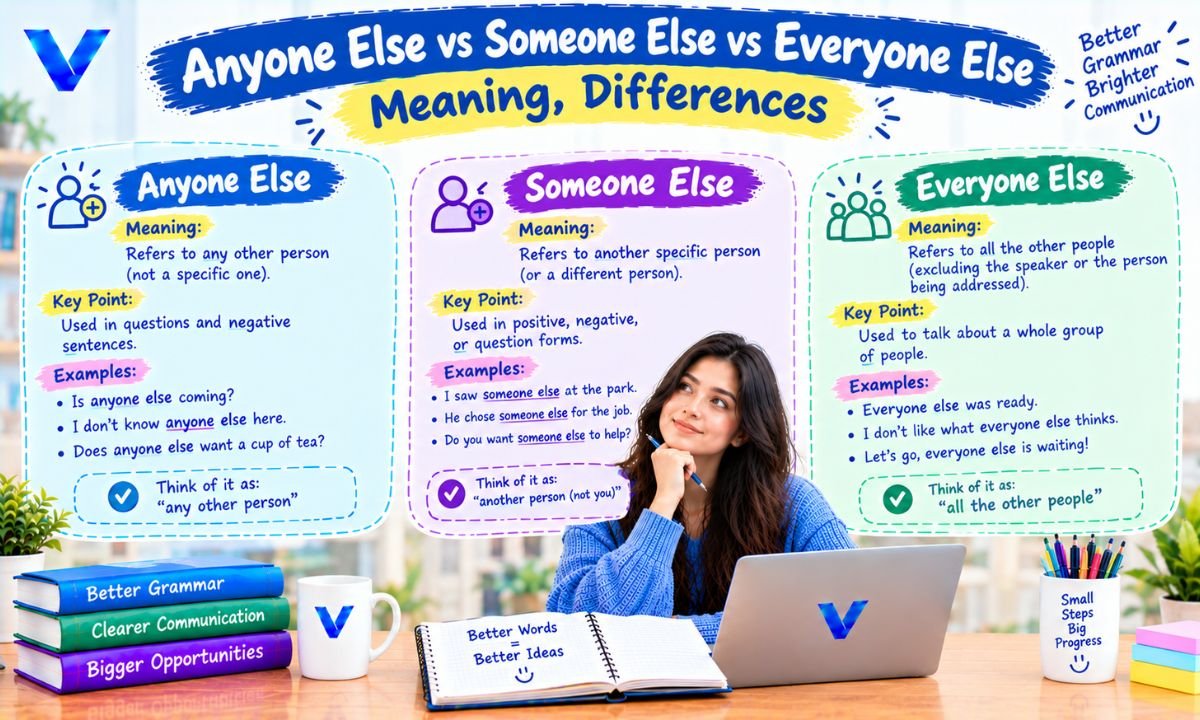
Anyone else means “any other person,” used when you don’t know or don’t care who that person is. It’s most common in:
- Questions: Is anyone else coming to the meeting?
- Negative sentences: I don’t think anyone else noticed.
- Conditional or open statements: If anyone else wants to join, let me know.
It keeps the scope wide open — you’re not assuming a specific person exists; you’re simply asking or allowing for the possibility.
Anyone Else vs Anybody Else
“Anyone else” and “anybody else” mean exactly the same thing. The only real difference is tone:
| Feature | Anyone Else | Anybody Else |
| Meaning | Any other person | Any other person |
| Formality | Slightly more formal | Slightly more casual |
| Common context | Writing, professional speech | Everyday conversation |
Use whichever fits your tone — grammar rules don’t force a choice here.
Understanding “Someone Else”
Someone else means “one other, unspecified person.” Unlike “anyone else,” it usually implies the speaker believes another person exists or is involved — it’s typically used in statements, not questions.
Examples:
- She gave the ticket to someone else.
- I think someone else already answered this question.
- We’ll need someone else to cover the shift.
The identity of that person may be unknown, but their existence isn’t in doubt.
Understanding “Everyone Else”
Everyone else refers to all the other people in a group, excluding someone or something already mentioned. It always talks about a group, not an individual.
Examples:
- Sarah finished early, but everyone else was still working.
- Everyone else agreed with the plan.
- He stayed calm while everyone else panicked.
This phrase is especially useful for drawing a contrast between one person (or a small group) and the rest of the crowd.
Everyone Else vs Everybody Else
Just like anyone/anybody, “everyone else” and “everybody else” are interchangeable in meaning.
| Feature | Everyone Else | Everybody Else |
| Meaning | All other people | All other people |
| Formality | Slightly more formal, common in writing | Slightly more casual, common in speech |
| Verb agreement | Singular verb | Singular verb |
Anyone Else vs Someone Else vs Everyone Else: Precision Comparison
Here’s a side-by-side look that makes the differences instantly clear:
| Phrase | Meaning | Number Implied | Typical Sentence Type |
| Anyone else | Any other person (unknown if one exists) | Unknown / open | Questions, negatives, conditionals |
| Someone else | One other, unspecified person | Singular (assumed to exist) | Positive statements |
| Everyone else | All other people in a group | Plural group | Statements of contrast or comparison |
A simple way to remember it: ANY = possibility, SOME = one real person, EVERY = the whole remaining group.
Certainty and Scope: Decision Framework
Choosing the right phrase comes down to two questions: how certain are you that another person exists, and how many people are you talking about?
- Are you asking or unsure? → Use anyone else.
- Are you referring to one specific (but unnamed) person you believe exists? → Use someone else.
- Are you talking about a whole group minus one person? → Use everyone else.
This certainty-and-scope test works for almost every real-life sentence you’ll write.
Sentence Structure Patterns You Must Know

These phrases follow predictable patterns you can lean on:
- Question pattern: Does anyone else + verb…? (Does anyone else want coffee?)
- Negative pattern: not + anyone else (I didn’t tell anyone else.)
- Statement pattern: someone else + verb (Someone else finished the report.)
- Contrast pattern: [Person], but everyone else + verb (Tom left, but everyone else stayed.)
- Possessive pattern: else’s is added to “else,” not the pronoun (someone else’s phone, not someone’s else phone).
“Anyone” vs “Everyone” Difference
The core difference isn’t about certainty but about scope. “Anyone” refers to a single, unspecified individual out of a possible group (“Can anyone help?” — one helper is enough). “Everyone” refers to the entire group without exception (“Everyone must help” — all of them). Adding “else” doesn’t change this core scope difference; it simply excludes someone already mentioned.
Common Mistakes That Damage Clarity
Even fluent speakers slip up with these phrases. Watch out for:
- Using “anyone else” in a statement where “someone else” fits better (and vice versa)
- Treating “everyone else” as plural for verb agreement (“everyone else are” ❌)
- Forgetting the possessive goes on “else,” not the pronoun
- Mixing tone inconsistently (anybody else in a formal report, for example)
Incorrect Word Order
The most common structural mistake is reversing the pronoun and “else.”
- ❌ Else anyone wants to try?
- ✅ Does anyone else want to try?
- ❌ Give it to else someone.
- ✅ Give it to someone else.
“Else” always follows the pronoun — no exceptions.
Advanced Usage and Edge Cases
A few trickier situations trip people up:
- Possessives: The correct form is always else’s — someone else’s car, everyone else’s opinion, anybody else’s turn. There is no such thing as “someone’s else.”
- Subject-verb agreement: Anyone else, someone else, and everyone else are all grammatically singular, even though “everyone else” refers to a group. Use singular verbs: Everyone else is ready, not are ready.
- Pronoun back-reference: Because these phrases don’t indicate gender, English speakers commonly use “they/their” afterward: If anyone else has a question, they can ask.
- Overlap in flexible contexts: Sometimes either “anyone else” or “someone else” is technically correct, and the choice depends on tone rather than strict grammar (e.g., “Does anyone else want cake?” vs. “Does someone else want cake?” — the first sounds more natural for open group questions).
“Someone” vs “Someone Else” in English Grammar
“Someone” simply means an unspecified person with no exclusion implied. “Someone else” adds a contrast — it excludes a person or option already mentioned or expected. Someone called just states a fact; someone else called implies it wasn’t the person you expected.
Real-Life Case Studies
Workplace email: “If anyone else has feedback before Friday, please send it my way.” — Open invitation, uncertain how many will respond.
Casual conversation: “I asked Mia, but maybe someone else knows the answer.” — One specific, unnamed person is assumed to exist.
Group comparison: “I was the only one who finished on time; everyone else needed extra hours.” — Clear contrast between one person and the rest of the group.
These examples show how the same underlying idea — “another person(s)” — shifts meaning entirely based on which phrase you choose.
Quick Mastery Checklist
- [ ] Use anyone else for questions, negatives, and open possibilities
- [ ] Use someone else for a specific but unnamed person in statements
- [ ] Use everyone else for a full group minus one person or item
- [ ] Keep verbs singular with all three phrases
- [ ] Form possessives as else’s, never pronoun’s else
- [ ] Remember “else” always comes right after the pronoun
Practice Section
Choose the correct phrase for each sentence:
- Does ______ want to join us for lunch? (anyone else / everyone else)
- I think ______ already took the last seat. (someone else / anyone else)
- Mark stayed quiet while ______ argued loudly. (someone else / everyone else)
- I didn’t ask ______ for permission. (anyone else / someone else)
- Is this ______ jacket, or is it yours? (someone / someone else’s)
(Answers: 1. anyone else, 2. someone else, 3. everyone else, 4. anyone else, 5. someone else’s)
FAQs
Q:Is it anyone else or anybody else?
Both are correct and mean the same thing. “Anyone else” is slightly more formal, while “anybody else” is more common in casual speech.
Q:What can I say instead of everyone else?
You can use “everybody else,” “all the others,” or “the rest of the group,” depending on context and tone.
Q:Is anyone else correct grammar?
Yes, it’s grammatically correct and commonly used in questions and negative statements, such as “Is anyone else coming?”
Q:Is anybody singular or plural?
“Anybody” is always grammatically singular, even though it can refer to any number of people in meaning. It takes a singular verb.
Q:Is anyone and everyone the same?
No. “Anyone” refers to a single, unspecified person from a group, while “everyone” refers to every person in that group without exception.
Conclusion
At first glance, anyone else, someone else, and everyone else look like near-identical twins. But once you understand the logic behind them — certainty, number, and sentence type — the differences become second nature. Use anyone else when you’re asking or unsure, someone else when you’re confident one other person exists, and everyone else when you’re talking about the rest of the group.
Master this small pattern, and your English will sound noticeably more precise and natural, whether you’re writing a quick text or a professional email.










2 thoughts on “Anyone Else vs Someone Else vs Everyone Else: Meaning, Differences”