If you’ve ever typed “authentification” into a search bar, paused, and wondered whether you spelled it right — you’re not alone. This mix-up shows up constantly in emails, technical documentation, and even published articles. The good news is that the answer is simple, and once you understand it, you’ll never second-guess yourself again.
This guide breaks down the exact difference between the two words, explains how authentication actually works, and walks through the modern methods — 2FA, MFA, biometrics, passwordless login — that keep your accounts safe.
Authentication vs Authentification (Straight Answer)
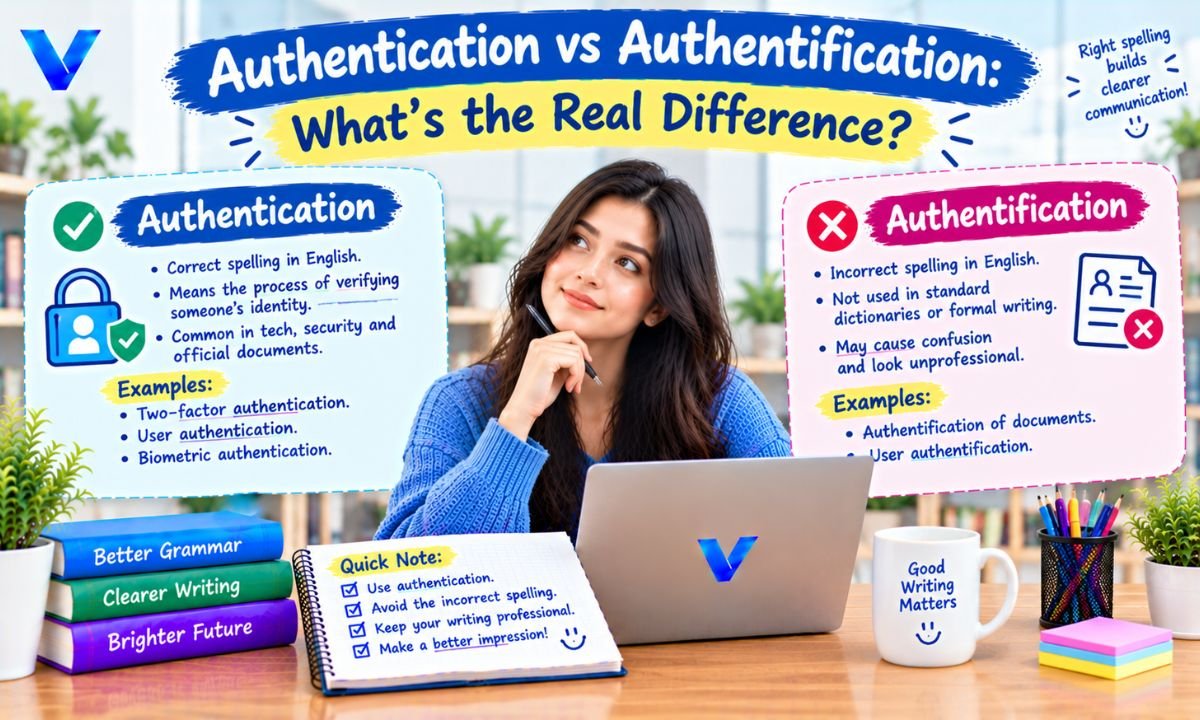
Authentication is the correct, standard English term used in technology, cybersecurity, and everyday writing. Authentification is a rarely used variant that shows up mostly in older texts or as a direct translation from French (“authentification”) and other Romance languages. Both words point to the same general idea — proving identity — but only one is considered correct in modern technical English.
| Term | Status | Common Usage |
| Authentication | Standard, widely accepted | Cybersecurity, software, IT, everyday English |
| Authentification | Rare, often flagged as incorrect | Older literature, French/European translations |
If you’re writing documentation, an app, or a security policy, always use authentication.
Read More: Modeling vs Modelling: Which Spelling Is Correct?
What Is Authentication? (Simple Explanation)
Authentication is the process of confirming that a user, device, or system is genuinely who or what it claims to be. It’s the digital equivalent of showing your ID at a checkpoint.
Every time you log into an email account, unlock your phone with your face, or enter a one-time code sent to your mobile number, you’re completing an authentication step. Without it, anyone could walk into any account, file, or system with zero resistance.
The Core Types of Authentication Factors
Security professionals group authentication methods into three broad factor categories:
- Something you know — passwords, PINs, security questions
- Something you have — a phone, hardware token, smart card
- Something you are — fingerprints, facial scans, voice patterns
A fourth category, somewhere you are (location-based authentication), is increasingly used alongside the three classic factors to flag suspicious login attempts.
Read More:Wonder vs Wander: Meaning, Difference, and How to Use Them Correctly
How Authentication Works (Step-by-Step Process)

- Identity claim — the user enters a username or email address.
- Credential submission — the user provides proof, such as a password or biometric scan.
- Verification — the system checks the submitted credential against stored records.
- Session grant — if verified, the system issues access (often a session token).
- Continuous checks — some systems re-verify identity periodically for sensitive actions.
Authentication vs Authorization: Stop Confusing Them
These two terms are related but not interchangeable.
| Aspect | Authentication | Authorization |
| Question it answers | Who are you? | What are you allowed to do? |
| Happens | First | After authentication |
| Example | Logging in with a password | Accessing admin-only settings |
Think of an airport: showing your passport is authentication; being allowed into the first-class lounge is authorization.
Authentication vs Authentification in Cyber Security
Inside cybersecurity teams, code, and compliance documents, “authentication” is the only accepted spelling. Using “authentification” in a technical report, resume, or codebase can come across as a language slip and may quietly undermine credibility with engineers, auditors, or hiring managers who expect precise terminology.
Authentification Pronunciation
“Authentification” is pronounced aw-then-tuh-fih-KAY-shun — essentially the same as “authentication” but with an extra “fi” syllable inserted before the ending.
Why “Authentification” Is Incorrect
“Authentification” isn’t a typo in the traditional sense — it’s a word borrowed from French, where “authentification” is the correct native spelling. The confusion happens because English speakers sometimes assume longer or more formal-sounding words are more “correct,” similar to how “orientate” gets used instead of “orient.” In standard English, the accepted noun form of “authenticate” is authentication, not “authentification.”
Why It Matters
Word choice might sound like a small detail, but in technical writing, precision builds trust. Using the standard term:
- Keeps documentation consistent with industry norms
- Improves clarity for international teams
- Avoids confusing search engines and readers
- Signals professionalism in resumes, whitepapers, and code comments
Modern Authentication Methods Explained
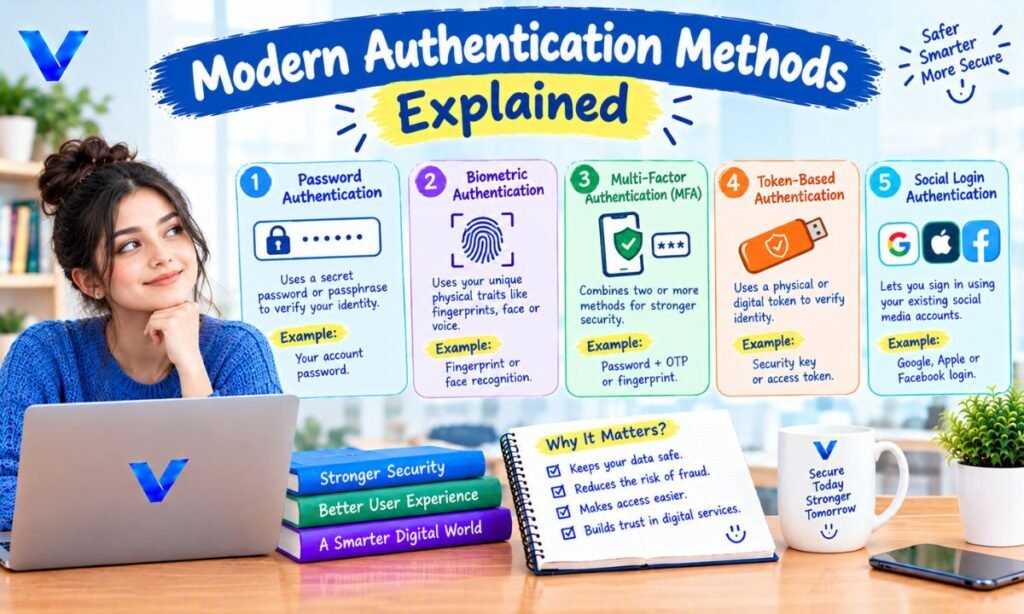
Authentication has evolved well beyond simple passwords. Here’s a breakdown of the methods shaping today’s security landscape.
Single-Factor Authentication (SFA)
This relies on just one credential — typically a password. It’s simple to implement but the weakest option, since a single leaked password grants full access.
Two-Factor Authentication (2FA)
2FA combines two different factor types, such as a password plus a one-time code sent via SMS or an authenticator app. It significantly reduces risk because attackers need both pieces to break in.
Multi-Factor Authentication (MFA)
MFA extends this further, requiring two or more factors from different categories — for example, a password, a fingerprint scan, and a hardware key. It’s the recommended standard for sensitive systems like banking or corporate networks.
Biometric Authentication
This uses unique physical traits — fingerprints, facial recognition, iris scans, or voice patterns — to confirm identity. It’s fast and hard to replicate, though it raises privacy considerations since biometric data can’t be “reset” like a password.
Certificate-Based Authentication
Devices or users present a digital certificate issued by a trusted authority. This is common in enterprise networks, VPNs, and machine-to-machine communication.
Passwordless Authentication
Instead of passwords, users verify identity through magic links, biometrics, or device-based passkeys. It removes the weakest link in security — the reused or weak password — while improving user experience.
Real-World Case Study: Authentication Failure
In several major data breaches over the past decade, attackers didn’t need to “hack” anything sophisticated — they simply exploited weak or missing authentication. Reused passwords, absent MFA, and unmonitored login attempts allowed intruders to walk through the front door using stolen or guessed credentials. These incidents pushed organizations worldwide to mandate MFA and adopt zero-trust security models, where every request is verified regardless of where it originates.
OAuth vs OpenID Connect (Simplified)
- OAuth 2.0 is an authorization framework — it lets an app access resources on your behalf without sharing your password (e.g., “Sign in with Google” granting a calendar app read access).
- OpenID Connect (OIDC) is built on top of OAuth 2.0 but adds an identity layer, meaning it actually authenticates who the user is, not just what they can access.
In short: OAuth handles permissions; OpenID Connect handles identity.
Authentication in Cloud Environments
Key Concepts
- Identity and Access Management (IAM) centralizes user authentication across cloud services.
- Single Sign-On (SSO) lets users authenticate once and access multiple connected apps.
- Federated identity allows authentication across different domains or organizations using a shared trust relationship.
Risks
- Misconfigured IAM roles granting excessive access
- Stolen API keys acting as unmonitored authentication tokens
- Weak session management leading to token hijacking
Common Authentication Vulnerabilities
- Credential stuffing — reusing leaked username/password pairs across sites
- Phishing — tricking users into revealing credentials
- Session hijacking — stealing an active authenticated session
- Brute-force attacks — automated guessing of passwords
- SIM swapping — bypassing SMS-based 2FA by hijacking a phone number
Best Practices for Secure Authentication
- Enforce MFA on all accounts, especially privileged ones
- Use passwordless or passkey-based login where possible
- Apply rate limiting and account lockouts against brute-force attempts
- Rotate and monitor API keys and tokens regularly
- Educate users on phishing red flags
- Adopt a zero-trust approach: verify every request, every time
When “Authentification” Might Appear
You may still encounter “authentification” in:
- Translated documents from French, Spanish, or German sources
- Older technical manuals predating modern style guides
- Non-native English writing where the term wasn’t corrected
Authentication vs Authentification Example
- ✅ “The app requires two-factor authentication before login.”
- ❌ “The app requires two-factor authentification before login.”
Only the first sentence follows standard English usage.
The Future of Authentication
Passwords are gradually being phased out in favor of passkeys, biometric verification, and continuous, behavior-based authentication that quietly checks typing patterns, device fingerprints, and location in the background. Expect authentication to become less visible to users while becoming more resistant to phishing and credential theft.
FAQs
Q:What is the meaning of authentification?
It’s a rarely used term meaning roughly the same as “authentication” — the process of verifying identity — but it’s not standard in modern English.
Q:Is “authentification” a real word?
It exists in dictionaries and in French, but it’s considered outdated or incorrect in current English technical writing.
Q:Is “authentification” the same as “authentication”?
They refer to the same underlying concept, but “authentication” is the correct and widely accepted English spelling.
Q:What is type 2 authentication?
There’s no official “type 2” category, but it commonly refers to the second factor in two-factor authentication (2FA), such as a code or biometric scan.
Q:Is OTP two-factor authentication?
Yes, a one-time password (OTP) sent via SMS or an app is a common second factor used in 2FA.
Conclusion
The difference between authentication and authentification comes down to correctness: authentication is the standard, professional term used across cybersecurity and technology, while authentification is an outdated or borrowed variant best avoided in modern English writing.
Beyond spelling, understanding how authentication actually works — from passwords to MFA to passwordless logins — is what truly protects your accounts and systems. Get the terminology right, and get the security practices right, and you’re covering both language and safety at once.










2 thoughts on “Authentication vs Authentification: What’s the Real Difference?”