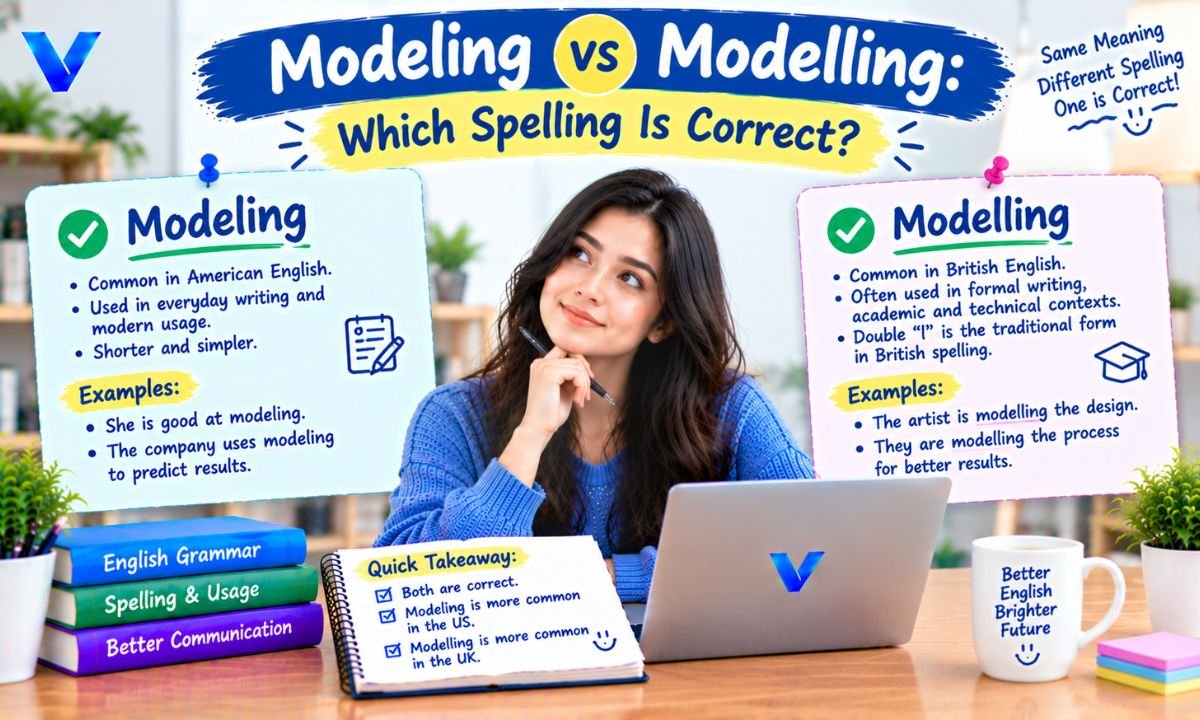
If you’ve ever paused mid-sentence wondering whether to type “modeling” or “modelling,” you’re not alone. This is one of the most common spelling mix-ups in English, and the good news is that the answer is simpler than it looks. Both spellings are correct — the one you should use just depends on your audience and which version of English you’re writing in.
This guide breaks down everything you need to know: the grammar rule behind the “double L,” how the word is used across industries like finance and fashion, what major style guides recommend, and how to avoid the mistakes writers make most often.
Quick Answer: Modeling vs Modelling
Here’s the short version before we dig deeper:
| Spelling | Region | Usage |
| Modeling | American English (US) | Standard spelling in the US and most North American writing |
| Modelling | British English (UK) | Standard spelling in the UK, Australia, New Zealand, and largely in Canada |
Both words come from the same root verb, “model,” and carry identical meanings. Neither one is a typo — they’re regional variants, similar to color vs. colour or traveling vs. travelling.
Modeling vs Modelling Meaning
There’s no difference in meaning between the two spellings. Both refer to:
- Working as a fashion or commercial model
- Creating a physical or digital representation of something (like a 3D model)
- Using data or math to simulate real-world systems (as in financial or scientific modeling)
- Demonstrating or setting an example (“modeling good behavior”)
Whichever spelling you choose, the underlying concept doesn’t change — only the letter count does.
Read More:Stay in Touch vs Keep in Touch: Meaning, Differences & Examples
Why Does the Spelling Change? The “Double L” Rule
The difference comes down to a consonant-doubling rule that British and American English apply differently.
In British English, when a verb ends in a single vowel followed by a single “l” (like “model”), the final “l” is doubled before adding a suffix that starts with a vowel, such as “-ing” or “-ed.” This gives you “modelling” and “modelled.”
American English generally skips this doubling when the final syllable isn’t stressed. Since the stress in “model” falls on the first syllable, US spelling rules leave the “l” alone, producing “modeling” and “modeled.”
This same pattern applies to other verbs like “travel” (travelling/traveling), “cancel” (cancelling/canceling), and “label” (labelling/labeling).
Read More:Authentication vs Authentification: What’s the Real Difference?
Does the Meaning Change? No — Here’s Why
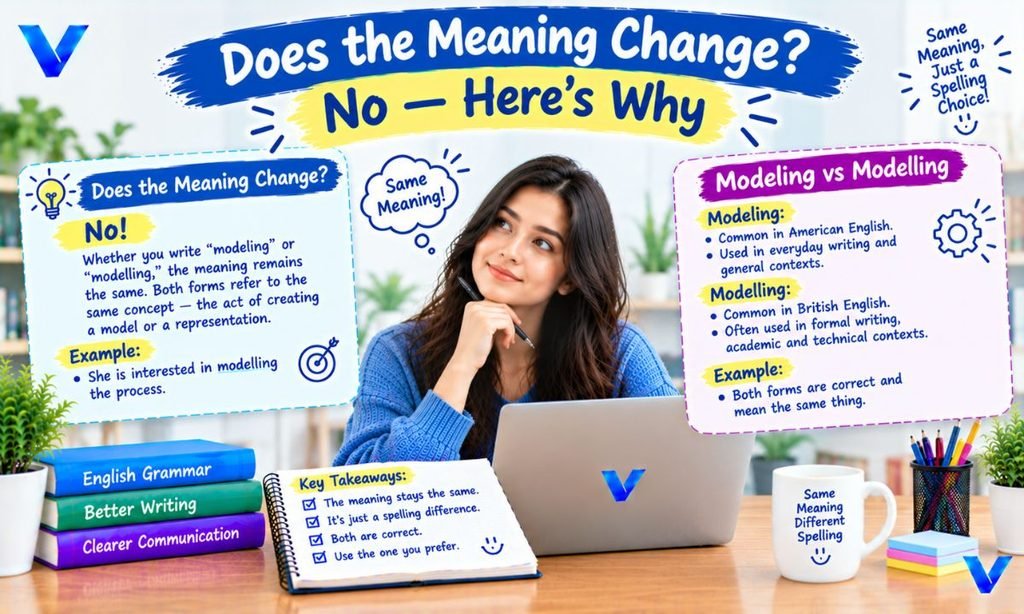
It’s worth repeating: the meaning stays exactly the same no matter which spelling you pick. This isn’t like “practice” vs. “practise,” where US and UK English sometimes assign different grammatical roles (noun vs. verb) to similar-looking words.
“Modeling” and “modelling” are simply two accepted spellings of the same present participle and gerund form of the verb “model.” A British fashion magazine and an American one could describe the exact same photoshoot using different spellings — and both would be grammatically correct.
Financial Modeling vs Modelling
In business and finance, this term shows up constantly — think revenue forecasting, valuation models, and risk simulations. The spelling rule still applies:
- US firms, textbooks, and job listings typically use “financial modeling.”
- UK, Australian, and many international finance publications use “financial modelling.”
If you’re writing a resume, report, or LinkedIn profile, match the spelling to the country or company you’re targeting. A finance professional applying to a UK-based bank should use “modelling,” while someone applying to a Wall Street firm should stick with “modeling.”
Modeling in Different Professions and Contexts
The word “model” — and its “-ing” forms — appears across many industries, each with a slightly different flavor of meaning:
- Fashion industry: Walking runways, posing for photoshoots, or representing a brand (fashion modeling/modelling).
- Finance: Building spreadsheets and forecasts to predict business performance.
- Science and engineering: Creating simulations of climate systems, structures, or chemical reactions.
- 3D design and animation: Building digital objects and characters for games, films, or product design.
- Education and parenting: “Modeling behavior” means demonstrating an action so others can learn from it.
- Statistics and data science: Building predictive or machine learning models from data.
No matter the field, the spelling rule (US vs. UK English) remains consistent throughout.
Grammar Forms You Should Know
Understanding how “model” changes across grammar forms helps you stay consistent in longer pieces of writing.
| Form | American English | British English |
| Base verb | model | model |
| Present participle/gerund | modeling | modelling |
| Past tense | modeled | modelled |
| Person who models | modeler | modeller |
Once you pick a regional style, apply it consistently across every one of these forms in the same document.
Common Mistakes Writers Make (And How to Avoid Them)

Even experienced writers slip up here. Watch out for these common errors:
- Mixing spellings in one document. Using “modeling” in one paragraph and “modelling” in another looks careless. Pick one and stick with it.
- Assuming one spelling is “more correct.” Neither spelling is superior — it’s purely regional preference.
- Forgetting related word forms. Writers often fix “modeling” but forget to adjust “modeler/modeller” or “modeled/modelled” to match.
- Ignoring the target audience. Publishing UK spelling for a US audience (or vice versa) can look like a typo to readers unfamiliar with the variant.
- Relying on autocorrect alone. Spell-checkers set to the wrong regional dictionary will “correct” the right spelling into the wrong one.
A simple fix: set your word processor’s language/region setting before you start writing, and let it flag inconsistencies as you go.
History of the Word “Model”
Root Origins
The word “model” traces back to the Latin word modulus, meaning “measure” or “standard,” by way of the Italian modello and the French modèle. It entered English in the late 16th century, originally referring to a small representation or design used as a pattern for something larger — like an architect’s model of a building.
Over time, the meaning expanded to include people who “model” clothing or products, systems that “model” real-world behavior, and objects built as scaled representations.
Why Spelling Split Happened
The US/UK spelling divide traces back largely to Noah Webster, the American lexicographer who published his influential dictionary in the early 1800s. Webster intentionally simplified many English spellings to distinguish American English and make it easier to learn — dropping unnecessary doubled letters, extra vowels, and silent letters.
Words like “colour,” “travelling,” and “modelling” were streamlined in American usage to “color,” “traveling,” and “modeling.” Interestingly, “modelling” was itself standard in American writing until the early 20th century, before the single-L form gradually took over.
Use Cases: When to Use Each Spelling
Use “Modeling” If:
- You’re writing for a US or North American audience
- Your company or publication follows American English style guides (like AP or Chicago)
- You’re targeting American job boards, resumes, or academic institutions
- Your content is for a global audience defaulting to US English (common in tech and SEO content)
Use “Modelling” If:
- You’re writing for UK, Australian, New Zealand, or Irish readers
- Your organization follows British English conventions (like Oxford style)
- You’re addressing a Canadian audience that leans toward British spelling
- You’re localizing content specifically for a Commonwealth market
Related Words With the Same Spelling Rule
The “double L” pattern isn’t unique to “model.” Several other common verbs follow the identical US/UK split:
| Base Verb | US Spelling | UK Spelling |
| travel | traveling, traveler | travelling, traveller |
| cancel | canceling, canceled | cancelling, cancelled |
| label | labeling, labeled | labelling, labelled |
| signal | signaling, signaled | signalling, signalled |
| fuel | fueling, fueled | fuelling, fuelled |
Recognizing this pattern makes it easier to remember which spelling applies elsewhere in your writing.
Modeling vs Modelling Grammar
Grammatically, both words function identically:
- As a gerund: “Modeling/modelling is her full-time career.”
- As a present participle: “She is modeling/modelling for a new campaign.”
- As part of a noun phrase: “Financial modeling/modelling requires strong Excel skills.”
The only grammatical consideration is regional consistency — not correctness. Neither spelling changes tense, part of speech, or sentence structure.
Case Study: Academic Writing Guidelines
Oxford and Cambridge (UK Focused)
British academic institutions, including Oxford and Cambridge, follow British English conventions across published research, style guides, and official communications. Students and researchers writing for these institutions are expected to use “modelling,” “modelled,” and “modeller” consistently, in line with the broader British spelling system (colour, organise, travelling, etc.).
Harvard and Stanford (US Focused)
American universities like Harvard and Stanford follow US English norms, meaning “modeling,” “modeled,” and “modeler” are the expected forms in academic papers, theses, and official publications. Most US-based journals and citation styles (APA, MLA, Chicago) also default to American spelling unless otherwise specified.
Quotes From Style Guides
Major language authorities agree on the regional split:
- Grammar-focused language resources note that the single-L spelling is preferred throughout the United States, while the double-L version is favored in nearly every other English-speaking country.
- Usage trend trackers point out that outside North America, the double-L forms remain the dominant choice, and while Canadian writers lean toward British spelling overall, the single-L forms still appear fairly often in Canadian writing.
The consistent takeaway: check your audience, then apply that region’s spelling rule uniformly.
Modeling vs Modelling Examples
Here’s how both spellings look in real sentences:
- She started modeling for a local agency at age 16. (US)
- She started modelling for a local agency at age 16. (UK)
- The team built a climate modeling tool to predict rainfall patterns. (US)
- The team built a climate modelling tool to predict rainfall patterns. (UK)
- He modeled his business plan on a successful competitor. (US)
- He modelled his business plan on a successful competitor. (UK)
- As a modeler, she specializes in 3D architectural visuals. (US)
- As a modeller, she specializes in 3D architectural visuals. (UK)
FAQs
Q:Which is correct, “modeling” or “modelling”?
Both are correct. “Modeling” is standard American English, while “modelling” is standard British English.
Q:Is modelling British spelling?
Yes. “Modelling,” with a double L, is the standard spelling used in the UK, Australia, and New Zealand.
Q:Is Kendall Jenner a model or supermodel?
Kendall Jenner is widely recognized as a supermodel, given her global fashion campaigns and high-profile runway work.
Q:What are types of modelling?
Common types include fashion, runway, commercial, fitness, plus-size, editorial, glamour, and 3D or digital modeling.
Q:What is another word for “modeling”?
Synonyms include simulating, designing, shaping, sculpting, forming, and demonstrating, depending on the context.
Conclusion
At the end of the day, “modeling” and “modelling” are two correct spellings of the same word, split by geography rather than grammar. Choose “modeling” for American audiences and “modelling” for British, Australian, or Commonwealth readers — and once you pick a spelling, use it consistently across every related word form, from “modeler/modeller” to “modeled/modelled.”
Getting this small detail right shows attention to detail, whether you’re writing a fashion blog post, a financial report, or an academic paper. When in doubt, match your spelling to your audience’s version of English, and your writing will read as polished and professional either way.










2 thoughts on “Modeling vs Modelling: Which Spelling Is Correct?”