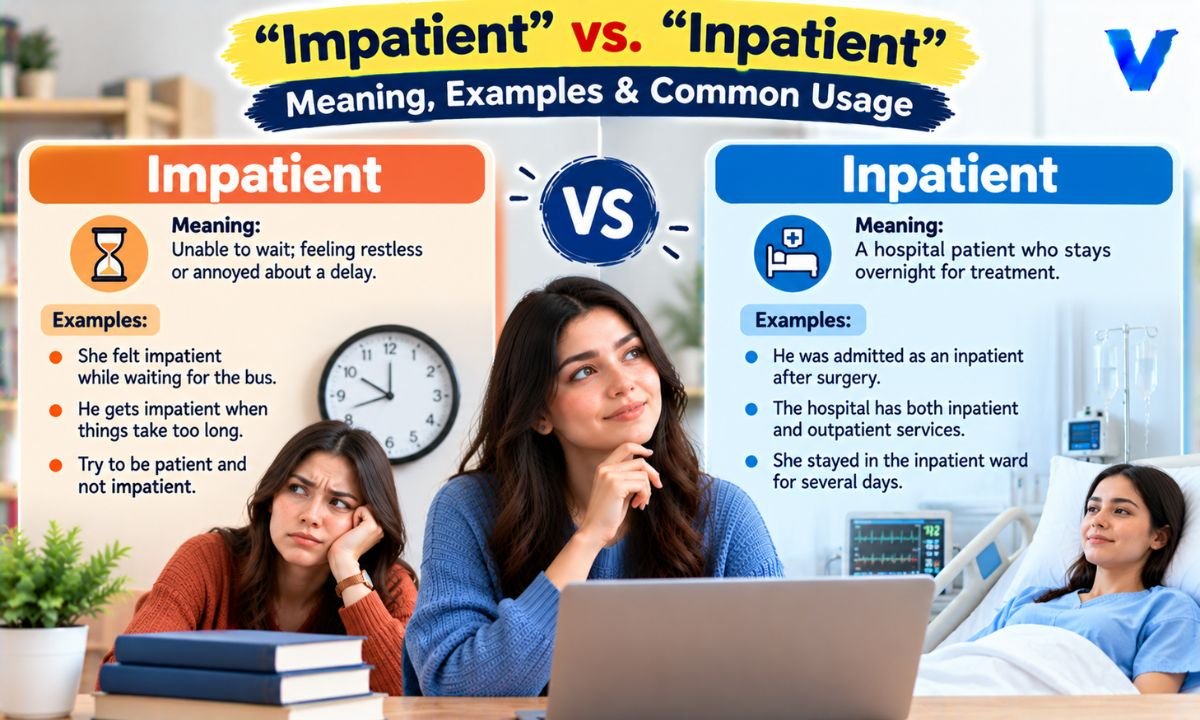
If you’ve ever typed “the doctor visited all the impatients” and had autocorrect just… let it happen, you’re not alone. Impatient and inpatient are two of the most commonly confused word pairs in English, and the mix-up isn’t just embarrassing — in medical writing, insurance forms, or hospital records, it can genuinely change the meaning of a sentence.
The good news? Once you understand where these words come from, you’ll never confuse them again. This guide breaks down the meaning, origin, and real-world usage of both words, shows you exactly when to use each one, and gives you memory tricks that actually stick.
Why “Impatient” vs. “Inpatient” Causes Confusion
These two words are nearly identical on paper. They share the same root word — “patient” — and differ by a single letter: m versus n. Say them out loud quickly and the difference practically disappears.
That single-letter gap is exactly why so many people type one when they mean the other. Add in autocorrect, fast typing, and the fact that both words can technically show up in a hospital setting, and the confusion makes a lot of sense.
Here’s the short version before we go deeper:
- Impatient = an emotion (restless, annoyed, unwilling to wait)
- Inpatient = a medical status (admitted to a hospital for care)
One lives in your feelings. The other lives in a hospital chart. Let’s unpack both.
Read More:Bad Rap vs Bad Rep: What’s the Difference?
What “Impatient” Really Means
Impatient is an adjective that describes someone who has trouble waiting calmly. It points to a person’s mood or behavior — frustration, restlessness, or eagerness for something to happen faster.
The word breaks down as im- (a prefix meaning “not”) + patient (calm, tolerant, able to wait). So literally, impatient means “not patient.”
You’ll see this word used to describe:
- A person’s temperament (“She’s an impatient driver.”)
- A temporary emotional reaction (“He grew impatient during the delay.”)
- A general trait (“Impatient people often multitask while waiting.”)
It’s an everyday word you’ll hear in offices, homes, traffic jams, and customer service calls — anywhere someone is waiting and doesn’t love it.
Read More:Is “Happiest Birthday” Correct? Meaning & Proper Usage
Impatient vs Inpatient Examples
Seeing both words side by side in real sentences makes the difference click faster than any definition:
- She became impatient while waiting in the long checkout line.
- My grandfather is an inpatient recovering from hip surgery.
- The teacher grew impatient with the constant interruptions.
- The hospital admitted 40 new inpatients this week.
- He tapped his foot, clearly impatient for the bus to arrive.
- Her insurance covers inpatient treatment but not certain outpatient visits.
Notice the pattern? Every “impatient” sentence involves a feeling. Every “inpatient” sentence involves a hospital.
Understanding the Meaning of “Inpatient”

Inpatient is primarily a medical term. It refers to a patient who is formally admitted to a hospital or healthcare facility and stays there — typically overnight or longer — to receive treatment, monitoring, or surgery.
The word breaks down as in- (meaning “inside”) + patient, so inpatient essentially means “inside the hospital as a patient.”
It can function in two ways:
- As a noun: “The inpatient was moved to the recovery ward.”
- As an adjective: “She’s receiving inpatient care for her condition.”
Inpatient status matters beyond just where someone sleeps. It affects:
- How insurance companies calculate coverage and billing
- What kind of monitoring and staffing a patient receives
- How hospitals track admissions and discharge planning
- Which treatments or procedures a facility can legally bill for
“Inpatient” vs. “Outpatient”
To fully understand “inpatient,” it helps to compare it with its natural counterpart: outpatient.
| Term | Meaning | Typical Duration |
| Inpatient | Admitted and stays in the hospital for treatment | Overnight or longer |
| Outpatient | Receives treatment and goes home the same day | A few hours, no overnight stay |
For example, someone undergoing major heart surgery would be an inpatient, since they need continuous monitoring. Someone getting a routine blood test or a minor outpatient procedure goes home the same day — no hospital bed required.
This inpatient–outpatient pairing is the real medical relationship. “Impatient” doesn’t factor into healthcare terminology at all, except as a description of how a patient might be feeling.
Inpatient Meaning in Hospital Settings
In a hospital context, “inpatient” specifically signals formal admission. A person isn’t an inpatient just because they visited the emergency room or sat in a waiting area — admission paperwork and an expected overnight stay are what make the status official.
Hospitals use this classification for record-keeping, staffing decisions, and billing codes, which is why getting the term right matters far beyond grammar — it affects real documentation.
Impatient in French
Interestingly, the word “impatient” crosses language lines almost unchanged. In French, impatient (or impatiente for feminine agreement) means exactly the same thing: eager, restless, or unable to wait.
For example, “Je suis impatient de te voir” translates to “I am eager to see you” or “I can’t wait to see you.” English borrowed heavily from French and Latin roots for words built on “patient,” which explains why the spelling and meaning transferred so smoothly. “Inpatient,” by contrast, is a modern English medical coinage and doesn’t have the same direct French equivalent.
Why “Impatient” and “Inpatient” Get Confused
Beyond sharing a root word, three specific factors make these words easy to mix up.
Visual Similarity
Swap one letter — “m” for “n” — and you’ve turned an emotional adjective into a medical term. Because both letters sit in the middle of the word and are easy to skim past, readers (and writers) often don’t notice the swap until it’s pointed out.
Pronunciation Overlap
When spoken at normal conversational speed, “im-” and “in-” blend together almost identically before the same following sound. Most people pronounce both prefixes the same way in casual speech, which reinforces the written mix-up.
Autocorrect Mistakes
Many keyboards and autocorrect tools treat these as legitimate alternate spellings of each other rather than flagging the swap, especially on mobile devices. If you’re typing quickly, it’s easy to let a wrong autocorrect suggestion slide through unnoticed.
Impatient in English: Grammar and Usage

“Impatient” is used almost exclusively as an adjective in English. It describes a noun (a person, tone, behavior, or mood) and cannot function as a standalone noun itself.
Correct: “He was impatient.” ✅ Incorrect: “He is an impatient in the waiting room.” ❌ (This should be “patient,” or in a hospital context, “inpatient.”)
It commonly appears with prepositions like “with” and “for”:
- Impatient with someone or something (a person, a process, a delay)
- Impatient for something (a result, an answer, an outcome)
Side-by-Side Usage in Sentences
Here’s a quick reference to help you use both words with confidence in everyday writing:
Impatient (emotion/behavior):
- The customers grew impatient after the long wait.
- Try not to sound impatient in your email replies.
- She’s impatient for her exam results.
Inpatient (medical status):
- He was treated as an inpatient after the accident.
- The clinic doesn’t offer inpatient services.
- Her recovery plan includes two weeks of inpatient care.
A simple trick: if you can replace the word with “frustrated” or “restless” and the sentence still makes sense, you want impatient. If the sentence is about a hospital stay, you want inpatient.
Comparison Table: “Impatient” vs. “Inpatient”
| Feature | Impatient | Inpatient |
| Part of speech | Adjective | Noun or adjective |
| Category | Emotional/behavioral | Medical/clinical |
| Prefix meaning | “im-” = not | “in-” = inside |
| Describes | A person’s mood or temperament | A hospital admission status |
| Common pairing | Patient (opposite) | Outpatient (counterpart) |
| Example | “He’s impatient with delays.” | “She’s an inpatient at the clinic.” |
| Used in healthcare? | Only to describe emotion | Yes, as a formal classification |
Impatient: Other Words (Synonyms)
If you want to vary your vocabulary or avoid repeating “impatient” too often, here are some useful alternatives depending on tone:
- Restless
- Eager
- Edgy
- Irritable
- Anxious (to proceed)
- Fidgety
- Testy
- Antsy (informal)
Each carries a slightly different shade of meaning — “eager” leans positive, while “testy” or “irritable” leans more negative.
A Quick Diagnostic Checklist: Which One Should You Use?
Run through these quick questions before you commit to a spelling:
- Is the sentence about a feeling or reaction? → Use “impatient.”
- Is the sentence about a hospital, clinic, or medical admission? → Use “inpatient.”
- Can you swap in “frustrated” or “restless” and keep the meaning? → Use “impatient.”
- Can you swap in “hospitalized” or “admitted” and keep the meaning? → Use “inpatient.”
- Are you writing about insurance, billing, or treatment plans? → It’s almost certainly “inpatient.”
If you’re still unsure, read the sentence aloud and ask: is this about emotion or admission? That single question resolves the confusion almost every time.
Impatient vs. Inpatient Treatment
This phrase trips a lot of people up specifically because “treatment” sounds medical — but the correct term here is always inpatient treatment, never “impatient treatment.” There’s no such thing as “impatient treatment” in any legitimate medical or clinical context.
Inpatient treatment refers to structured medical or therapeutic care that requires a person to stay at a facility, such as:
- Post-surgical recovery
- Intensive mental health or addiction treatment programs
- Extended monitoring after a serious diagnosis
If you ever catch yourself typing “impatient treatment,” it’s worth pausing — that’s almost always a typo for “inpatient treatment.”
Impatient in a Sentence
To wrap up the usage side, here are a few more natural examples showing “impatient” doing its job as an everyday adjective:
- The impatient shopper sighed loudly at the register.
- Don’t be impatient — good things take time.
- The impatient tone in his message made the request feel urgent.
- Children are often impatient while waiting for a birthday.
FAQs
Q:What is a positive synonym for “impatient”?
“Eager” is the most common positive synonym — it reframes restlessness as enthusiasm, such as being “eager for good news” rather than simply unable to wait.
Q:What does “inpatient” mean in medical terms?
It refers to a patient formally admitted to a hospital or facility who stays overnight or longer to receive treatment, monitoring, or surgery.
Q:What is the difference between impatience and impatient?
“Impatience” is the noun form (the state or feeling itself), while “impatient” is the adjective that describes a person showing that feeling.
Q:What is the opposite of inpatient?
“Outpatient” is the direct opposite — someone who receives treatment and leaves the facility the same day without an overnight stay.
Q:What is an idiom for being impatient?
“Champing at the bit” is a common idiom meaning someone is restless and eager to act without delay.
Conclusion
The difference between “impatient” and “inpatient” comes down to one letter and two completely different worlds: one is about emotion, the other about medical admission. Remember the shortcut — im- means “not,” so impatient means “not patient” (restless), while in- means “inside,” so inpatient means “inside the hospital.” Keep that prefix trick in mind, and you’ll pick the right word every time, whether you’re writing a text message or a medical report.










2 thoughts on ““Impatient” vs. “Inpatient”: Meaning, Examples & Common Usage”