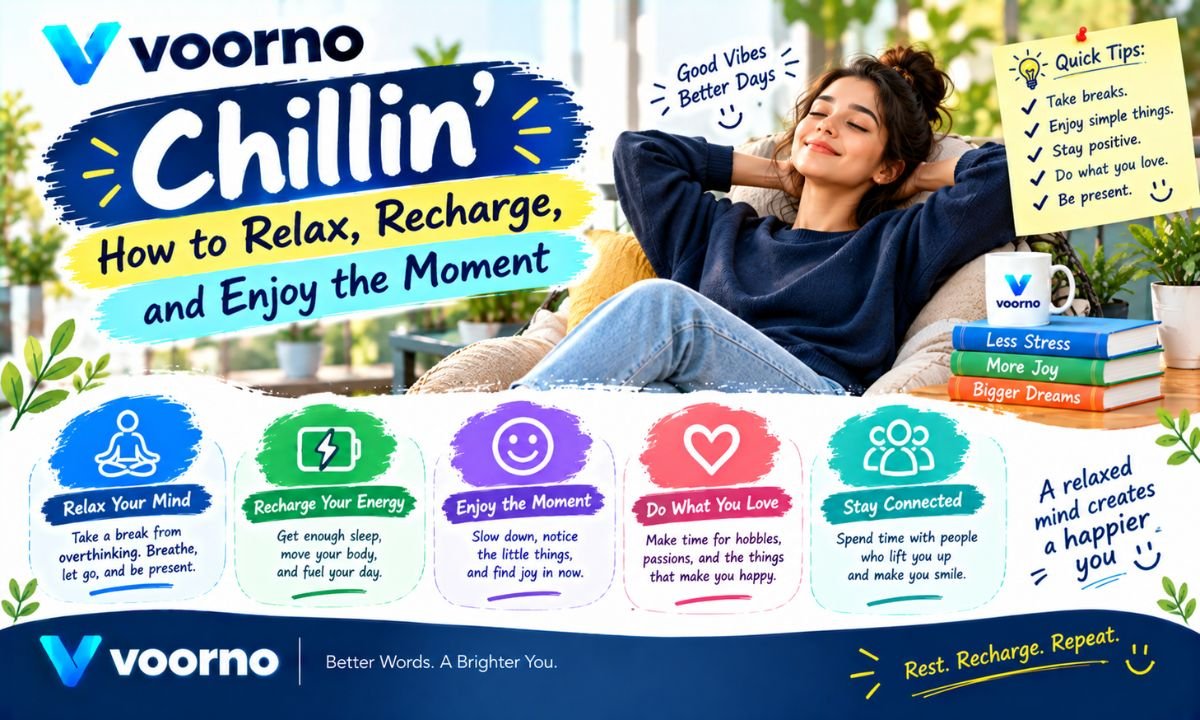
Life moves fast, and somewhere along the way, “chillin'” became the shorthand for hitting pause. It’s the word you text a friend when plans are loose, the caption under a beach photo, and the answer to “what are you up to?” when the honest reply is nothing much, and that’s the point.
This guide breaks down what chillin’ really means, where it came from, how people use it today, and why it still feels so natural almost a century after it first showed up in slang. Whether you’re curious about the word itself or just want to relax and enjoy the moment a little better, you’ll find both here.
What “Chillin'” Means — A Clear, Everyday Definition
At its core, chillin’ is the informal, dropped-g form of “chilling,” which comes from the verb to chill. It describes a relaxed, low-effort state of being — hanging out, taking it easy, or simply doing nothing with no pressure attached.
In plain terms:
- Chillin’ = relaxing, unwinding, or spending unhurried time doing something enjoyable
- It can describe an activity (“just chillin’ at home”) or a mood (“I’m chill about it”)
- It almost always carries a laid-back, positive, low-stress tone
Unlike “resting,” which implies recovery from tiredness, chillin’ is about intentional ease — choosing to slow down rather than needing to.
Read More:Need vs Needs: Rules, Examples & Tips for Better English
What “Chillin'” Really Implies (Context Matters)
The word rarely stands alone in meaning. Its exact sense shifts with context:
| Context | What It Implies |
| “Just chillin’ at home” | Doing nothing productive, fully at ease |
| “We were chillin’ with friends” | Casual social hangout, no formal plans |
| “He’s a chill guy” | Easygoing, unbothered, calm personality |
| “Let’s chill for a bit” | A short break or pause from activity |
| “It’s chill” | A situation is fine, low-stakes, no drama |
So while the root idea — ease and relaxation — stays constant, chillin’ flexes to describe people, places, moods, and moments.
Origins of “Chillin'” — From Cool to Culture

The word traces back to the literal meaning of chill: to make or become cold. Over time, English speakers stretched that cold-temperature idea into an emotional one — a “cool,” unbothered temperament.
By the mid-20th century, “chill” and “chillin'” had entered African American Vernacular English (AAVE) as slang for relaxing or hanging out, closely tied to jazz-era and later hip-hop culture’s idea of being “cool.” From there, it spread through music, television, and everyday youth culture in the 1980s and ’90s, eventually becoming a mainstream, universally understood term across English-speaking countries.
Today it’s fully embedded in casual English — used in texting, social media captions, music lyrics, and everyday conversation without a second thought.
Read More:Baptised vs. Baptized: British vs. American English Explained
Chillin’ Quotes
A few lines that capture the spirit of chillin’:
- “Sometimes the most productive thing you can do is relax.”
- “Chillin’ isn’t laziness — it’s recovery.”
- “Good vibes and slow days.”
- “Do less. Feel more.”
These aren’t attributed to any single source — they’re the kind of everyday sayings people share alongside a chillin’ photo or status update.
How “Chillin'” Is Used in Everyday Conversation
You’ll hear or type chillin’ in a handful of common patterns:
- As a reply to “what’s up?” — “Nothing much, just chillin’.”
- As an invitation — “Come over, we’re just chillin’.”
- As a description of a place or vibe — “This café has a chill atmosphere.”
- As advice — “Relax, just chill.”
- As a personality trait — “She’s super chill about everything.”
It works in texts, captions, and spoken conversation, but it’s almost never used in formal writing, resumes, or professional emails.
Different Shades of Chillin’
Not all chillin’ looks the same. Here are the common variations:
- Solo chillin’ — reading, napping, watching a show alone
- Social chillin’ — low-key hangouts with friends, no agenda
- Outdoor chillin’ — a park bench, a porch, a beach towel
- Digital chillin’ — scrolling, gaming, or streaming with zero urgency
- Chillin’ out — deliberately calming down after stress or conflict
Each version shares the same DNA: minimal effort, maximum ease.
Tone and Social Meaning — Why It Works
Part of why “chillin'” stays popular is its tone. It’s friendly, non-judgmental, and instantly relatable. Saying “I’m chillin'” sounds far more approachable than “I’m relaxing” or “I’m at leisure,” which can feel stiff by comparison.
Socially, calling someone “chill” is also a compliment — it signals they’re easygoing, low-drama, and comfortable to be around. That social weight is a big reason the word has stuck around for decades.
Chillin or Chillin’ — Which Spelling Is Correct?
Both spellings are common, but they serve slightly different purposes:
| Spelling | When to Use |
| Chillin’ | The traditional informal spelling; the apostrophe marks the dropped “g” |
| Chillin | Common in texting and social media where punctuation is often skipped |
Neither is “more correct” in casual writing — style guides don’t formally recognize either as standard English, so consistency within your own writing matters more than which one you pick.
Synonyms and Related Terms (And How They Compare)
| Word/Phrase | Closest Meaning | Formality |
| Relaxing | Resting, easing tension | Neutral/formal |
| Hanging out | Spending casual time with others | Informal |
| Unwinding | Releasing stress after activity | Neutral |
| Taking it easy | Slowing the pace deliberately | Informal |
| Vegging out | Doing very little, often watching TV | Very informal |
| Kicking back | Relaxing, often literally reclining | Informal |
| Lounging | Reclining comfortably, at ease | Neutral |
Chillin’ sits in the same family as these terms but feels the most conversational and culturally current of the group.
Situations Where “Chillin'” Sounds Natural
- Texting a friend about weekend plans
- Social media captions (photos of naps, beaches, hangouts)
- Casual conversation with peers
- Song lyrics, memes, and pop culture references
- Describing a laid-back venue (“chill vibe,” “chill spot”)
When You Shouldn’t Use “Chillin'”
- Professional emails or business communication
- Academic writing or formal reports
- Resumes or cover letters
- Legal, medical, or official documentation
- Formal presentations or interviews
In these settings, swap it for “relaxing,” “taking time off,” or “unwinding” instead.
Common Misunderstandings About “Chillin'”
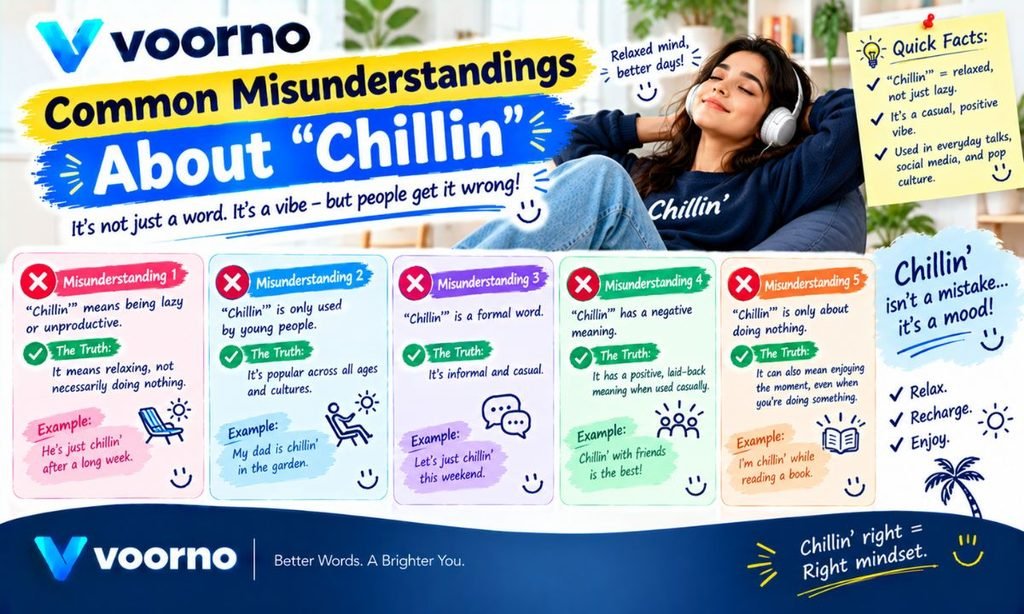
- Myth: Chillin’ always means being lazy. In reality, it usually means intentional rest, not avoidance of responsibility.
- Myth: It’s only for young people. While popularized by youth culture, it’s now used across generations.
- Myth: “Chill” and “chillin'” mean the exact same thing. “Chill” can be an adjective (a chill person) or a command (just chill), while “chillin’” is specifically the ongoing action.
Cultural Influence and Pop Culture Usage
Chillin’ has long been part of music and entertainment — from hip-hop and R&B lyrics to sitcom dialogue and viral internet captions. It’s featured in countless song titles and hooks, embedded in meme culture, and used constantly across social platforms to caption low-key, feel-good moments. That steady presence in music and media is a major reason the word has stayed fresh instead of fading into dated slang.
Examples in Full Sentences — Real-Life Style
- “We spent Sunday just chillin’ on the couch, no plans at all.”
- “The dog was chillin’ in a sunny spot by the window.”
- “After finals, I just want to chill for a week straight.”
- “It’s a chill bar — good music, no pressure to dress up.”
- “They were chillin’ by the pool the entire trip.”
Why People Prefer Saying “Chillin'” Instead of “Relaxing”
“Relaxing” sounds clinical, almost like advice from a wellness app. “Chillin'” sounds like something you’re actually living in the moment, shared with friends or enjoyed solo, without effort or self-consciousness. It’s warmer, more casual, and carries a social, shareable quality that “relaxing” doesn’t quite capture.
How to Say It Naturally (Pronunciation Tips)
The key to sounding natural is dropping the hard “g” sound and softening the ending, the way it’s spoken in casual speech rather than read off a page.
Pronunciation Breakdown
- Say it as “chill-in”, not “chill-ing”
- Keep the stress on the first syllable: CHILL-in
- Let the final “n” trail off softly rather than sounding clipped
- In fast, casual speech, it often blends into the next word — “chillin’ out,” “chillin’ here”
Mini Case Study — “Chillin’ in Different Settings”
Consider three people using the same word in very different moments:
- A college student texts, “Just chillin’ before my exam tomorrow,” meaning a short, deliberate break to reset.
- A remote worker posts a photo captioned “Chillin’ with my coffee,” signaling a slow, unhurried morning routine.
- A group of friends plans a weekend as “just chillin’, nothing fancy,” meaning low-key time together with no strict itinerary.
Same word, three different scenes — but the underlying feeling of ease stays constant across all of them.
Quick List — How “Chillin'” Enhances Conversation
- Makes casual conversation feel warmer and more relatable
- Signals low-stakes, judgment-free social interaction
- Works as a quick, honest answer to “what are you doing?”
- Adds a friendly, culturally current tone to texts and captions
- Instantly communicates mood without over-explaining
Common Mistakes and How to Fix Them
| Mistake | Fix |
| Using it in formal writing | Replace with “relaxing” or “resting” |
| Overusing it in every sentence | Mix in synonyms like “unwinding” or “taking it easy” |
| Assuming it always means laziness | Use context to clarify it’s intentional downtime |
| Inconsistent spelling (chillin/chillin’) | Pick one style and stay consistent in the same piece of writing |
Why “Chillin'” Matters in Today’s Language
In a culture that often glorifies busyness, “chillin'” pushes back — gently reminding people that rest is valid, valuable, and worth naming out loud. It’s a small word that carries a bigger idea: that enjoying the moment, without an agenda, is worth talking about as much as productivity is.
FAQs
What does chillin mean?
Chillin’ means relaxing, hanging out, or spending time in a calm, low-pressure way, without stress or urgency.
What does the phrase “just chillin'” mean?
It means doing nothing in particular — resting, relaxing, or passing time casually with no specific plans.
When a guy says “let’s chill”?
It usually means an invitation to hang out casually, often with friends, though context can sometimes suggest a more relaxed, low-pressure date.
How can I use chill?
Use “chill” as a verb (“let’s chill”), an adjective (“he’s so chill”), or a command (“just chill”) depending on the sentence’s meaning.
What does “chill girl” mean?
It describes someone easygoing, low-drama, and relaxed about most situations — someone comfortable to be around without excessive expectations.
Conclusion
“Chillin'” has grown from a piece of cool-culture slang into a word that captures something universal: the simple, worthwhile act of slowing down. Whether you’re using it to describe a lazy Sunday, a relaxed friend, or a low-key hangout, it carries warmth, ease, and a reminder that not every moment needs a purpose. So the next time someone asks what you’re up to, there’s no better answer than the honest one — just chillin’.










2 thoughts on “Chillin’: How to Relax, Recharge, and Enjoy the Moment”