
There’s a particular kind of ache that comes with distance. Maybe it’s a friend who moved cities, a coworker who left the team, or someone you’ve lost for good. In moments like these, three simple words often surface: “You are missed.”
But is that phrase actually correct English? Does it carry the same emotional punch as “I miss you”? And when should you use it — or avoid it? This guide breaks down the grammar, the emotional meaning, and gives you dozens of heartfelt quotes and alternatives you can actually use.
Is “You Are Missed” Grammatically Correct?
Yes. “You are missed” is completely grammatically correct. It’s a passive voice construction built from the verb “to miss” — specifically the present tense passive form: subject + to be + past participle.
In this sentence:
- “You” is the subject receiving the action
- “Are” is the auxiliary verb (present tense of “to be”)
- “Missed” is the past participle of “miss”
Grammatically, this mirrors other passive sentences like “The cake was eaten” or “The letter is being written.” The structure is standard, and it’s used in newspapers, tribute cards, farewell speeches, and everyday conversation. So if you’ve ever hesitated before typing this phrase, you can stop worrying — it holds up under grammatical scrutiny.
Read More:Fair vs Good: What’s the Difference? A Simple Guide
Why Passive Voice Feels Different
Even though it’s correct, passive voice changes how a sentence feels. In an active sentence like “I miss you,” the speaker is clearly present, taking ownership of the emotion. In “You are missed,” the person doing the missing disappears from the sentence entirely.
This isn’t a flaw — it’s a feature. Passive voice shifts the spotlight onto the person being addressed rather than the speaker. It can make a message feel broader, gentler, or more universal, which is exactly why it shows up so often in group cards, memorials, and workplace farewells.
Emotional Comparison
| Phrase | Voice | Emotional Tone | Best Used For |
| “I miss you” | Active | Personal, direct, intimate | Close friends, partners, family |
| “You are missed” | Passive | Gentle, collective, reflective | Group messages, tributes, farewells |
| “You are so missed” | Passive (intensified) | Warm, emphatic | Emotional cards, condolences |
| “You’re missed around here” | Passive (casual) | Friendly, informal | Coworkers, group chats |
You Are Missed Synonym
If you want to vary your wording, here are natural synonyms and near-equivalents:
- We miss you
- Your presence is felt
- You’re in our thoughts
- Your absence is felt
- We think of you often
- You’re never far from our minds
- Your presence is longed for
Read More:“Absolutely True”: Incredible Facts That Sound Too Good to Be True
What Does “You Are Missed” Actually Mean?
At its core, “you are missed” means that someone’s absence has been noticed and felt emotionally by others. It’s not just an observation (“you’re not here”) — it’s an expression of emotional connection. It tells the person: your presence mattered, and its absence has left a gap.
This phrase can apply to:
- Someone who has passed away
- A friend who moved far away
- A former employee or teammate
- A partner who is temporarily traveling
- A pet that is no longer around
When “You Are Missed” Feels Awkward
There are moments when this phrase can land oddly:
- In very personal, romantic texts — “I miss you” feels warmer and more direct than “You are missed.”
- When used repeatedly — overusing the same passive phrase in a short message can sound stiff or robotic.
- In casual daily chats — it can feel overly formal for a quick “hey, thinking of you” text.
- When context is missing — without explanation, it can sound vague or even sarcastic.
Alternatives to “You Are Missed”
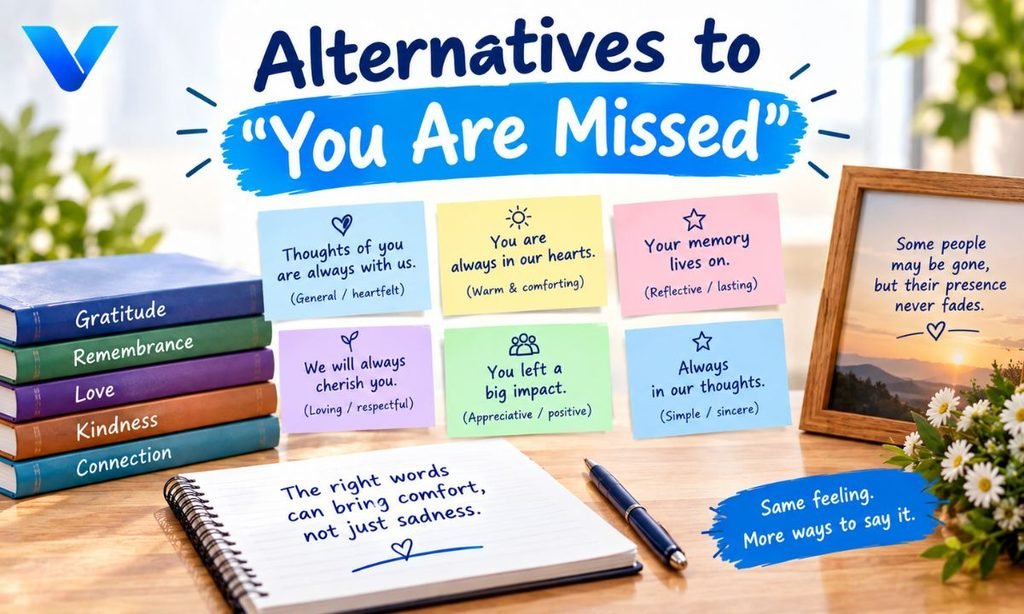
If the phrase doesn’t quite fit your tone, try one of these instead:
- “It’s not the same without you.”
- “We felt your absence today.”
- “Wishing you were here.”
- “Things aren’t quite right without you around.”
- “Your energy is missed at the office.”
- “We keep thinking about you.”
- “The house feels quieter without you.”
You Are Missed Quotes
Here are heartfelt quotes you can use in cards, messages, or social posts:
- “Some people leave footprints on our hearts, and we are never quite the same. You are missed more than words can say.”
- “Absence doesn’t make you a memory — it makes your presence even more valuable.”
- “Every day without you feels a little emptier, and every memory of you feels a little fuller.”
- “You are missed not because you’re gone, but because you mattered.”
- “The best people leave the deepest quiet behind them. You are missed.”
- “Distance hasn’t changed a thing — you’re still thought of daily, still missed nightly.”
- “There isn’t a day that passes where your absence isn’t felt in some small way.”
When “You Are Missed” Works Beautifully
This phrase truly shines in specific situations:
- Farewell cards signed by an entire team or class
- Memorial services and sympathy messages
- Corporate emails announcing someone’s departure
- Anniversary tributes for someone who has passed
- Group greeting cards where many people share one sentiment
In these contexts, the passive structure works in the phrase’s favor — it reflects a shared, collective feeling rather than one individual’s personal longing.
Understanding the Grammar Behind “You Are Missed”
The Structure of the Sentence
Breaking the sentence down further:
| Element | Word | Function |
| Subject | You | Receiver of the action |
| Auxiliary verb | Are | Present tense “to be” |
| Main verb | Missed | Past participle of “miss” |
| Implied agent | (by someone) | Often omitted |
Notice that the phrase leaves out “by me” or “by us.” This is common in passive constructions when the person doing the action is either obvious from context or intentionally left unspecified to soften the tone.
Passive vs Active: Emotional Impact Table
| Feature | Active Voice (“I miss you”) | Passive Voice (“You are missed”) |
| Focus | Speaker’s feelings | Recipient’s importance |
| Intimacy level | High | Moderate |
| Formality | Casual | Neutral to formal |
| Common setting | One-on-one messages | Group messages, cards |
| Emotional directness | Very direct | Softer, more reflective |
Cultural Differences in Expressing Absence

Not every culture or language expresses missing someone the same way. In English, “I miss you” is the default emotional phrase. In many other languages, the structure is closer to “you are lacking to me” or “I feel your lack” — grammatically closer to the passive style of “you are missed.”
This is worth noting because English speakers sometimes borrow that passive, almost formal tone — especially in written English like cards or emails — even when the emotion behind it is deeply personal. Understanding this helps explain why “you are missed” doesn’t always feel wrong, even though “I miss you” is more common in daily speech.
Why “I Miss You” Feels Stronger
Active voice puts the speaker front and center. When you say “I miss you,” you’re claiming the emotion. There’s no ambiguity about who feels what. This directness is why “I miss you” remains the more popular phrase for close relationships — it doesn’t just describe a feeling, it declares one.
“You are missed,” by contrast, describes a state rather than an action. It’s less about “I feel this” and more about “this is true.” That subtle shift is why the two phrases, though related, aren’t fully interchangeable.
Common Misunderstandings About “You Are Missed”
- Myth: It’s past tense. It’s not — “are missed” is present tense. “Were missed” would be past tense.
- Myth: It’s grammatically wrong. It’s a valid, standard passive construction.
- Myth: It only applies to death or loss. It can be used for any kind of absence, including short trips or job changes.
- Myth: It’s impersonal. With the right context or added details, it can feel just as warm as active phrasing.
Psychological Impact of “You Are Missed”
Hearing or reading “you are missed” can have a real emotional effect. It validates a person’s sense of belonging and reminds them that their presence has weight in others’ lives. Psychologically, this kind of affirmation can:
- Reduce feelings of loneliness or isolation
- Strengthen a sense of social connection
- Provide comfort during transitions (new job, new city, grief)
- Reinforce self-worth by showing that someone’s absence was noticed
This is part of why the phrase appears so frequently in sympathy cards and workplace farewells — it offers gentle reassurance without demanding an emotional response in return.
You Are Missed Meaning in Text
When texted casually, “you are missed” usually means the sender is thinking about the recipient and wants them to know their absence has been noticed. In texting culture, it’s often shortened or softened, such as “missed ya” or “you’re missed lol,” to keep the tone light rather than heavy.
Quick Decision Framework: Should You Say “You Are Missed”?
Use this simple checklist before sending your message:
- Is this a group message? → “You are missed” works well.
- Is this a romantic or very close relationship? → Consider “I miss you” instead.
- Is this a formal card or tribute? → “You are missed” fits perfectly.
- Is this a quick, casual text? → Try a lighter alternative like “miss ya!”
- Do you want to add warmth? → Pair it with a specific memory or detail.
Real-Life Usage Examples
- Farewell card: “Your hard work and kindness shaped this team. You are missed every single day.”
- Text to a friend: “Saw your old coffee mug today and thought of you — you are missed!”
- Sympathy message: “Grandpa, you are missed more than words could ever express.”
- Workplace email: “As we settle into the new quarter, your leadership and insight are missed.”
Linguistic Insight: Why We Drop “By Me”
In full passive form, the sentence would technically be “You are missed by me.” But English speakers almost always drop the “by me” or “by us” portion. This happens because:
- The agent (who is missing the person) is usually obvious from context.
- Omitting it makes the sentence feel less self-focused and more about the recipient.
- It shortens the sentence, making it more natural for cards, texts, and speech.
This is a common feature of passive voice in English — the “by” phrase is optional and frequently dropped when it doesn’t add necessary information.
The Role of “To Be” in Passive Construction
Every passive sentence relies on a form of “to be” plus a past participle. In “you are missed,” “are” is doing the grammatical heavy lifting. Change the tense, and the meaning shifts slightly:
- Present: You are missed (ongoing, current)
- Past: You were missed (no longer ongoing, or referring to a specific past event)
- Future: You will be missed (anticipating future absence)
- Present perfect: You have been missed (emphasizes duration)
Choosing the right tense changes how the emotional weight lands, so it’s worth pausing before deciding which form fits your message.
Tone Analysis in Written vs Spoken English
In writing — especially formal writing like cards, eulogies, or emails — “you are missed” tends to sound polished and appropriate. In spoken conversation, however, it can come across as stiff or overly formal unless softened with tone, humor, or added context.
| Context | Recommended Phrase |
| Formal card or eulogy | “You are missed” |
| Text to a close friend | “Miss you!” or “I miss you” |
| Workplace farewell email | “You are missed” or “Your contributions are missed” |
| Casual phone call | “I’ve missed you a ton” |
Mini Case Study: Corporate Farewell Email
Consider two versions of a farewell email for a departing employee:
Version A (too passive, no context): “You are missed. Good luck in your next role.”
Version B (passive voice done well): “Your positive energy and problem-solving during last quarter’s launch are missed already. We wish you the best in your next chapter, and you are missed more than this email can say.”
Version B succeeds because it pairs the passive structure with a specific, personal detail. This is the key takeaway: passive voice isn’t the problem — vagueness is. Add context, and “you are missed” becomes genuinely touching rather than generic.
FAQs
Q:How to flirty say I miss you?
Try something playful like “My phone’s been way too quiet without your texts” or “I miss you more than my favorite snack.” Adding humor or a personal reference makes it feel flirty rather than formal.
Q:Is it correct to say you are missed?
Yes, it’s grammatically correct. It’s a standard passive voice sentence meaning someone’s absence is currently being felt.
Q:What is correct, I miss or missed?
Both are correct but express different tenses. “I miss you” is present tense (an ongoing feeling), while “I missed you” is past tense (referring to a completed period of absence).
Q:How do you say “I miss you” in a poetic way in English?
Try phrases like “You linger in every quiet moment” or “Your absence writes itself into my day.” Poetic language often uses imagery rather than stating the feeling directly.
Q:What are 4 different ways to say “I miss you”?
“I miss you,” “You are missed,” “Wish you were here,” and “It’s not the same without you” all express the same core sentiment with different tones.
Conclusion
“You are missed” is far more than a passive grammar curiosity — it’s a genuinely useful phrase for expressing that someone’s absence has left a mark. While “I miss you” carries more personal intimacy, “you are missed” offers a gentler, more universal way to express longing, especially in group settings, farewells, and tributes.
The key isn’t choosing one phrase over the other forever — it’s knowing when each one fits. Pair passive phrasing with specific, heartfelt details, and it stops sounding formal and starts sounding exactly like what it is: a simple, honest way of saying someone’s presence truly mattered.










2 thoughts on “Heartfelt Quotes: “You Are Missed” — About Missing Someone”