If you’ve ever received an email with an invoice attached and the line “please keep this for your records,” you already have a working sense of the phrase. But where did it come from, is it grammatically correct, and when should you actually use it?
This guide breaks down the meaning, grammar, pronunciation, and real-world usage of “for your records” — plus the best alternatives for different situations.
What “For Your Records” Really Means
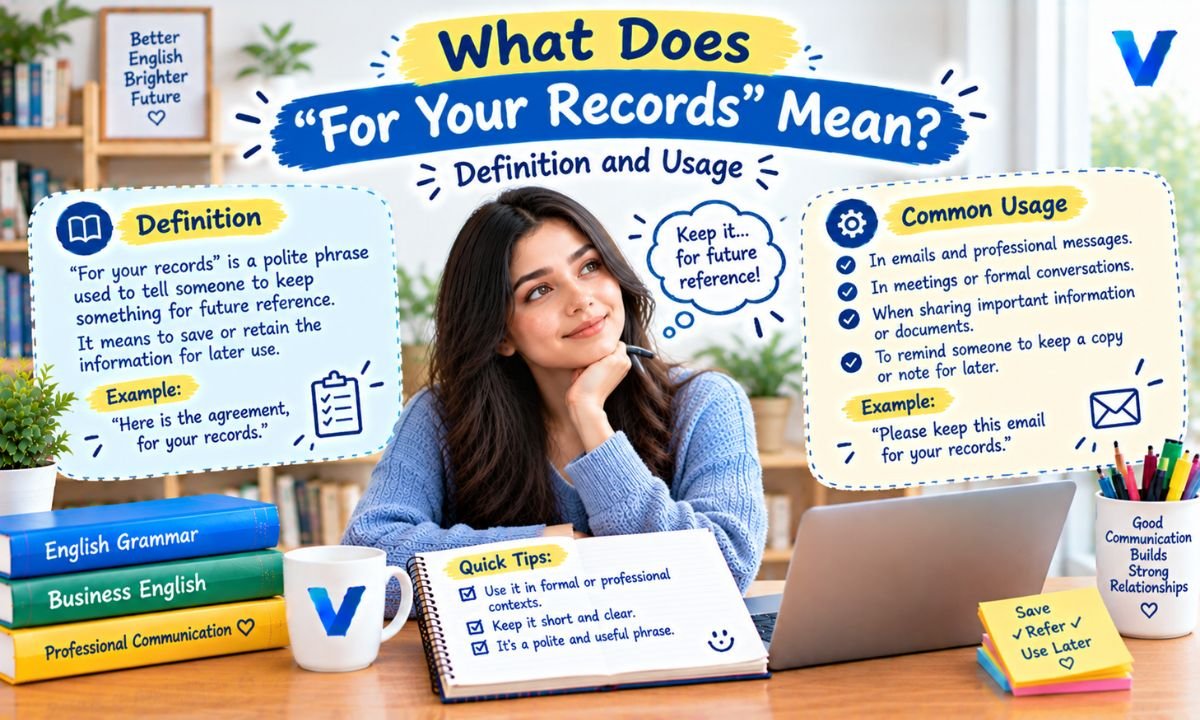
“For your records” means the information being shared should be kept for future reference, not acted on immediately. It’s a signal, not an instruction. The phrase tells the reader: you may need this later, so file it away.
You’ll typically see it attached to:
- Invoices and receipts
- Payment confirmations
- Contracts and agreements
- Meeting summaries
- Tax documents and statements
The tone is neutral and mildly formal. It doesn’t demand a reply, and it doesn’t imply urgency — it simply flags that the document has archival value.
Example: “Please find the attached invoice for your records.”
Here, the sender isn’t asking for anything back. They’re letting the recipient know the invoice is worth saving, perhaps for accounting or warranty purposes.
Read More: Having vs Having Had: Meaning, Grammar Rules & Examples
Record vs Records: Understanding the Grammar
Grammatically, “for your records” is a prepositional phrase. “For” expresses purpose, while “records” functions as the object of the preposition, referring to documents, files, or information kept for reference.
So why plural, not singular?
- “Records” (plural) implies an ongoing collection of documents — the kind of file folder or digital archive most people maintain. This is the standard, default form in almost all professional writing.
- “Record” (singular) is used only when referring to one specific, unique item, such as a single certificate or one transaction.
| Form | When to Use | Example |
| For your records | Default, most contexts | “Attached are your tax forms for your records.” |
| For your record | One specific document | “This diploma is for your record.” |
In everyday and business English, plural wins nearly every time, because people rarely store just one document — they store an accumulating set of them.
Read More:Deepest Sympathy: Meaning, Examples & How to Use It
For Your Records Synonym
Looking for a different way to phrase the same idea? Here are natural alternatives:
- For your reference — slightly more general, works well outside formal documentation
- For future reference — implies the info might matter later, not necessarily as a formal record
- For your files — casual-professional, common in office settings
- To keep on file — action-oriented phrasing
- For documentation purposes — highly formal, used in legal or compliance writing
- FYI (for your information) — informal, best for quick internal messages
Real-World Examples That Show the Difference
Seeing the phrase in context makes the nuance click faster than any rule can.
- “Here is your payment confirmation for your records.” — routine transaction, no action needed.
- “I’m attaching the signed contract for your records.” — legal documentation, long-term storage expected.
- “Please keep this receipt for your records in case of a refund.” — practical, consumer-facing.
- “The meeting notes are shared below for your records.” — internal business communication.
- “This certificate is enclosed for your record.” — singular, one-off official document.
Notice the pattern: the phrase almost always follows the document itself, reinforcing that the information — not an action — is the point.
Record Pronunciation
“Record” is a heteronym: same spelling, different pronunciation depending on whether it’s a noun or a verb.
- Noun — REC-ord (stress on the first syllable), as in “She set a world record.”
- Verb — re-CORD (stress on the second syllable), as in “Please record the meeting.”
In “for your records,” the word functions as a noun, so the stress falls on the first syllable: REC-ords. Getting this right matters in spoken business English, especially in presentations or phone calls, where mispronunciation can briefly confuse listeners.
Why “For Your Records” Dominates Formal Communication

The phrase has stuck around in professional English for a simple reason: it’s efficient. In one short phrase, it tells the reader:
- What the document is for
- That no immediate action is required
- That it has future value worth preserving
This efficiency is exactly why it shows up so often in finance, law, HR, and administration — fields where paper trails and documentation matter. It reads as polite, professional, and low-pressure, which is a hard combination to beat in business writing.
Grammar Nuances You Should Know
A few details separate confident use of this phrase from shaky use:
- Don’t confuse it with “for the record.” “For the record” is used to state something clearly, often for clarification or emphasis (“For the record, I disagreed with that decision”). It has nothing to do with documentation.
- Placement matters. Keep the phrase close to the noun it modifies. “Attached is the invoice for your records” is clearer than burying it mid-sentence.
- Capitalization — only capitalize it when it appears in a title or heading, not in regular sentence use.
- It’s informational, not instructional. It never functions as a command; it simply labels the purpose of the shared material.
For Your Records in a Sentence
Quick reference examples for different contexts:
- Business: “Attached is your invoice for your records.”
- Legal: “A copy of the signed agreement is enclosed for your records.”
- Medical: “Your test results are included for your records.”
- Academic: “Your transcript is attached for your records.”
- Everyday: “Here’s the receipt for your records, just in case.”
American vs British English: Is There a Difference?
Yes, a subtle one.
- American English uses “for your records” frequently and consistently across business, legal, and everyday writing. It’s the default phrase.
- British English uses it less often, tending to favor alternatives like “for your information” or “for your reference” in comparable situations. When British writers do use “record,” singular form appears slightly more often in formal correspondence, though plural is still generally preferred.
Neither version is wrong — it’s a matter of regional convention rather than grammatical correctness.
Best Situations to Use “For Your Records”
Use the phrase when:
- You’re sharing a document with long-term reference value (invoices, contracts, statements)
- The recipient doesn’t need to respond or act right away
- You want to signal that the information should be filed, not ignored
- The context is professional, administrative, legal, or financial
When NOT to Use “For Your Records”
Skip the phrase when:
- The message is casual or conversational (texts, quick chats)
- You actually need the recipient to take action — use clearer instructional language instead
- The information has no real reference value (small talk, one-off comments)
- You’re speaking, not writing, in an informal setting — it can sound stiff out loud
Alternatives to “For Your Records” (And When to Use Them)

Common Alternatives
- For your reference — broader, less document-specific
- For your files — casual professional tone
- For future reference — emphasizes potential future usefulness
- To keep on file — direct and action-focused
- For documentation purposes — formal, compliance-heavy contexts
- Just so you have it — friendly, informal
- FYI — quick, internal, low-stakes messages
Comparison Table: Choosing the Right Phrase
| Phrase | Formality | Best Used For |
| For your records | Formal-neutral | Invoices, contracts, official documents |
| For your reference | Neutral | General information sharing |
| For your files | Semi-formal | Office/internal documentation |
| For future reference | Neutral | Guidance or notes that may matter later |
| For documentation purposes | Highly formal | Legal, compliance, audits |
| FYI | Informal | Quick internal updates |
Cross-Industry Usage Explained
Legal
In legal writing, “for your records” often accompanies signed agreements, contracts, or compliance documents. It reinforces the idea of an official paper trail — something that could matter if a dispute or audit arises later.
Education
Schools and universities use the phrase when sending transcripts, enrollment confirmations, or grade reports. It tells students or parents that the document may be needed for applications, verification, or future reference.
Common Mistakes and Misinterpretations
- Confusing “for your records” with “for the record” (documentation vs. clarification)
- Using singular “record” when multiple documents are involved
- Overusing the phrase in casual or unnecessary contexts
- Treating it as a call to action when it’s purely informational
Tone Mismatches
Using “for your records” in a casual text or chat can feel oddly formal, almost robotic. Conversely, skipping it in a legal or financial document can make the communication feel incomplete or unprofessional. Matching tone to context is the real skill here.
Quick Usage Checklist
- [ ] Is the information meant to be stored, not acted on?
- [ ] Is the context professional, legal, financial, or academic?
- [ ] Are you sending more than one document? (Use plural “records.”)
- [ ] Is the phrase placed close to the document it refers to?
- [ ] Would a simpler alternative (like “FYI”) fit better in a casual setting?
For Your Records or Record
Default to “for your records” (plural) in almost every situation — it’s the standard, natural-sounding choice in modern English. Reserve “for your record” (singular) for cases involving one specific, unique document, such as a single certificate or a one-time transaction confirmation.
FAQs
Q:What does the phrase “for your records” mean?
It means the shared information should be kept for future reference, not necessarily acted on right away.
Q:How do you say “keep for your records”?
Simply write “please keep this for your records” — it’s a standard, professional way to ask someone to save a document.
Q:Which is correct for your record or for your records?
“For your records” (plural) is correct in nearly all cases; use singular “record” only for one specific document.
Q:How do you say “for the record professionally”?
Use it to add clarity or emphasis, such as “For the record, the deadline was extended,” which is different from documentation-focused “for your records.”
Q:What is an alternative word for “record”?
Common alternatives include “file,” “document,” “archive,” or “documentation,” depending on context.
Conclusion
“For your records” is a small phrase that does a lot of work: it signals purpose, sets expectations, and adds a layer of professionalism to everyday communication. Use the plural form by default, reserve the singular for one-off documents, and swap in alternatives like “for your reference” or “FYI” when the tone calls for something lighter. Once you understand the nuance, you’ll never second-guess when — or how — to use it again.










2 thoughts on “What Does “For Your Records” Mean? Definition and Usage”