
Two tiny words, one giant grammar headache. “Having” and “having had” look almost identical, yet they can quietly change the timeline of everything you write. Get them mixed up, and a sentence that should sound polished suddenly feels off — even if you can’t say why.
This guide breaks down the meaning, grammar rules, and real-world examples of “having” vs “having had” so you can use both with total confidence, whether you’re writing an email, an essay, or a novel.
Why “Having” vs. “Having Had” Confuses Even Fluent Speakers
The confusion isn’t really about vocabulary — it’s about timing. Both phrases come from the verb “have,” but they point to different moments in time.
- “Having” usually describes something happening now, or at the same time as another action.
- “Having had” describes something that was already finished before another action took place.
Because the words look so similar, many learners (and native speakers too) default to whichever one sounds more natural in the moment, without checking whether the timeline actually matches. That’s where the mistakes creep in.
Read More:Spoilt vs Spoiled: Which Is Correct? A Complete Guide
Is “Having Had” Grammatically Correct?
Yes, “having had” is completely correct English. It’s called a perfect participle, and it’s used to show that one action was fully completed before a second action began. For example: “Having had breakfast, she left for work.” The breakfast happened first; leaving happened second.
Meaning of “Having”
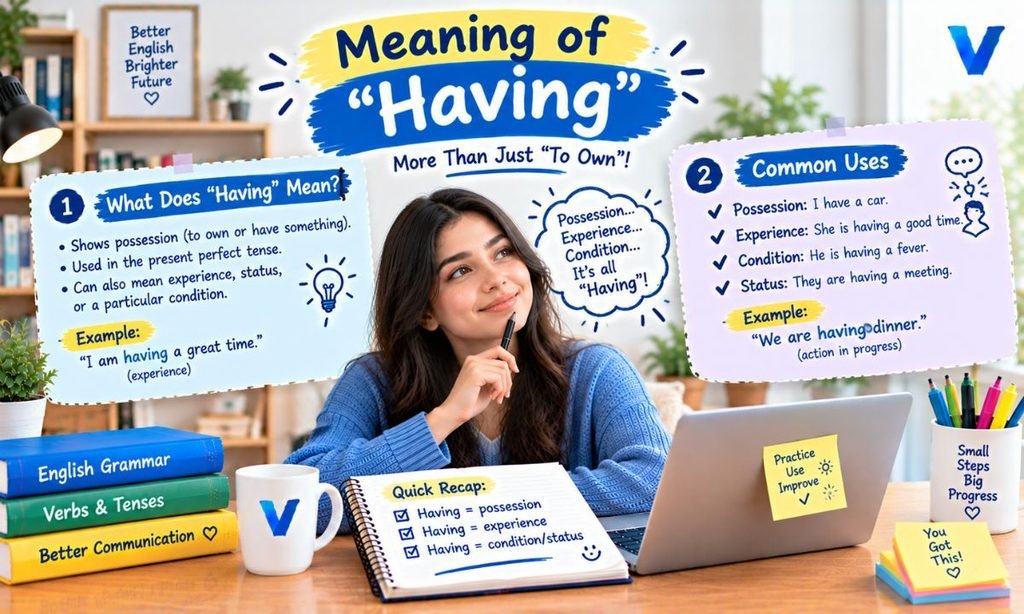
Definition of “Having”
“Having” is the present participle of the verb “have.” Depending on context, it can express possession, experience, an ongoing state, or an action happening alongside another one.
- Possession: Having a car makes commuting easier.
- Experience: She loves having coffee with friends.
- Ongoing state: Having doubts, he paused before signing.
Read More: What Does “For Your Records” Mean? Definition and Usage
How “Having” Functions in a Sentence
“Having” is flexible. It can work as:
- A gerund — acting like a noun (Having pets requires patience.)
- Part of a participial phrase — describing the subject (Having no other option, they waited.)
- Part of a continuous or causal clause — showing reason or simultaneous action (Having a headache, she left early.)
Sentence Structure Patterns for “Having”
Most “having” sentences follow one of these patterns:
| Pattern | Example |
| Having + noun | Having a plan makes decisions easier. |
| Having + adjective/noun clause | Having no idea what to say, he stayed silent. |
| Having + object, + main clause | Having free time, I decided to read. |
Common Errors with “Having”
- Using “having” when the action is already finished before another one. ❌ Having finished the report, she is submitting it now. Better: Having finished the report, she submitted it. (still fine here, since “having + past participle” already implies completion before the next action)
- Overusing “having” instead of a simpler tense. In casual speech, “having” often sounds stiff. Having lunch, I called my friend is less natural than I had lunch and then called my friend.
- Confusing “having” with “having had” when a clear “before-and-after” sequence exists.
Meaning of “Having Had”
“Having had” is a perfect participle — it combines “having” with “had,” the past participle of “have.” It signals that an action, state, or experience was completed before another action in the past.
Think of it as a shorthand replacement for “after I had…” or “because I had…”:
- Having had dinner, they went for a walk. = After they had had dinner, they went for a walk.
- Having had years of experience, she handled the crisis calmly. = Because she had had years of experience…
Real-World Examples of “Having Had”
- Having had no sleep, he struggled to concentrate.
- Having had extensive training, she performed exceptionally well.
- Having had a difficult childhood, he understood the students better than most teachers.
- Having had three cups of coffee already, I decided to skip the fourth.
- Having had the flu last winter, she made sure to get a flu shot this year.
Notice the pattern: in every case, one event (the training, the sleep deprivation, the illness) is fully wrapped up before the next event happens.
Key Differences Between “Having” and “Having Had”
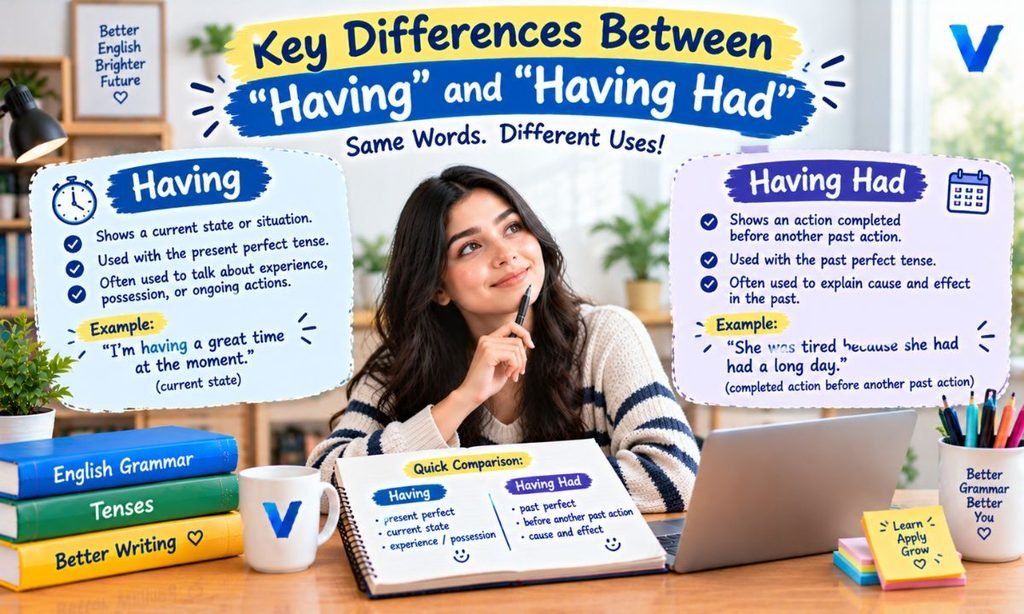
Core Grammatical Differences
| Feature | Having | Having Had |
| Grammar form | Present participle | Perfect participle |
| Timing | Present or simultaneous | Past, completed before another action |
| Formality | Neutral, common in speech and writing | More formal, common in writing |
| Typical use | Ongoing states, habits, general facts | Sequenced past experiences |
Functional Differences
- “Having” connects two things happening at roughly the same time, or expresses a general truth or state.
- “Having had” connects two things happening in sequence, where the first must finish before the second starts.
Quick Comparison Table
| Sentence | Meaning |
| Having a headache, she skipped the meeting. | The headache and skipping happen together. |
| Having had a headache all morning, she finally took medicine. | The headache existed before she took medicine. |
| Having money doesn’t guarantee happiness. | General truth, no sequence implied. |
| Having had money trouble in the past, he now budgets carefully. | Past trouble happened before current habit formed. |
When to Use “Having”
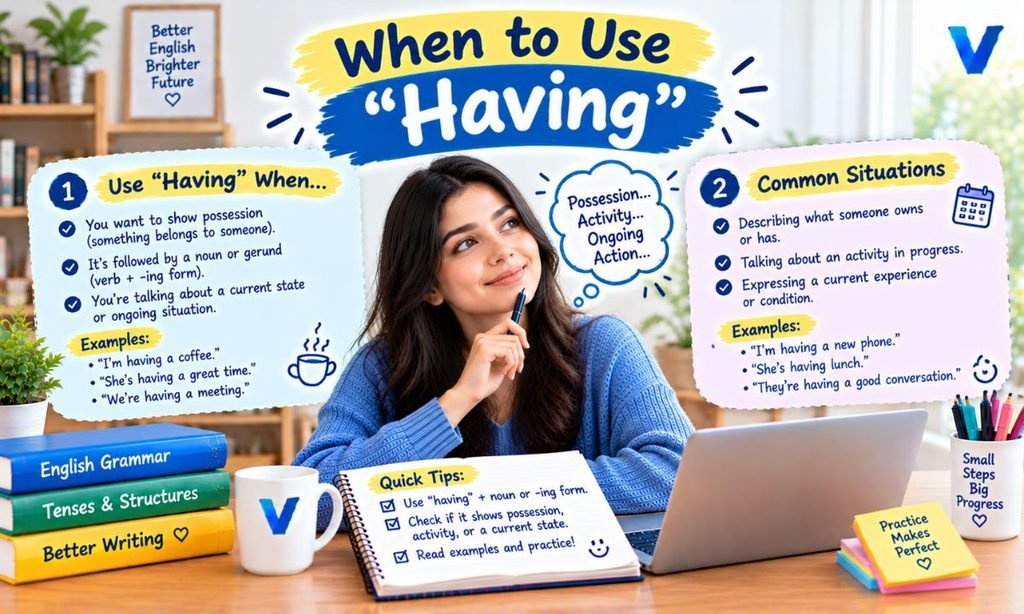
Use “having” when:
- You’re describing a current state, habit, or possession.
- Two actions happen at the same time.
- You’re forming a gerund phrase (having something = the act of possessing/experiencing it).
- The sentence expresses a general or timeless truth.
Examples:
- Having a good routine improves productivity.
- She enjoys having quiet mornings.
- Having no regrets, he moved forward confidently.
When to Use “Having Had”
Use “having had” when:
- One action was completed before another past action.
- You want to show cause and effect across two past events.
- You’re writing in a formal, literary, or academic tone and want precise sequencing.
Examples:
- Having had a long day, she went straight to bed.
- Having had no response for weeks, they assumed the deal was off.
- Having had the chance to travel widely, he valued different cultures.
Spoken English: When “Having Had” Works Naturally

In everyday conversation, “having had” can sound a little formal or even clunky. Native speakers often simplify it:
- Formal/written: Having had breakfast, she left for the office.
- Natural speech: She had breakfast and then left for the office.
That said, “having had” still shows up naturally in spoken English when people want to briefly explain a past reason before moving on — for example: “Having had that experience before, I knew exactly what to do.” It’s common in interviews, storytelling, and professional speech, just less common in casual chit-chat.
Common Grammar Questions About “Having” and “Having Had”
Is “having had” redundant?
No. Although it repeats the verb “have,” each word plays a different grammatical role — one is the participle, the other is the past form — so there’s no true redundancy.
Can “having” replace “having had” in past contexts?
Only if the two actions happen at the same time. If one action must be finished before the other starts, “having had” is more accurate.
Is “having had” formal or casual?
It leans formal and is more common in written English, literature, and professional writing than in casual conversation.
Does “having had” always need a comma after it?
Usually yes, when it starts a sentence as an introductory participial phrase — for example, “Having had a rough week, she decided to take a break.”
Is There a Difference in British vs. American Usage?

Both British and American English use “having” and “having had” the same way grammatically. The difference is mostly stylistic: British English, especially in formal and literary writing, tends to use perfect participles like “having had” slightly more often than American English, which often favors simpler, more direct sentence structures (e.g., “After I had breakfast…” instead of “Having had breakfast…”).
Practical Strategies to Master the Difference
Quick Method to Choose the Right Form
Ask yourself one question: Did the first action finish before the second one started?
- If yes → use “having had.”
- If no, or if they happen together → use “having.”
Real-World Case Studies
- Case 1 – Job interview: “Having worked in customer service for five years, I understand client needs.” (ongoing skill, still relevant) vs. “Having had five years in customer service before switching careers, I bring a unique perspective.” (clearly finished before the switch)
- Case 2 – Storytelling: “Having had no idea what awaited her, she opened the door.” (the not-knowing existed before the discovery)
- Case 3 – Academic writing: “Having had access to the original documents, the researcher was able to verify the claims.” (access came first, verification came second)
Transformation Exercises
Try converting these sentences:
- She finished her homework. Then she watched TV. → Having had finished her homework, she watched TV. (Corrected: Having finished her homework, she watched TV.)
- He had no money left. He couldn’t buy the ticket. → Having had no money left, he couldn’t buy the ticket.
- They lived abroad for years. Now they speak three languages. → Having lived abroad for years, they now speak three languages.
Summary Table: Quick Reference Guide
| Situation | Use |
| Ongoing action or current state | Having |
| Two actions at the same time | Having |
| General truth or habit | Having |
| One past action before another | Having Had |
| Formal explanation of a past cause | Having Had |
| Simple past narration in speech | Had (skip both participles) |
FAQs
Q:Is it correct to say “having had”?
Yes, it’s grammatically correct. It’s a perfect participle used to show one past action was completed before another.
Q:When should you use have and had?
Use “have” for present actions or states, and “had” for actions or states that were already completed in the past.
Q:Is it correct to say “I’m having dinner”?
Yes. “I’m having dinner” is standard present continuous, meaning the action is happening right now.
Q:How do I reply to “having dinner”?
A natural reply is simply acknowledging it, like “Enjoy your dinner!” or asking a follow-up question such as “What are you having?”
Q:Is “I had dinner” grammatically correct?
Yes. “I had dinner” is the simple past tense, showing the action was completed at a specific point in the past.
Conclusion
“Having” and “having had” aren’t interchangeable — they’re two precise tools for two different jobs. “Having” keeps you in the present or shows simultaneous action, while “having had” signals that something wrapped up before the next event began.
Once you start asking “did this happen before or at the same time?”, choosing the right form becomes second nature. With a little practice, this once-confusing pair will become one of the clearest tools in your writing toolkit.










2 thoughts on “Having vs Having Had: Meaning, Grammar Rules & Examples”