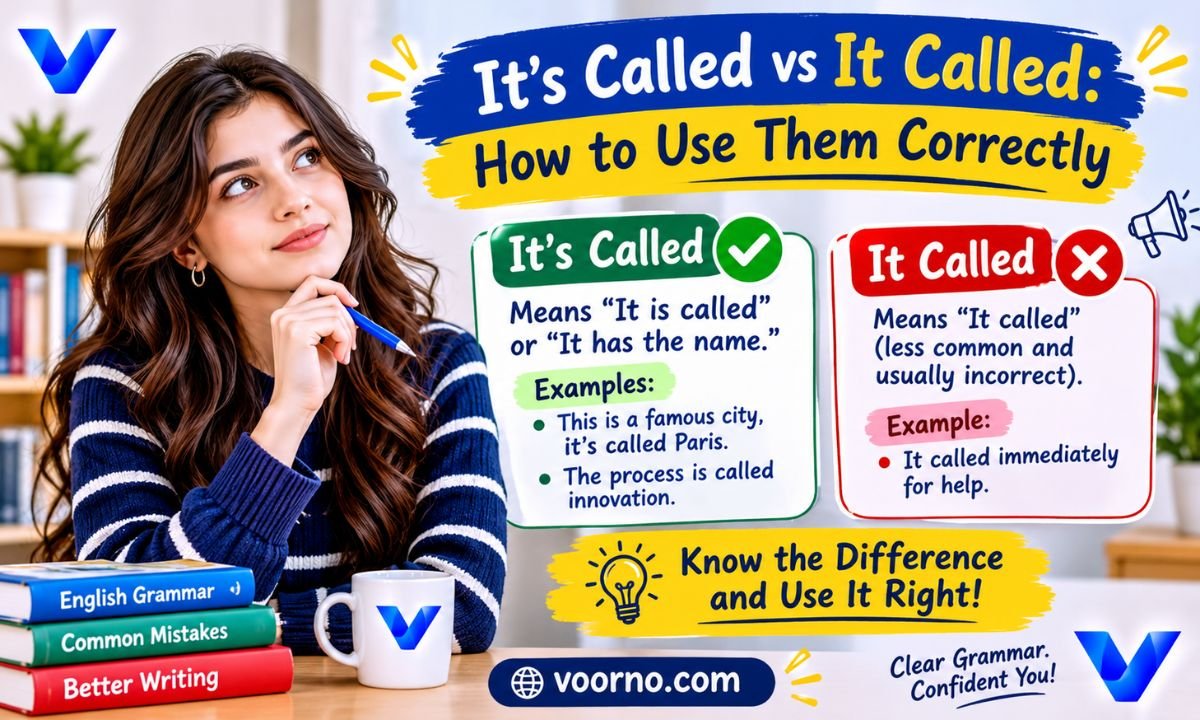
If you’ve ever paused mid-sentence wondering whether to write “it’s called” or “it called,” you’re not alone. This tiny apostrophe causes big confusion for native speakers and English learners alike. One missing mark can turn a clear sentence into a confusing one.
This guide breaks down the difference in plain language, shows you exactly when to use each phrase, and gives you practical examples so you never second-guess yourself again.
Quick Overview of “It’s Called vs It Called”
Here’s the short version before we go deeper:
| Phrase | Meaning | Grammar Type | Example |
| It’s called | It is named/labeled | Present passive voice | “It’s called a smartwatch.” |
| It called | It performed the action of calling | Simple past active voice | “It called for immediate action.” |
“It’s called” is used far more often because most sentences are about naming things — objects, places, feelings, or ideas. “It called” only works when “it” is the one doing the calling.
Read More: “Deem Fit”: Meaning, Legal Usage, and How to Use It Correctly
What’s the Actual Difference Between “It’s Called” and “It Called”?
The difference isn’t about spelling — it’s about function.
- “It’s” is a contraction of “it is.” Add “called” after it, and you get a passive construction used for naming or identifying something.
- “It” on its own is simply a pronoun. Pair it with “called” (the past tense of “call”), and you get an active sentence describing an action that already happened.
In short: one phrase labels, the other performs. Losing the apostrophe doesn’t just change spelling — it changes the entire grammatical role of the sentence.
Read More: Is It “To” Early or “Too Early”? Correct Grammar Explained
Understanding “It’s Called” – Meaning and Usage
“It’s called” expands to “it is called.” It uses the passive voice, meaning the subject receives a name instead of doing something.
You’ll reach for this phrase when you’re:
- Naming an object, place, or concept
- Defining a term or process
- Answering the question “What is this?”
Examples:
- “It’s called a thesaurus.”
- “This condition is called insomnia.”
- “The process is called photosynthesis.”
Because it identifies rather than acts, “it’s called” shows up constantly in definitions, explanations, and everyday conversation.
When “It Called” Is Correct
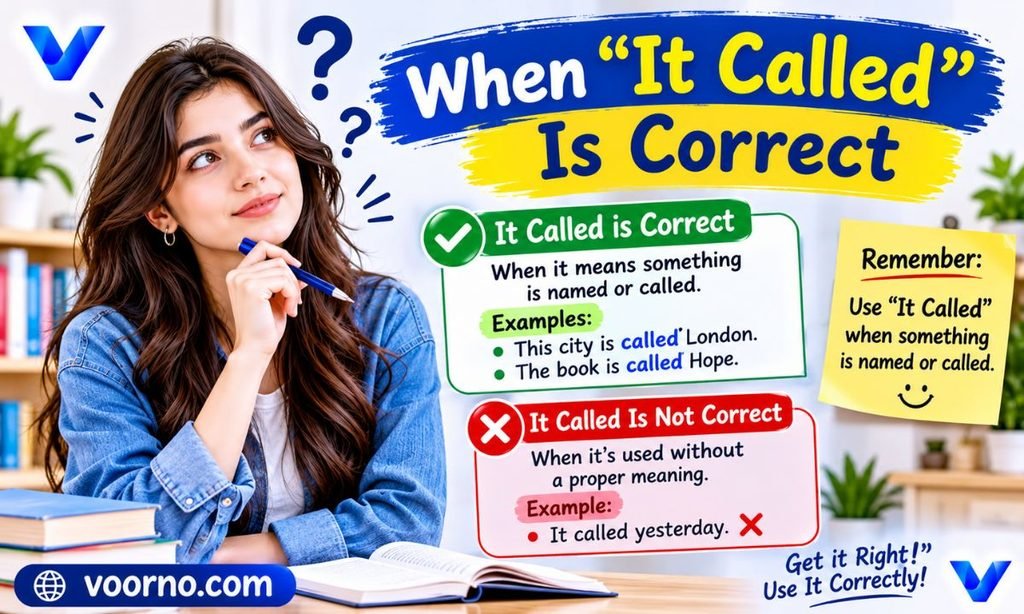
“It called” is the simple past tense of the verb “to call,” used in the active voice. This means “it” is the subject actually performing the action.
Use “it called” when referring to something — usually an object, device, animal, or organization — that made a call, either literally (a phone call) or figuratively (calling out, summoning, or naming something in the past).
Examples:
- “The phone rang, and it called my mother’s number.”
- “It called for a complete strategy change.”
- “The bird called loudly before flying away.”
Notice that in each case, something specific is doing the calling. Without that action, “it called” doesn’t fit.
It’s Called vs It Called: Use in Sentences
Seeing both forms side by side makes the distinction click faster.
| Sentence | Correct Form | Why |
| This tool ___ a wrench. | It’s called | Naming an object |
| The meeting ___ off due to rain. | It called (rare, needs context) | Describes an action |
| ___ a coincidence. | It’s called | Naming/labeling |
| The alarm went off, and ___ everyone to safety. | It called | Active action performed |
| What is this dish ___? | It’s called | Identifying something |
A simple test: if you can rephrase the sentence as “it is [named],” you need “it’s called.” If you can rephrase it as “it performed the action of calling,” you need “it called.”
Common Mistakes and Misunderstandings

Most errors with these phrases fall into a few predictable patterns:
- Dropping the apostrophe entirely — writing “its called” instead of “it’s called.” This is always incorrect, since “its” is a possessive pronoun, not a contraction.
- Using “it called” for naming — writing “it called a bug” instead of “it’s called a bug.”
- Confusing “how” and “what” — asking “How is it called?” instead of the natural English phrasing, “What is it called?”
- Mixing tenses — pairing “it’s called” with past-tense context when “it was called” is more appropriate.
Grammar Confusions
A lot of the confusion traces back to three overlapping issues: contractions, possessives, and passive voice. Since “it’s” and “its” sound identical when spoken, writers often mix them up in text. Add the passive-versus-active voice distinction, and it’s easy to see why even confident writers hesitate.
It’s Called vs It Called in Grammar
Grammatically, “it’s called” is a present passive verb phrase (is + past participle), while “it called” is a simple past active verb. One shows a state of being named; the other shows a completed action. Recognizing the verb form is the fastest way to pick the right phrase.
Examples in Real-Life Contexts
Seeing these phrases in natural, everyday situations helps cement the rule:
- Cooking: “It’s called risotto, and it takes patience to make.”
- Technology: “It’s called dark mode — it’s easier on your eyes at night.”
- Customer service: “She dialed the support line, and it called back within minutes.”
- Nature: “It’s called migration when animals travel seasonally.”
- Workplace: “The fire drill went off, and it called everyone outside.”
How to Decide Which One to Use

Ask yourself these two quick questions before writing either phrase:
- Am I naming or identifying something? → Use “it’s called.”
- Is “it” performing the action of calling? → Use “it called.”
If you’re still unsure, try replacing the phrase with its full form (“it is called” or “it did call”). Whichever version keeps the sentence grammatically correct is the one you need.
It’s Called vs It Called Synonyms
- Instead of “it’s called,” you can say: it is known as, it is referred to as, it is termed, it is named.
- Instead of “it called,” you can say: it rang, it summoned, it phoned, it cried out.
Using these alternatives can also help you avoid repeating the same phrase too often in your writing.
Grammar Tips for ESL and Native Speakers

- Remember: its (no apostrophe) always shows possession — “The dog wagged its tail.”
- It’s (with apostrophe) always means “it is” or “it has.”
- When in doubt, expand the contraction. If “it is called” makes sense, keep the apostrophe.
- Read your sentence aloud — passive naming phrases usually sound smoother with “it’s called.”
Understanding Verb Tenses
“It’s called” sits in the present tense because the name currently applies. “It called” sits in the simple past tense because the action already happened and finished. If you need a past-tense naming phrase, use “it was called” instead of “it called.”
Active vs Passive Voice Notes
Passive voice (“it’s called”) shifts focus onto the thing being named rather than the person doing the naming. Active voice (“it called”) puts the subject front and center as the one performing the action. English favors passive voice for definitions and active voice for describing events — which is exactly why “it’s called” appears far more frequently in everyday writing.
Quiz: Test Your Understanding
Choose the correct phrase for each sentence:
- This fruit ___ a dragon fruit.
- The teacher’s phone rang, and ___ during class.
- ___ a rare skin condition.
- The siren went off, and ___ the whole building to evacuate.
- What ___ in French?
Answers
- It’s called
- It called
- It’s called
- It called
- it called (as part of “What is it called”)
FAQs
Q:Which is correct: “it called” or “it’s called”?
Both can be correct depending on context. “It’s called” is used for naming something, while “it called” describes a past action performed by the subject.
Q:What does “it’s called” mean?
“It’s called” means “it is called” — a phrase used to identify, define, or name something.
Q:When to use it vs its?
Use “it’s” as a contraction for “it is” or “it has.” Use “its” (no apostrophe) to show possession, as in “the cat licked its paw.”
Q:What is it called grammatically correct?
The grammatically correct question is “What is it called?” — not “How is it called?” This phrasing is standard in English for asking about names or labels.
Q:How do you pronounce “called”?
“Called” is pronounced as one syllable: “kawld,” rhyming with “bald” or “hauled.”
Conclusion
The difference between “it’s called” and “it called” comes down to one small but powerful apostrophe. “It’s called” names or identifies something and shows up in the vast majority of everyday sentences.
“It called” describes a completed action performed by the subject and applies far less often. Once you internalize this distinction, you’ll write and speak with more confidence — no more second-guessing that apostrophe.










2 thoughts on “It’s Called vs It Called: How to Use Them Correctly”