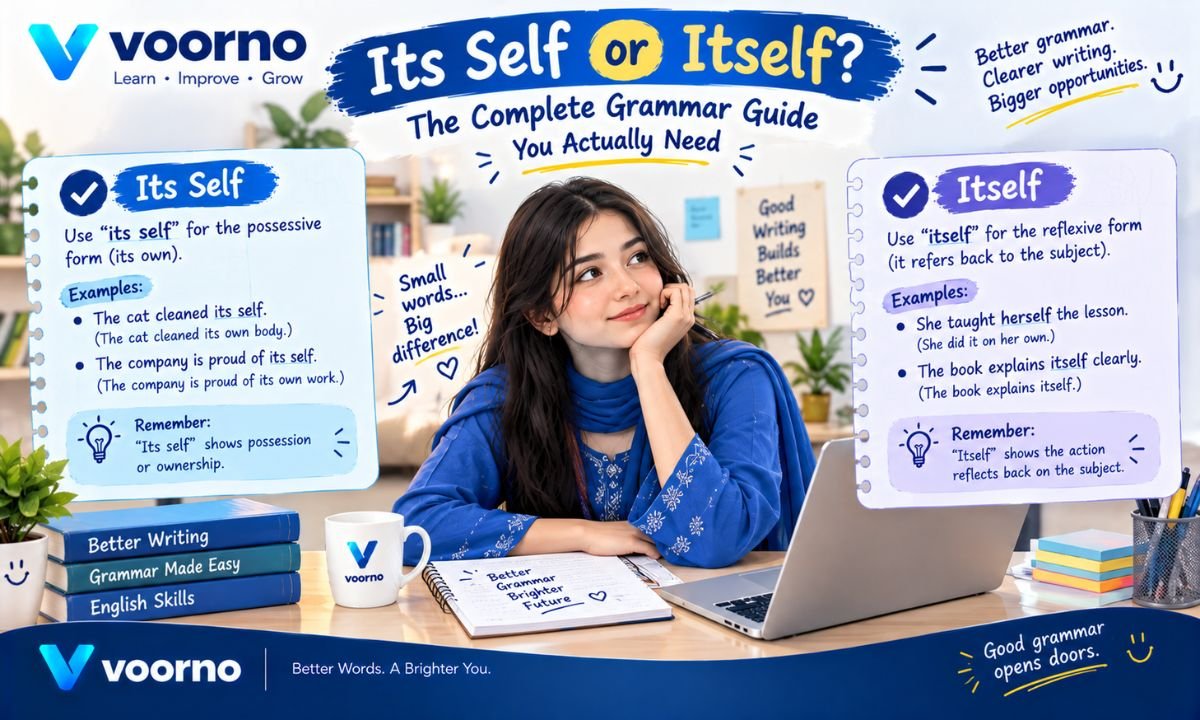
If you’ve ever paused mid-sentence wondering whether to write “itself” or “its self,” you’re not alone. This is one of the most common pronoun mix-ups in English, right up there with “its” versus “it’s.” The confusion usually comes from a simple visual trick: “itself” looks like it could be split into two words, “its” and “self.” But grammatically, these two forms serve completely different purposes.
This guide breaks down the rule in plain language, shows you exactly when (if ever) “its self” is acceptable, and gives you practical tricks so you never second-guess yourself again.
Quick Answer: Is It “Its Self” or “Itself”?
In almost every situation, “itself” is correct. It’s a single-word reflexive pronoun used when a subject acts on or refers back to itself.
- ✅ The cat cleaned itself.
- ✅ The company prides itself on quality service.
- ❌ The cat cleaned its self.
“Its self,” written as two separate words, is grammatically valid only in rare, specialized writing — usually philosophy, psychology, or discussions about identity and consciousness — where “self” is treated as a standalone noun (as in “the self”).
Rule of thumb: If you’re writing everyday English — emails, essays, articles, business copy — always use “itself.” Save “its self” for academic or philosophical contexts where “self” refers to a concept of identity.
Read More:All Time vs All-Time: Meaning, Usage & Grammar Rules
Comparison Table: “Itself” vs “Its Self”
| Feature | Itself | Its Self |
| Word count | One word | Two words |
| Part of speech | Reflexive pronoun | Possessive pronoun + noun |
| Common usage | Everyday English, all writing styles | Philosophy, psychology, abstract identity discussions |
| Grammatically standard? | Yes, always | Rarely; only in specific contexts |
| Example | The machine shut itself off. | The mind reflects upon its self. |
| Frequency | Extremely common | Extremely rare |
Understanding “Itself”: The Reflexive Pronoun
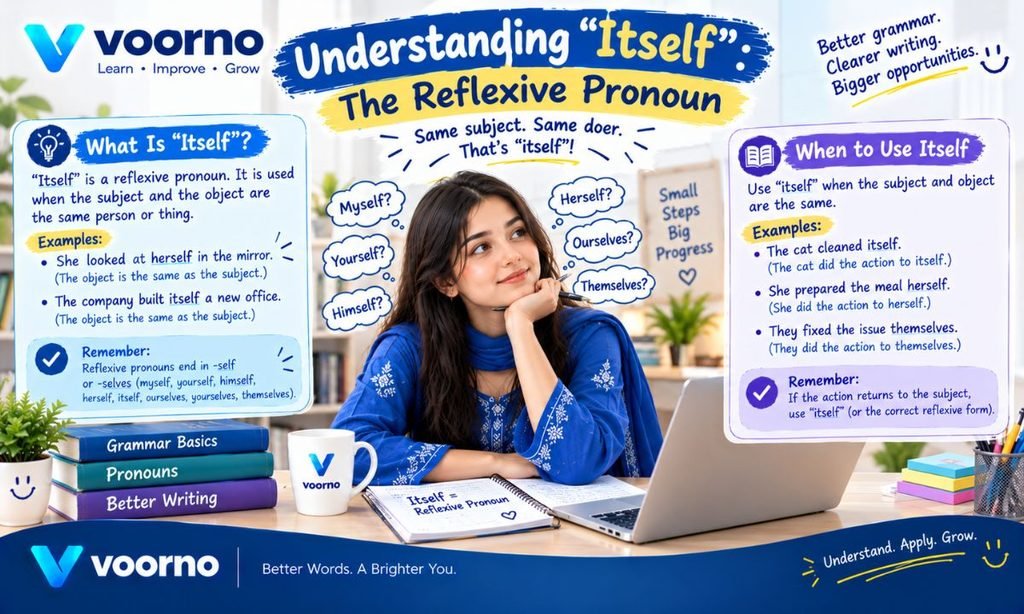
“Itself” belongs to a group of words called reflexive pronouns, which also includes “himself,” “herself,” “themselves,” and “myself.” Reflexive pronouns are used when the subject and the object of a sentence refer to the same thing.
You use “itself” in two main situations:
- Reflexive action — when something performs an action on itself.
- The oven cleans itself.
- Emphasis — when you want to stress that something did an action alone, without help.
- The problem itself wasn’t difficult; the deadline was the issue.
Because “itself” is always written as a single word with no apostrophe, there’s no ambiguity once you understand its function. It never shows possession, and it never needs to be split apart.
Read More:“Prompt Action” Explained: How to Act Quickly and Effectively
What Does “Its Self” Even Mean? When It’s Ever Right
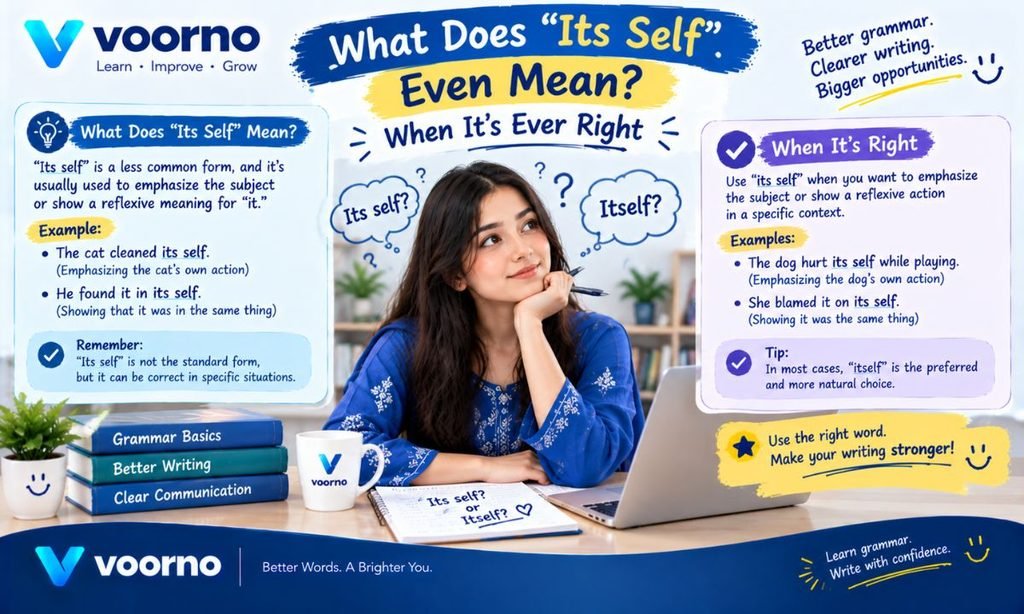
Here’s where things get interesting. “Its self” isn’t a typo or an invented phrase — it’s a legitimate two-word construction made up of:
- Its — a possessive pronoun (no apostrophe)
- Self — a noun referring to one’s identity, consciousness, or essential being
When combined, “its self” refers to an entity’s own identity or inner nature, not a reflexive action. This usage is uncommon in modern writing, but it does show up in specific fields.
Where “Its Self” Can Legitimately Appear
- Philosophy and psychology — discussions of consciousness, identity, and “the self” as a concept.
- “The organism becomes aware of its self through experience.”
- Academic or AI research writing — when referring to an internal model or representation of identity.
- “The neural network updates its self-model during training.”
- Older or literary texts — some 18th- and 19th-century writing separated the phrase deliberately for emphasis.
Why Most Writers Should Avoid It
Unless you’re writing in one of the niche contexts above, “its self” will almost always read as a grammar mistake to your audience. Most readers — and most grammar checkers — expect “itself.” or “its self” used outside academic writing risks:
- Confusing your reader
- Looking like a typo rather than an intentional stylistic choice
- Undermining the credibility of your writing
Bottom line: if you’re not specifically discussing “the self” as a philosophical concept, use “itself.”
Common Grammar Mistakes: “Its,” “It’s,” “Itself,” and “Its Self”
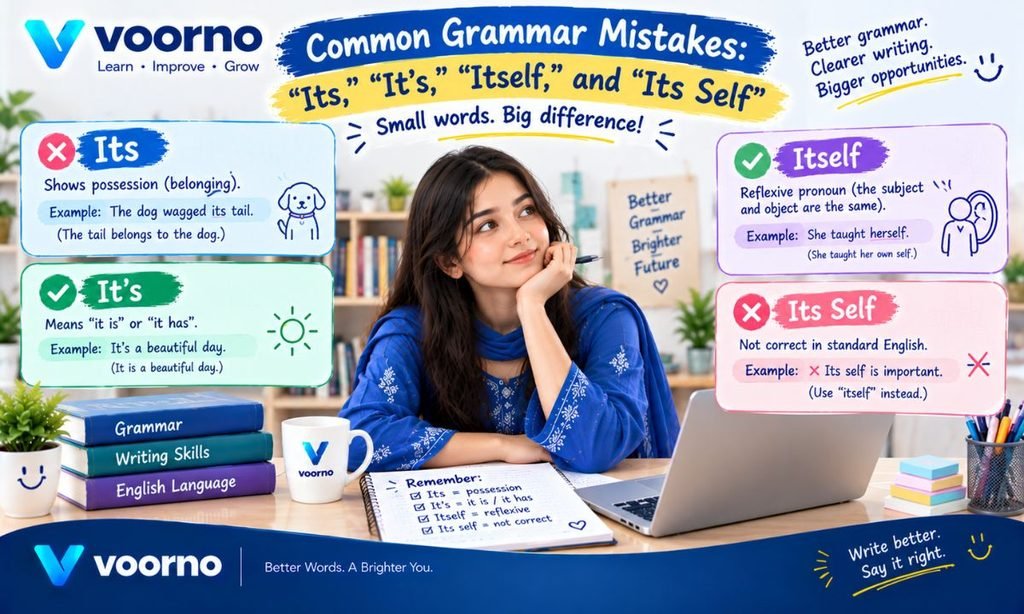
These four forms trip up even experienced writers. Here’s a simple breakdown:
- Its — possessive, shows ownership, no apostrophe.
- The dog wagged its tail.
- It’s — a contraction of “it is” or “it has,” always has an apostrophe.
- It’s raining outside.
- Itself — reflexive pronoun, one word, no apostrophe.
- The system rebooted itself.
- Its self — possessive + noun, two words, used only for identity/consciousness discussions.
- The mind explores its self.
Clean Comparison Table
| Word | Function | Example | Apostrophe? |
| Its | Possession | Its color faded. | No |
| It’s | Contraction (it is/has) | It’s getting late. | Yes |
| Itself | Reflexive pronoun | She fixed itself… wait, “it fixed itself.” | No |
| Its self | Possessive + noun (identity) | The AI reflects on its self. | No |
How Context Shapes Meaning
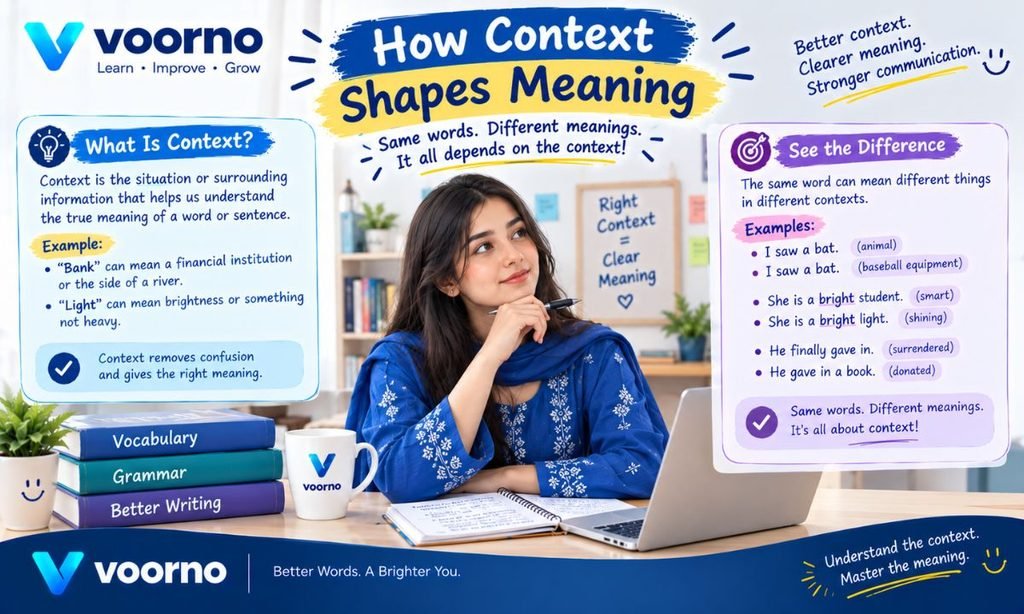
Context is everything when choosing between these forms. A single sentence can mean two very different things depending on which version you use.
Its self or itself examples
- Itself: “The economy corrected itself after the crash.” (Reflexive action — the economy fixed its own condition.)
- Its self: “The economy, in its self, is a reflection of collective human behavior.” (Abstract identity — “its self” here means its essential nature.)
Its self or itself grammar
The grammatical test is simple: ask whether the sentence describes an action happening to the subject (use “itself”) or whether it’s describing the subject’s identity or inner nature as a noun (use “its self”). If you’re unsure, “itself” is the safer, statistically correct choice about 99% of the time.
Spot the Difference: Test Yourself
Ready to check your understanding? Try these quick exercises before checking the answers.
Exercises
- The washing machine cleaned _____ after the cycle ended.
- Philosophers have long debated how the mind comes to know _____.
- The company rebranded _____ to attract younger customers.
- The universe, in _____, may be indifferent to human concerns.
- The AI system updated _____-model to improve accuracy.
Answers with Explanations
- Itself — reflexive action; the machine cleaned its own parts.
- Its self — abstract identity; refers to the mind’s own consciousness.
- Itself — reflexive action; the company changed its own image.
- Its self — philosophical/abstract use referring to the universe’s inherent nature.
- Its (self-model is a compound noun here, not “its self”) — a common trap; check whether “self” functions as part of a hyphenated term.
Real-World Examples from Media and Literature

Writers and public figures use “itself” constantly for emphasis and reflexive meaning. For example, phrases like “the idea itself was revolutionary” appear often in journalism and essays to highlight that a concept stands on its own merit, independent of surrounding factors. In philosophical and psychological literature, meanwhile, “its self” occasionally appears when authors discuss identity formation or consciousness as a subject in its own right — a usage that remains largely confined to academic writing rather than everyday prose.
Writing Tips to Never Mix These Up Again
- Read it aloud. If the sentence sounds natural with “itself,” that’s almost always your answer.
- Use the replacement test. Try substituting “himself” or “herself” — if it fits, “itself” is correct.
- Ask if “self” is a noun. If you’re literally discussing “the self” as a concept, “its self” may apply.
- Default to “itself.” When in doubt, one word is the statistically safer, more standard choice.
- Watch for compounds. Terms like “self-model” or “self-awareness” are different from the two-word “its self.”
Is Itself One Word?
Yes. “Itself” is always written as a single word with no apostrophe, regardless of tense or context.
Itself Plural
“Itself” doesn’t have a plural form because it refers to a singular, non-human, or non-personified subject. The plural equivalent for multiple subjects is “themselves.”
FAQs
Which is correct, itself or its self?
“Itself” is correct in nearly all everyday writing. “Its self” only applies in rare philosophical or academic contexts about identity.
Do I say it’s or its?
Use “it’s” only when you mean “it is” or “it has.” Use “its” to show possession, with no apostrophe.
How to use itself in a sentence?
Use “itself” when the subject performs an action on itself or when you want to add emphasis, such as “The plan itself was solid.”
Is it correct grammar to say “I myself”?
Yes, “I myself” is grammatically correct and used for emphasis, similar to how “itself” emphasizes a non-human subject.
Is it ownself or own self?
“Ownself” is not standard English. The correct phrasing is “own self,” written as two separate words, often paired with “its” or “his/her.”
Conclusion
The difference between “itself” and “its self” comes down to function: one is a reflexive pronoun used constantly in everyday English, while the other is a rare, two-word noun phrase reserved for discussions of identity and consciousness.
For nearly every sentence you’ll ever write, “itself” is the safe, correct, and expected choice. Save “its self” for the rare moment you’re genuinely writing about the philosophical concept of “the self.” Keep this guide handy, and you’ll never second-guess this pairing again.





2 thoughts on “Its Self or Itself? The Complete Grammar Guide You Actually Need”