
If you’ve ever read a business email, a legal notice, or a manager’s memo, chances are you’ve come across the phrase “prompt action.” It shows up everywhere — yet very few people stop to ask whether it’s actually the right phrase to use, or whether it’s grammatically sound in the first place.
This guide breaks down exactly what “prompt action” means, whether it’s correct English, why it sometimes backfires in real communication, and what to use instead when you need people to actually respond — not just nod along.
What Does “Prompt Action” Mean?
At its simplest, “prompt action” means doing something quickly, without unnecessary delay. It combines two words:
- Prompt (adjective) — quick, immediate, or done without hesitation
- Action (noun) — a step taken to achieve a result
Put together, the phrase describes a fast, efficient response to a situation that needs attention. It’s not about panic or rushing — it’s about acting within a reasonable, short timeframe once a need has been identified.
You’ll typically see it used when someone wants to signal urgency while still sounding professional and composed, rather than alarmed.
Read More:Its Self or Itself? The Complete Grammar Guide You Actually Need
Is “Prompt Action” Grammatically Correct?
Yes — “prompt action” is completely correct English. It follows a standard adjective-plus-noun structure, the same pattern as phrases like “quick response” or “immediate assistance.”
Major dictionaries support this usage. Cambridge defines “prompt” as something done without delay, and Oxford lists “prompt action” itself as an example sentence for the word. There’s nothing unusual, informal, or broken about the grammar here — it’s a stable, standard collocation in both British and American English.
Where confusion sometimes creeps in is with related forms:
| Phrase | Correct? | Notes |
| Prompt action | ✅ Yes | Standard adjective + noun |
| Promptly action | ❌ No | “Promptly” is an adverb; it can’t directly modify a noun this way |
| Act promptly | ✅ Yes | Verb + adverb, a valid alternative |
| Prompt actions | ✅ Yes, but less common | Treats “action” as countable rather than an abstract concept |
The Tone Behind “Prompt Action”
“Prompt action” carries a formal, businesslike tone. It’s polite but firm — urgent without being aggressive. That’s exactly why it’s so popular in professional writing: it applies pressure without sounding rude or panicked.
Compare it to stronger phrases like “immediate action” or “urgent response,” which suggest a crisis. “Prompt action” sits in the middle — serious, but measured.
Prompt Action in a Sentence
Here are a few natural examples:
- The doctor’s prompt action saved the patient’s life.
- We kindly request prompt action on this outstanding invoice.
- Prompt action from the maintenance team prevented further water damage.
- Failure to take prompt action may result in account suspension.
Notice how the phrase works as a subject, object, or part of a formal request in each case.
Where You Commonly See “Prompt Action”
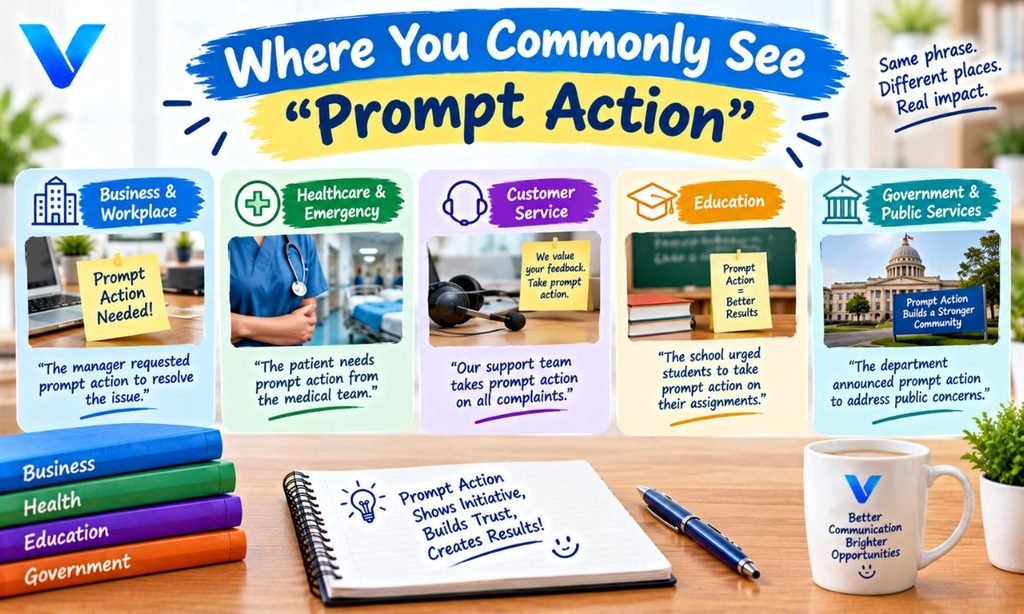
This phrase isn’t randomly scattered across the internet — it clusters in a handful of predictable contexts:
- Business and workplace emails — reminders, follow-ups, and internal memos
- Legal notices and contracts — warnings about consequences of inaction
- Customer service communication — billing reminders, account alerts
- Government and official documents — public notices, compliance letters
- News and journalism — reporting on responses to incidents or emergencies
The Problem With “Prompt Action”: Vagueness
Here’s the catch: while “prompt action” is grammatically fine, it’s often functionally weak. The phrase doesn’t tell the reader what to do, by when, or what happens if they don’t.
Telling someone “we require prompt action” leaves too much room for interpretation. One person might respond within the hour; another might wait a week and still feel they acted “promptly.” That’s the core issue — the phrase relies on the reader’s personal sense of urgency, which varies wildly from person to person.
Clarity Comparison
| Vague Version | Clear Version |
| Please take prompt action on this matter. | Please submit the signed form by Friday, June 12. |
| We request your prompt action regarding payment. | Your balance of $480 is due by March 12 to avoid a late fee. |
| Prompt action is required to resolve this issue. | Please respond within 48 hours with your decision. |
The clear version always wins because it removes guesswork. Specificity drives action; vagueness invites delay.
Breaking Down the Grammar of “Prompt Action”
Grammatically, “prompt” functions as an attributive adjective — it sits directly before the noun it modifies, “action.” This is the most common adjective placement in English and requires no special punctuation or structure.
A few grammar notes worth knowing:
- “Prompt” doesn’t take the comparative forms “prompter” or “promptest” in modern usage; instead, use “more prompt” or simply switch to “quicker.”
- “Action” can be singular or plural depending on whether you’re referring to one unified response (“prompt action”) or several distinct steps (“prompt actions”).
- The phrase can function as a subject (“Prompt action is needed”), an object (“We need prompt action”), or the object of a preposition (“insist on prompt action”).
Why Do Some People Question “Prompt Action”?

Some writers hesitate to use the phrase — not because it’s wrong, but because it feels like corporate filler. Overused business jargon often triggers skepticism in readers, who’ve learned to associate vague urgency with emails that ultimately require no real effort from the sender.
In other words, people don’t question the grammar. They question the intent — is this a genuine, specific ask, or a polite way of saying nothing much at all?
Case Study: Corporate Email Communication
Let’s look at two versions of the same reminder email.
Version One
Subject: Prompt Action Required
Dear Team,
We request your prompt action regarding the pending documentation. Please treat this matter with urgency.
This version sounds official, but it gives the reader nothing to act on. What documentation? By when? What happens if it’s late?
Version Two
Subject: Please Submit Your Onboarding Documents by Friday
Dear Team,
Please submit your signed contract and ID copy by Friday at 5 PM so we can finalize your onboarding. Delayed submissions may push your start date back by one week.
This version states the exact task, the deadline, and the consequence. It reads as helpful rather than bureaucratic — and it’s far more likely to get a response.
Why Specific Deadlines Outperform “Prompt Action”
Specific deadlines outperform vague urgency phrases for a simple psychological reason: humans respond better to concrete boundaries than abstract pressure. A deadline creates a mental checkpoint. A vague request for “prompt action” creates only a vague feeling of should-probably-do-this-eventually.
This principle lines up with plain-language writing standards used in official communication, which favor direct, specific instructions over formal but ambiguous phrasing.
Alternatives to “Prompt Action” Based on Tone
| Tone | Alternative Phrase |
| Formal / Legal | Immediate action, timely response |
| Professional / Business | Swift action, quick turnaround |
| Friendly / Casual | Get back to me soon, handle this quickly |
| Urgent / Critical | Urgent response required, act without delay |
Common Mistakes When Using “Prompt Action”
- Saying “promptly action” instead of “prompt action” or “act promptly”
- Stacking intensifiers, such as “urgent prompt action,” which is redundant
- Using it without any specifics, leaving the reader unsure what to do
- Overusing it across every email, which dilutes its impact until it’s ignored
- Relying on it in casual contexts, where it can sound stiff or overly formal
Case Study: Legal Notice Language
Legal writing often favors broad phrasing like “prompt action” on purpose — contracts are written to cover many possible scenarios, so specific deadlines aren’t always practical. A clause might read:
Failure to take prompt action upon notice may result in termination of this agreement.
Here, the vagueness is intentional; it gives flexibility across different situations. But in consumer-facing letters — like a billing notice — this same vagueness becomes a weakness, because the average reader wants a plain answer, not legal flexibility.
Is “Prompt Action Required” Correct?
Yes, it’s grammatically correct and commonly used as a subject line or heading. It functions as a noun phrase followed by an adjective, similar to “action required” or “response needed.”
“Prompt Action” vs “Act Promptly”
Both phrases mean the same thing, but they work differently in a sentence:
- Prompt action — a noun phrase, used as a subject or object (“We need prompt action.”)
- Act promptly — a verb phrase, used as an instruction (“Please act promptly.”)
“Act promptly” tends to sound slightly more direct and personal, since it addresses the reader with a verb rather than describing an abstract concept.
Prompt Action Synonym
Common synonyms include: immediate action, swift action, quick response, timely response, urgent response, and fast turnaround.
Psychological Impact of Vague Urgency
Vague urgency phrases can backfire because they trigger low-priority filing in a reader’s mind. When a request doesn’t specify a deadline or consequence, the brain tends to treat it as optional rather than time-sensitive — even if the sender intended otherwise. Over time, repeated vague requests can also breed message fatigue, where readers start skimming past anything that sounds like a template.
When You Should Use “Prompt Action”
- In formal letters, contracts, or legal notices where flexible language is intentional
- In internal reports summarizing that a fast response occurred (“The team’s prompt action minimized the damage.”)
- In headlines or subject lines where brevity matters more than detail
When You Should Avoid “Prompt Action”
- When you need someone to complete a specific task by a specific time
- In customer-facing messages where clarity builds trust
- In casual conversations, texts, or informal chats
- When you’ve already used the phrase multiple times in the same message or thread
Writing Better Urgency: Practical Framework
- State the task — say exactly what needs to happen.
- Set a deadline — give a date or time, not just “soon.”
- Explain the consequence — briefly note what happens if there’s a delay.
- Match your tone to your audience — formal for legal/business, direct for customer-facing text.
Examples Across Contexts
| Context | Example |
| Business email | “Please confirm your attendance by Thursday noon.” |
| Legal notice | “Failure to take prompt action within 30 days may result in penalties.” |
| Customer service | “Please update your payment details by June 15 to avoid service interruption.” |
| Medical/emergency reporting | “The nurse’s prompt action stabilized the patient before the ambulance arrived.” |
Professional Tone vs Plain Language
Professional tone and plain language aren’t opposites — the best business writing blends both. You can keep a respectful, polished tone while still being specific. “Prompt action” leans toward tradition and formality; plain language leans toward clarity and results. The strongest writing borrows from both: professional in tone, plain in substance.
Quick Reference Table: Should You Use “Prompt Action”?
| Situation | Use “Prompt Action”? |
| Legal contract clause | ✅ Yes |
| Billing reminder to a customer | ❌ No — use a specific deadline |
| Internal report describing past events | ✅ Yes |
| Text message to a colleague | ❌ No — too formal |
| Subject line for an urgent notice | ✅ Yes, if followed by details in the body |
FAQs
Q:Is prompt action correct?
Yes, “prompt action” is grammatically correct and widely used in formal and professional English.
Q:What’s another word for prompt action?
Common alternatives include immediate action, swift action, quick response, and timely response.
Q:How do I reply to a prompt?
Respond directly and specifically, confirming what you’ll do and by when, rather than replying with vague agreement.
Q:How do you say thank you for prompt action?
You can say, “Thank you for your prompt response” or “I appreciate how quickly you handled this.”
Q:How to write a good prompt?
A good prompt is clear, specific, and states exactly what outcome or action you’re expecting, with any relevant deadline or context included.
Conclusion
“Prompt action” isn’t grammatically wrong — far from it. It’s a correct, well-established phrase with a long history in formal and professional English. But correctness and effectiveness aren’t the same thing. In many real-world situations, the phrase is too vague to actually drive results.
The smartest approach isn’t to abandon “prompt action” altogether — it’s to know when it fits (legal language, headlines, formal reports) and when a specific deadline, clear task, and stated consequence will get you a faster, better response. Master both, and you’ll never again send a message that sounds urgent but changes nothing.










2 thoughts on ““Prompt Action” Explained: How to Act Quickly and Effectively”