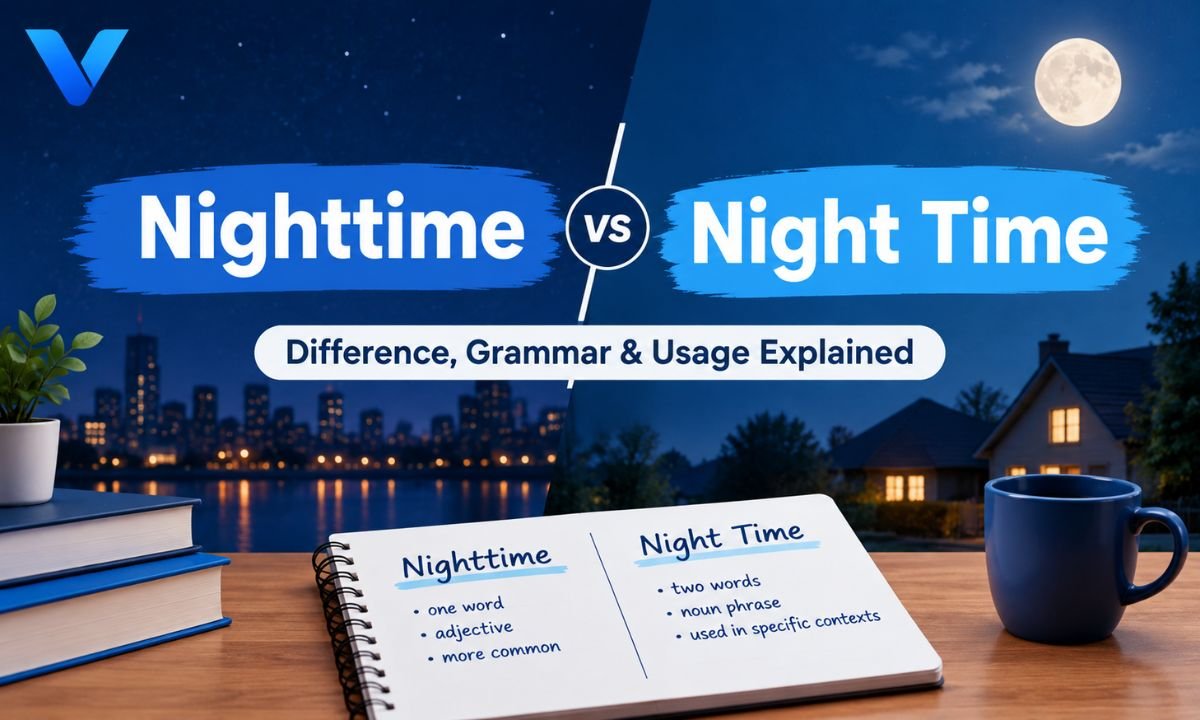
Have you ever paused mid-sentence, unsure whether to write “nighttime” or “night time”? You’re not alone. This is one of the most common compound-word mix-ups in English, and it trips up students, bloggers, and even professional writers.
The short answer: “nighttime” is the standard, dictionary-preferred spelling in modern English, while “night time” is an older, less formal two-word variant. But the full story involves grammar rules, regional spelling habits, and how English compound words evolve over centuries.
This guide breaks down everything you need to know — meaning, grammar, British vs. American usage, real examples, and expert-backed rules you can apply immediately.
What You Need to Know First: Nighttime vs Night Time
Before diving deep, here’s the quick version:
| Form | Status | Common Use |
| Nighttime | Standard, preferred (US & modern UK) | Formal writing, dictionaries, journalism |
| Night-time | Accepted British variant (hyphenated) | UK publications, older style guides |
| Night time | Informal, considered outdated | Casual speech, older texts |
Both forms describe the same thing — the hours of darkness between sunset and sunrise — but only “nighttime” (or its hyphenated British cousin) is treated as a proper compound word by major dictionaries.
Read More: Sizable vs Sizeable: Difference, Definition & Examples
Nighttime Meaning Explained
“Nighttime” is a noun (and sometimes an adjective) referring to the period of the day when it’s dark outside, typically from dusk until dawn. It works the same way as other time-based compounds like daytime, bedtime, and lunchtime.
- As a noun: “Nighttime is when most nocturnal animals are active.”
- As an adjective: “She prefers nighttime walks over morning ones.”
“Night time,” written as two words, carries the same meaning but reads as a description of “time at night” rather than a single, unified concept.
How Compound Words Work in English
To understand why “nighttime” beat out “night time,” it helps to know how compound nouns form in English. Compounding typically follows three stages:
- Open form — two separate words (e.g., “night time”)
- Hyphenated form — words joined with a hyphen (e.g., “night-time”)
- Closed form — words fused into one (e.g., “nighttime”)
Words that are used together often enough eventually merge for efficiency and readability. This is exactly what happened with “daytime,” “lunchtime,” “sometime,” and “nighttime.” Because “night” and “time” almost always appear side by side when describing darkness, English speakers gradually collapsed them into a single word.
Read More:Heard vs Herd vs Hurd: How to Use Each Word Correctly
What Dictionaries and Style Guides Say
Major dictionaries and editorial style guides are fairly consistent on this point:
- Merriam-Webster lists “nighttime” as the standard noun form, with no hyphen.
- Cambridge Dictionary also favors the closed compound “nighttime.”
- Oxford Dictionaries traditionally list “night-time” (hyphenated) as a valid British form, though “nighttime” appears increasingly in modern British usage.
- AP Style recommends the one-word form for American publications.
The takeaway: reputable sources accept “nighttime” and “night-time,” but none of them endorse “night time” as two separate words for standard writing.
Historical Development: How the Word Changed Over Time
The word’s roots stretch back centuries:
- Middle English period (12th–15th century): Phrases like “nyght tyme” or “on nyhtes time” appear in early manuscripts, treated as two words.
- 1700s: The hyphenated form “night-time” gained traction as compounding conventions developed.
- 1900s: Dictionaries and publishers increasingly adopted the closed, one-word form “nighttime,” mirroring similar words like “daytime” and “bedtime.”
- Today: “Nighttime” dominates in edited, professional writing across both American and British English, while “night time” survives mainly in casual or older texts.
This mirrors a broader linguistic pattern: frequently paired words tend to compress into single units as a language standardizes.
Trends in Usage: What Data Shows
Corpus data (such as Google Ngram Viewer results) consistently shows:
- American English has overwhelmingly favored “nighttime” since the mid-20th century.
- British English shows more variation, with “night-time” still common in newspapers and formal writing, though “nighttime” is catching up.
- The two-word form “night time” appears far less frequently in edited, published text than in casual online writing.
In short, published, professional English has settled on the compound form — spoken and informal writing is where “night time” lingers.
Nighttime or Night-Time: UK Spelling
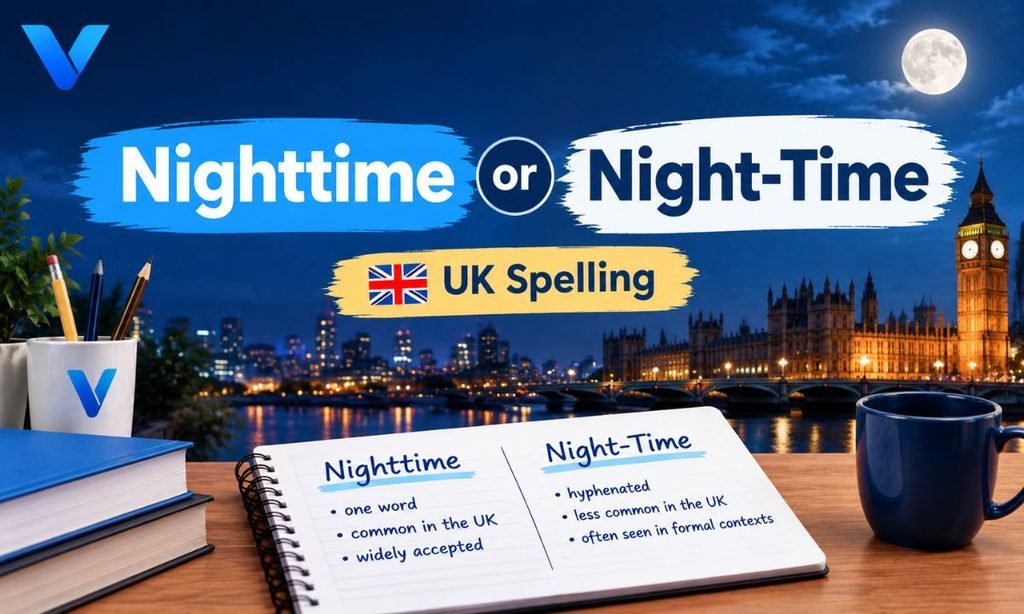
British English traditionally leans toward the hyphenated “night-time,” following a pattern seen in other UK spellings like long-term, short-term, and part-time. That said, modern British publications increasingly use “nighttime” without a hyphen, especially in digital and journalistic writing.
American vs British English: Any Differences?
Both Varieties Prefer “Nighttime”
Despite some historical divergence, both American and British English now lean toward the same general direction:
- American English: Strong, near-universal preference for “nighttime.”
- British English: Traditionally “night-time” (hyphenated), but “nighttime” is now widely accepted, especially in contemporary and digital writing.
Neither variety treats “night time” (two separate words) as a standard or preferred spelling in formal contexts.
Grammar Matters: How “Nighttime” Works in Sentences
“Nighttime” functions in two main grammatical roles:
- Noun: “The temperature drops sharply during nighttime.”
- Adjective (modifier): “We took a nighttime flight to save money.”
When used as a modifier before another noun, the closed compound form is strongly preferred over the two-word version.
- ✅ “a nighttime routine”
- ❌ “a night time routine”
Nighttime vs Night Time: Grammar
Grammatically, “night time” (written as two words) is more likely to appear as a noun phrase where “night” acts as a modifier of “time” — for example, “at night time” in casual speech. However, this construction is considered less polished than simply writing “at night” or “during nighttime.”
Common Mistakes Writers Make

- Writing “night time” as an adjective (e.g., “night time walk” instead of “nighttime walk”)
- Assuming spellcheck will always catch the two-word error — many tools don’t flag it
- Mixing spellings inconsistently within the same document
- Confusing regional preference (“night-time”) with incorrect spelling (“night time”)
Real-World Example Sentences That Work
- “Nighttime temperatures can drop below freezing in the desert.”
- “The city comes alive with nighttime markets and street food stalls.”
- “Doctors recommend limiting screen time before nighttime sleep.”
- “Night-time driving requires extra caution in fog.” (British style)
Comparisons: Better vs Worse
| Sentence | Verdict |
| “I enjoy nighttime reading.” | ✅ Correct, modern, professional |
| “I enjoy night-time reading.” | ✅ Acceptable in British English |
| “I enjoy night time reading.” | ❌ Outdated, avoid in formal writing |
Practical Guidelines You Can Use Today
Quick Rules to Remember
- Default to “nighttime” for American English and most modern writing.
- Use “night-time” if you’re writing in British English and want a more traditional style.
- Avoid “night time” as two separate words in professional or published content.
- Treat “nighttime” the same way you’d treat “daytime” or “bedtime” — as one word.
Checklist for Writers
- Am I using “nighttime” as a noun or adjective? Keep it one word.
- Am I writing for a British audience with a traditional style guide? Consider the hyphen.
- Did I check consistency across the whole document?
- Would a dictionary (Merriam-Webster, Cambridge) confirm my spelling?
Nighttime vs Night Time: Examples
| Context | Recommended Form |
| Business report | Nighttime |
| UK newspaper article | Night-time |
| Academic paper (US) | Nighttime |
| Casual text message | Either (informal context) |
| Marketing copy | Nighttime |
Wrap-Up: What to Remember
“Nighttime” is the modern, dictionary-approved standard for describing the hours of darkness, used confidently across American English and increasingly across British English. “Night-time” remains an accepted hyphenated variant in the UK, while “night time,” written as two separate words, is best reserved for casual speech rather than polished writing.
Nighttime vs Night Time: Oxford Dictionary
Oxford’s references have historically listed the hyphenated “night-time” as the primary British form, reflecting the UK’s broader habit of hyphenating compound time-related terms. However, Oxford’s learner and online dictionaries increasingly show “nighttime” as an accepted alternative, reflecting how usage continues to shift toward the closed compound.
FAQs
Q:Is “nighttime” or “night-time” the correct spelling in Australia?
Australian English generally follows British conventions, so “night-time” is common, though “nighttime” also appears frequently in modern Australian writing.
Q:Is “nighttime” or “night time” the correct spelling?
“Nighttime” is the correct, standard spelling in modern English; “night time” as two words is considered outdated and non-standard.
Q:What is the difference between “night” and “nighttime”?
“Night” refers to the general concept of darkness or a specific evening, while “nighttime” specifically denotes the period between sunset and sunrise.
Q:Is it midnight in Australia now?
Australia spans multiple time zones, so the current time varies by state; check a live time zone converter for Sydney, Perth, or Adelaide for an accurate answer.
Q:What is the biggest time zone in Australia?
Australian Eastern Standard Time (AEST), used by Queensland, New South Wales, Victoria, Tasmania, and the ACT, covers the largest population and most widely used zone.
Conclusion
Choosing between “nighttime,” “night-time,” and “night time” comes down to region and formality rather than meaning. For most writers, “nighttime” is the safest, most modern, and most widely accepted choice — whether you’re drafting a business email, a novel, or a blog post. Keep it consistent, match your audience’s regional style, and you’ll never second-guess this compound word again.










2 thoughts on “Nighttime vs Night Time: Difference, Grammar & Usage Explained”