If you’ve ever paused mid-sentence wondering whether to type “sizable” or “sizeable,” you’re not alone. This tiny spelling puzzle trips up students, bloggers, and even experienced business writers. The good news? Once you understand the simple rule behind it, you’ll never second-guess yourself again.
In this guide, you’ll learn exactly what each spelling means, why two versions exist, which one to use for your audience, and how top style guides handle the choice.
Why the Sizable vs Sizeable Spelling Question Still Matters
Spelling consistency shapes how professional your writing looks. A single inconsistent word can make a polished report feel careless, especially when it’s read by international audiences, editors, or clients.
Because “sizable” and “sizeable” are both technically correct, writers often mix them up in the same document without noticing. That inconsistency is what actually damages credibility — not the choice of spelling itself.
Read More:“Absolutely True”: Incredible Facts That Sound Too Good to Be True
Meaning of Sizable and Sizeable — No Difference in Definition
Here’s the simple truth: sizable and sizeable mean exactly the same thing.
Both words are adjectives that describe something fairly large, substantial, or considerable in size, amount, or extent. Neither spelling is “more correct” than the other — they’re regional variants of one word.
Definition: Fairly large; considerable in size, amount, or degree.
Examples:
- The company reported a sizable profit this quarter.
- She inherited a sizeable piece of land from her grandfather.
- They received a sizable donation from an anonymous donor.
- The town has a sizeable population of international students.
Notice how both sentences work identically — swap the spellings and the meaning doesn’t change at all.
Read More: Nighttime vs Night Time: Difference, Grammar & Usage Explained
Why Two Spellings Exist — The Real Linguistic History
The word comes from the noun “size” plus the suffix “-able,” which typically turns a root word into an adjective (think fixable, relatable, workable).
The spelling split traces back to the broader divergence between American and British English that began in the 18th and 19th centuries. Lexicographer Noah Webster pushed for simplified, streamlined American spellings — dropping silent or “unnecessary” letters wherever possible (think “color” instead of “colour,” or “center” instead of “centre”). British English, by contrast, tended to preserve older, more traditional spelling patterns.
“Sizable” fits Webster’s simplification pattern, while “sizeable” kept the silent “e” from the root word “size” before adding “-able.” Neither version is a modern invention — both have appeared in dictionaries and literature for well over a century.
Sizable vs Sizeable — The Quick Clear Answer
| Aspect | Sizable | Sizeable |
| Region | American English | British English |
| Meaning | Fairly large / considerable | Fairly large / considerable |
| Common in | US, Canada (mixed) | UK, Australia, India, Commonwealth countries |
| Style guide preference | AP Style, US dictionaries | Oxford, Cambridge dictionaries |
| Example | “A sizable investment” | “A sizeable investment” |
Quick regional comparison
- United States: sizable
- United Kingdom: sizeable
- Canada: both appear, with sizable slightly more common in formal writing
- Australia & New Zealand: sizeable is standard
- India & South Asia: sizeable is more common due to British English influence
Sizeable synonym
If you want to avoid the spelling debate entirely, several synonyms work well in most contexts:
- Substantial
- Considerable
- Large
- Ample
- Significant
- Hefty
- Respectable (as in “a respectable sum”)
Regional Usage Patterns — Where Each Spelling Dominates
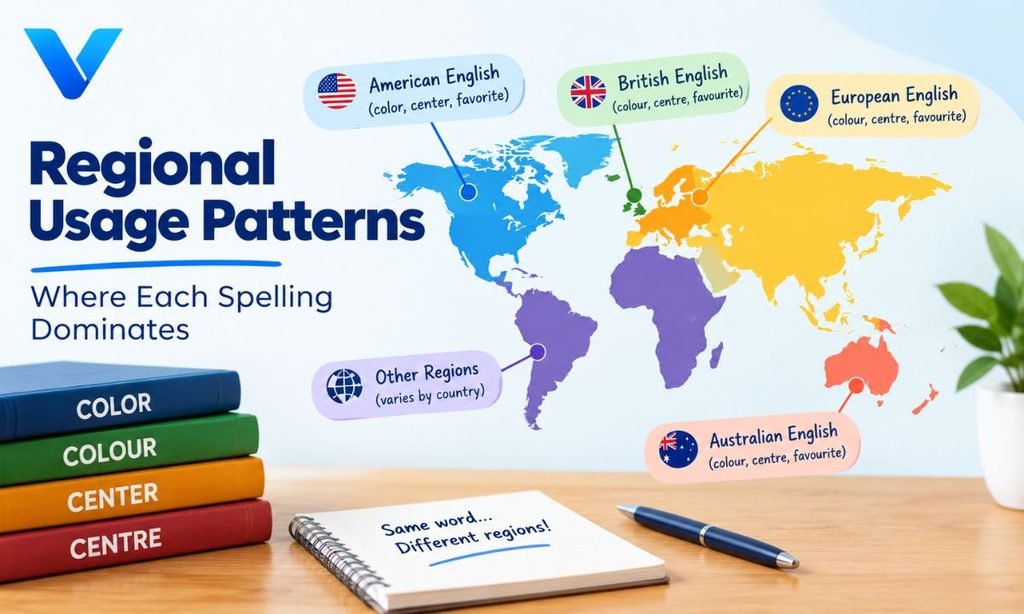
Regional preference is the single biggest factor in choosing between the two spellings. Publications, newspapers, and institutions generally follow the dialect of their home country.
- US-based outlets like The Wall Street Journal and The New York Times almost always use sizable.
- UK-based outlets like The Guardian and BBC News consistently use sizeable.
- Commonwealth countries (Australia, India, South Africa) typically follow the British pattern.
If you’re writing for a specific market, matching the local spelling convention signals attention to detail and cultural awareness.
Popularity Trends — Which Spelling Wins Online
Globally, sizable tends to edge out sizeable in raw search and usage volume, largely because American English dominates online content production. However, when you filter by UK or Commonwealth-based websites, sizeable remains firmly in the lead.
Estimated online usage comparison
| Region/Platform | Preferred Spelling | Approximate Dominance |
| US publications | Sizable | ~85% |
| UK publications | Sizeable | ~80% |
| Global web content | Sizable | Slightly higher overall |
| Academic journals (UK-based) | Sizeable | Majority |
| Academic journals (US-based) | Sizable | Majority |
Does Spelling Affect Meaning, Tone, or Reader Perception
No — the spelling itself doesn’t change meaning or tone. Both words carry the same neutral, moderately formal register and can be used in casual, business, or academic writing.
However, perception can shift subtly based on audience expectations. A British reader encountering “sizable” might briefly register it as “American-style” writing, and vice versa. This isn’t a grammar error, but it can create a small sense of dissonance if the rest of your content follows the opposite dialect.
Real-World Usage of Sizable and Sizeable Across Industries
- Finance & business: “The merger created a sizable competitive advantage.” / “Investors secured a sizeable return.”
- Real estate: “The property sits on a sizable plot of land.”
- Journalism: “A sizeable crowd gathered outside the courthouse.”
- Academic writing: “The study found a sizeable correlation between the two variables.”
- Marketing copy: “Enjoy sizable savings this holiday season.”
Across all these industries, the word functions the same way — only the letter count changes.
When the Sizable vs Sizeable Choice Truly Matters
The choice matters most in these situations:
- Formal business documents aimed at a specific regional audience
- Academic papers following a required style guide
- Branded content where consistency across a website or publication is expected
- Legal or contractual writing, where precision and uniformity matter
- SEO content targeting a specific country’s search audience
In casual writing, emails, or personal blogs, either spelling is perfectly acceptable.
Style Guide Preferences That Shape Writing Standards
- AP Style (Associated Press): Recommends “sizable,” aligning with American English conventions.
- Oxford Style Guide: Recommends “sizeable,” aligning with British English conventions.
- Chicago Manual of Style: Defaults to “sizable” as the American standard.
- Cambridge Dictionary: Lists “sizeable” as the primary British form, with “sizable” as the American variant.
Quick reference table
| Style Guide | Preferred Spelling |
| AP Style | Sizable |
| Chicago Manual of Style | Sizable |
| Oxford Style Guide | Sizeable |
| Cambridge Dictionary | Sizeable |
| Merriam-Webster | Sizable |
Sizeable pronunciation
Both spellings are pronounced identically: /ˈsaɪ.zə.bəl/ (SY-zuh-buhl). There is no audible difference between the American and British versions — the distinction exists only in writing.
Practical Writing Tips for Using Sizable or Sizeable Naturally
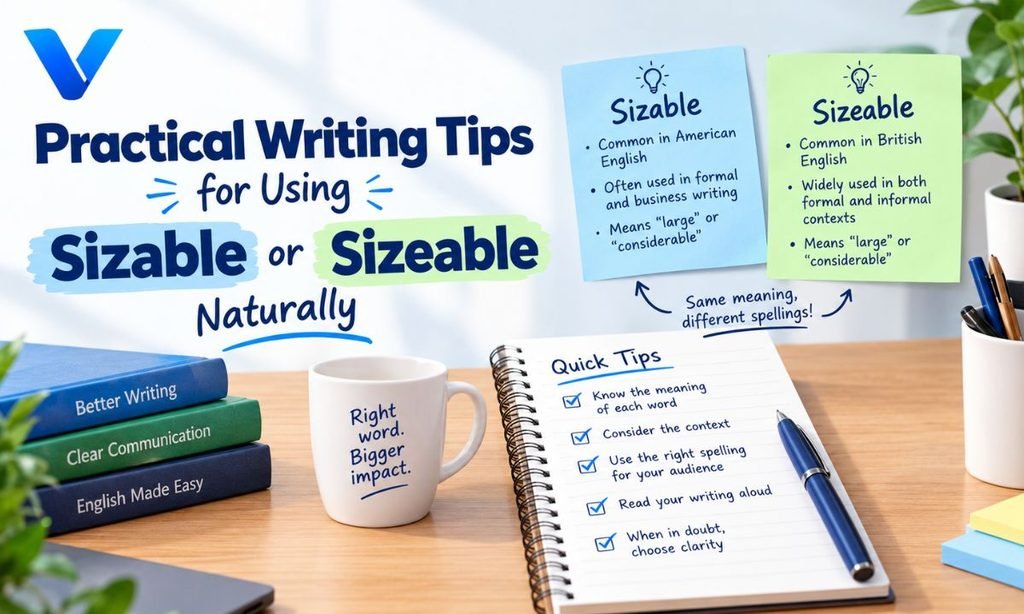
- Identify your audience’s location before you start writing.
- Set your spell-checker to the correct English variant (US or UK).
- Use a simple memory trick: sizeable has an extra “e,” like England.
- Stick to one spelling throughout an entire document or website.
- When in doubt for a global audience, “sizable” is the more widely recognized form online.
Understanding the “-able vs -eable” Spelling Pattern
This same pattern shows up in other English words derived from a root ending in a silent “e”:
- Like → likable / likeable
- Love → lovable / loveable
- Move → movable / moveable
- Size → sizable / sizeable
In each case, American English tends to drop the silent “e,” while British English tends to retain it.
Pronunciation Reality — Spoken English Shows No Difference
Since spelling differences don’t affect pronunciation, spoken English offers no clue about which version a speaker prefers in writing. This is purely a written-language distinction, unlike words such as “schedule,” which are pronounced differently across dialects.
How Inconsistent Spelling Weakens Professional Content
Switching between “sizable” and “sizeable” within the same article, report, or website creates a subtle but noticeable inconsistency. Readers may not consciously flag it, but it can quietly undermine the sense of polish and editorial care in your content. Search engines and editors alike tend to favor consistent language use across a domain or publication.
Quick Decision Checklist — Choosing Sizable or Sizeable
Step-by-step decision guide
- Identify your audience’s country (US vs UK/Commonwealth).
- Check your organization’s style guide, if one exists.
- Set your word processor’s language/dialect setting accordingly.
- Search your document for the other spelling to catch inconsistencies.
- Default to “sizable” if writing for a broad, international, or unspecified audience.
Sizeable antonym
Common antonyms include:
- Small
- Tiny
- Minor
- Negligible
- Insignificant
- Modest
Case Study — Corporate Writing Consistency in Action
A mid-sized marketing agency serving both US and UK clients once audited its blog archive and found “sizable” and “sizeable” used almost equally across articles — sometimes even within the same post. After standardizing content by client region (sizable for US clients, sizeable for UK clients), the agency reported cleaner editorial reviews and fewer client style queries. The lesson: the fix wasn’t choosing one “correct” spelling — it was applying the right one consistently per audience.
Common Mistakes Writers Make with Sizable vs Sizeable
- Mixing both spellings in the same document
- Assuming one version is grammatically wrong
- Ignoring the target audience’s regional dialect
- Forgetting to update spell-check language settings
- Confusing “sizable/sizeable” with unrelated words like “scalable”
Future Trends — Will One Spelling Eventually Dominate
Given the growing global reach of American media, tech platforms, and search engines, “sizable” may continue gaining ground in international online content. However, “sizeable” remains deeply established in British, Australian, and Commonwealth institutions, meaning both spellings are likely to coexist for the foreseeable future. Language evolves slowly, and regional identity in spelling tends to persist even amid globalization.
FAQs
Q:What is the opposite of sizable?
Common opposites include small, tiny, minor, and negligible.
Q:Which is correct, “sizable” or “sizeable”?
Both are correct; “sizable” is preferred in American English and “sizeable” in British English.
Q:Does British English use S instead of Z?
Not in this word — the difference here is the extra “e,” not an S/Z swap (that pattern applies to words like “realise” vs “realize”).
Q:What is the British spelling of “sizeable”?
“Sizeable” is already the British spelling; it retains the “e” from the root word “size.”
Q:Is it sizeable or sizable?
Either is acceptable — choose based on your audience’s regional English variant.
Conclusion
At the end of the day, sizable and sizeable are two correct spellings of the same word, separated only by geography, not grammar. Use “sizable” for American audiences and “sizeable” for British or Commonwealth readers, and most importantly, stay consistent throughout your writing. Get that right, and this small spelling choice will never distract from your message again.










2 thoughts on “Sizable vs Sizeable: Difference, Definition & Examples”