Have you ever paused mid-email, unsure whether to write “a question about,” “a question on,” or “a question regarding” your topic? You’re not alone. This tiny preposition choice trips up native speakers and English learners alike, and it can quietly change how professional — or casual — your message sounds.
This guide breaks down the real difference between these three phrases, shows you exactly when to use each one, and gives you a simple system so you never have to second-guess yourself again.
Why Question Word Choice Matters in Communication
Prepositions are small words, but they carry big signals. The one you choose after “question” tells your reader something about your tone before they even process your actual message.
- A casual “question about” feels approachable and friendly.
- A structured “question on” feels academic or topic-focused.
- A formal “question regarding” feels polished and businesslike.
Since so much communication today happens over email, chat, and written requests, getting this small detail right helps your message land the way you intend — whether that’s warm, neutral, or strictly professional.
Read More:Some of Whom or Some of Who? Correct Grammar Explained
Core Grammar Insight: How “Question” Combines With Prepositions
English doesn’t have a strict rulebook dictating which preposition must follow “question.” Instead, these pairings are collocations — word combinations that sound natural to native speakers because of habitual use, not because of a fixed grammatical law.
That’s why all three phrases are grammatically correct. The differences lie in tone, formality, and framing, not in right-versus-wrong grammar.
Question About vs Question On vs Question Regarding Grammar
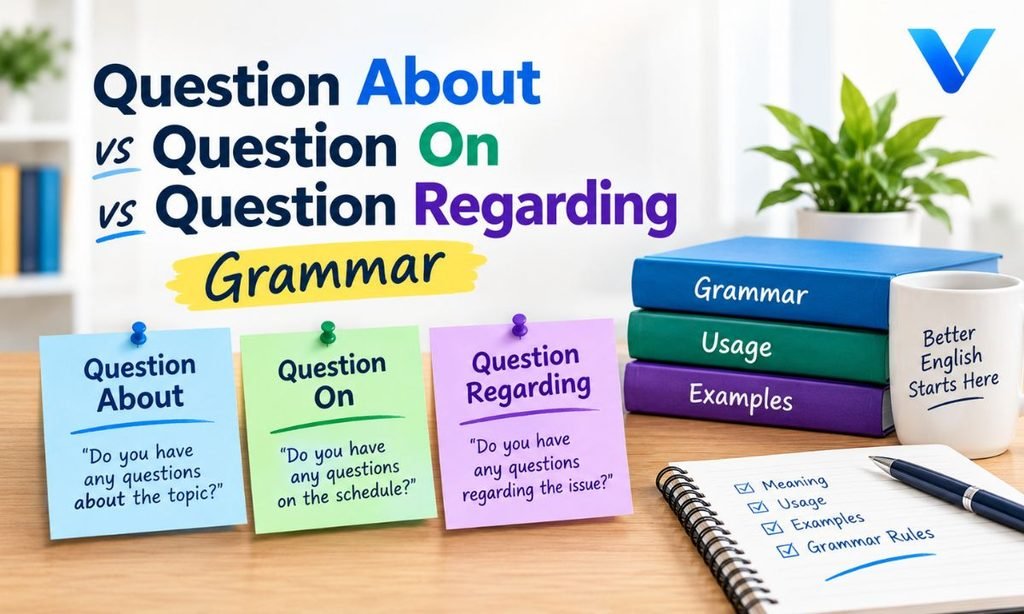
Here’s the short version before we go deeper:
| Phrase | Tone | Best Used For |
| Question about | Casual, everyday | General topics, broad or personal inquiries |
| Question on | Neutral to formal | Specific subjects, academic or structured topics |
| Question regarding | Formal, professional | Business, official, or precise correspondence |
Now let’s unpack each one.
“Question About” — The Most Natural and Common Form
“Question about” is the default, all-purpose choice in English. It works in nearly any setting — casual conversation, customer service, emails, and everyday writing — because it’s flexible and doesn’t force a formal tone.
Read More:“Thanks for Asking” Explained: Meaning, Examples & Responses
Examples in Context
- “I have a question about your return policy.”
- “She asked a question about the homework assignment.”
- “Do you have a question about how this works?”
Limitations
“Question about” can feel too casual for high-stakes formal writing, such as legal correspondence or official business letters, where more precise or polished phrasing is expected.
“Question On” — Topic Framing and Structured Tone
“Question on” narrows the focus to a specific subject, field, or defined topic. It’s common in academic, technical, and structured professional contexts where the “topic” itself is the anchor of the sentence.
Examples in Context
- “The exam included a question on thermodynamics.”
- “He answered questions on the history of jazz.”
- “She raised a question on the new compliance guidelines.”
Limitations
Using “question on” for casual, everyday topics can sound stiff or overly academic. Saying “I have a question on your weekend plans” feels unnatural compared to “a question about your weekend plans.”
“Question Regarding” — Formal, Precise, and Professional
“Question regarding” is the most formal of the three. It signals professionalism, distance, and precision — ideal for business emails, official applications, and situations where clarity and respect matter most.
Examples in Context
- “I have a question regarding the terms outlined in the contract.”
- “We received a question regarding your recent application.”
- “Please clarify the question regarding the payment schedule.”
Limitations
Overusing “question regarding” in casual conversation can come across as cold, distant, or unnecessarily stiff. It’s best reserved for formal writing rather than everyday speech.
Question On or About?
When you’re unsure whether to use “on” or “about,” ask yourself: Am I referring to a defined subject or field (use “on”), or something more general or conversational (use “about”)? In most everyday situations, “about” is the safer, more natural default.
Direct Comparison: Question About vs Question On vs Question Regarding
| Feature | Question About | Question On | Question Regarding |
| Formality level | Low to medium | Medium to high | High |
| Common setting | Everyday speech, general writing | Academic, technical, structured topics | Business, legal, official communication |
| Flexibility | Very flexible | Moderately flexible | Less flexible |
| Example use case | Customer support, casual emails | Exams, research, subject-specific queries | Contracts, official letters, applications |
| Risk if misused | Rarely sounds wrong | Can sound overly formal casually | Can sound distant or robotic |
Real-World Usage Scenarios
- Customer service email: “I have a question about my recent order.” (Friendly, approachable)
- University exam: “Answer the question on Renaissance art.” (Topic-specific, academic)
- Job application follow-up: “I have a question regarding the interview timeline.” (Formal, respectful)
Common Mistakes and Misconceptions
Frequent Mistakes
- Using “question regarding” in casual texts or chats, making the message feel unnecessarily stiff.
- Using “question on” for general personal topics instead of defined subjects.
- Assuming all three phrases are fully interchangeable in every context.
Common Misconceptions
- Misconception: These phrases follow strict grammar rules. Reality: They’re collocations shaped by convention and tone, not fixed grammar.
- Misconception: “Regarding” is always the “correct” formal choice. Reality: Overusing it can sound unnatural or overly bureaucratic.
Quick Fix Approach
If you’re stuck, use this shortcut:
- Default to “about” for general, everyday communication.
- Switch to “on” when referring to a specific subject, topic, or field of study.
- Reserve “regarding” for formal, professional, or official writing.
How to Choose the Right Phrase Step by Step
- Identify your audience. Formal recipient? Lean toward “regarding.” Casual recipient? Use “about.”
- Check the context. Academic or technical topic? “On” often fits best.
- Consider the medium. Emails to colleagues can be neutral; legal or business documents call for formality.
- Read it aloud. If it sounds stiff for the situation, simplify to “about.”
- Match the tone of surrounding text. Consistency matters more than the “perfect” word.
Cultural and Contextual Differences
British vs American English
Usage patterns of “about,” “on,” and “regarding” are largely similar across British and American English, though British professional writing tends to lean slightly more toward formal phrasing like “regarding” in workplace correspondence, while American English often favors the more direct and casual “about” even in semi-formal settings.
Best Practices for Effective Questioning
- Keep questions concise and specific, regardless of which preposition you choose.
- Match formality to the relationship and setting, not just habit.
- Avoid stacking formal phrases unnecessarily — one “regarding” per message is usually enough.
- Read your message from the recipient’s perspective before sending.
Question About vs Question On vs Question Regarding Examples
| Situation | Recommended Phrase | Example Sentence |
| Asking a friend something | About | “Question about your trip — when do you leave?” |
| Academic exam or research | On | “A tricky question on cell biology.” |
| Formal business email | Regarding | “A question regarding the invoice details.” |
| Customer support chat | About | “I have a question about billing.” |
| Conference topic session | On | “Questions on renewable energy policy.” |
Practice Tips for Mastering Question Forms
- Rewrite five casual sentences using all three phrases and compare how the tone shifts.
- Read professional emails and note which phrase appears — notice the pattern.
- Practice switching tone: write the same question casually, academically, and formally.
Quick Reference Summary Table
| Phrase | Formality | Typical Use |
| Question about | Low | General, everyday topics |
| Question on | Medium | Specific subjects, academic settings |
| Question regarding | High | Business, formal, official writing |
Final Insight: The Real Art of Asking Questions
Choosing between “about,” “on,” and “regarding” isn’t about memorizing a rigid rule — it’s about reading the room. The right preposition helps your question match your intent, your audience, and the tone you want to set. Once you internalize the pattern, the choice becomes instinctive rather than something you have to stop and think about.
FAQs
Q:When to use “about” or “on”?
Use “about” for general or everyday topics, and “on” when referring to a specific subject, field, or structured topic like an exam or report.
Q:Is it “questions on” or “questions about”?
Both are correct; “questions on” fits specific or academic topics, while “questions about” works better for general, everyday inquiries.
Q:Which is correct: “on,” “about,” or “regarding”?
All three are grammatically correct — the right choice depends on the formality and context of your message, not strict grammar rules.
Q:How do I use “on”?
Use “on” when your question is about a defined subject, topic, or field, such as “a question on tax law” or “a question on chapter three.”
Q:What is the meaning of “regarding”?
“Regarding” means “concerning” or “in relation to,” and it’s typically used to introduce a topic in formal or professional communication.
Conclusion
“Question about,” “question on,” and “question regarding” all serve the same basic purpose — introducing a topic — but each carries a distinct tone. “About” keeps things natural and approachable, “on” adds subject-specific focus, and “regarding” signals formality and precision. By matching your phrase to your audience and setting, you’ll communicate more clearly and sound exactly as professional (or casual) as the moment calls for.









2 thoughts on “Question About vs Question On vs Question Regarding: What’s the Difference?”