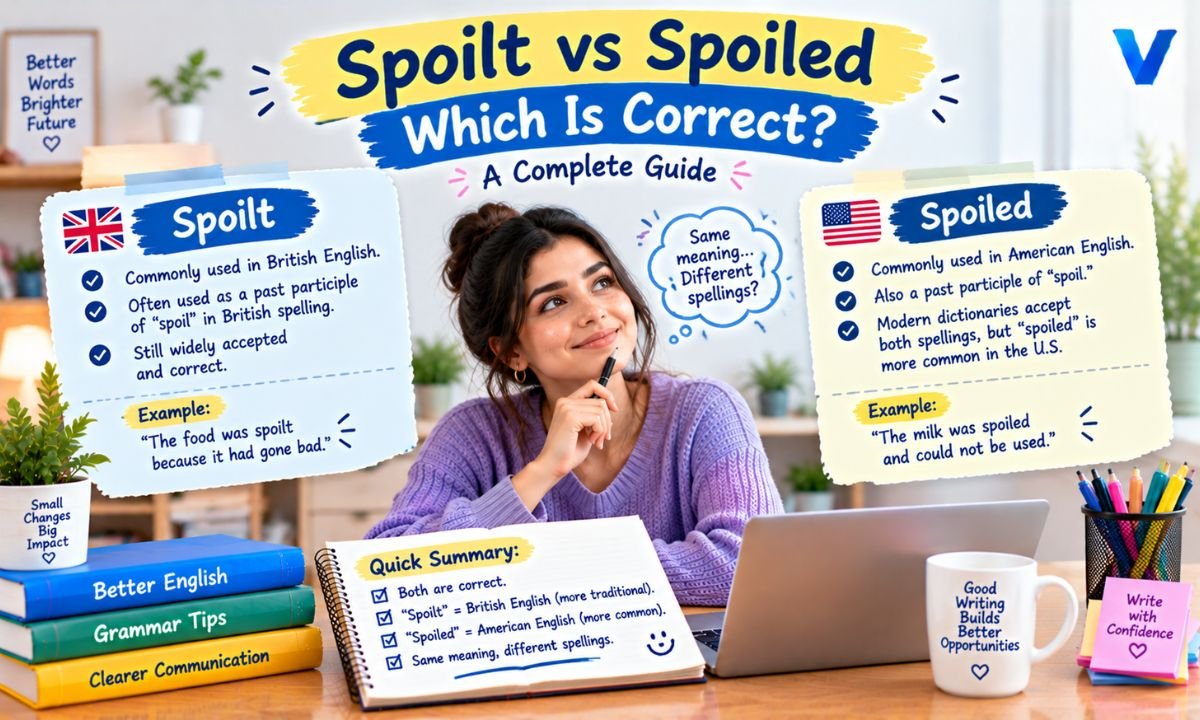
If you’ve ever paused mid-sentence wondering whether to write “the milk has spoiled” or “the milk has spoilt,” you’re not alone. This is one of the most common spelling mix-ups in English, and the honest answer is: both are correct — it just depends on where your reader lives.
This guide breaks down the grammar, the regional split, the etymology, and the practical rules you need so you never second-guess yourself again.
What Do “Spoilt” and “Spoiled” Actually Mean?
Both words come from the verb spoil, which carries a few related meanings:
- To damage or ruin something (“the rain spoiled our picnic”)
- To go bad or rot (“the fish has spoiled”)
- To indulge someone excessively, especially a child (“her grandparents spoiled her”)
“Spoiled” and “spoilt” are simply two different past tense and past participle forms of the same verb. Neither one changes the meaning of the sentence — the only difference is spelling convention.
Read More:Receiver vs Reciever: How to Spell It Correctly
British and Commonwealth English: Why “Spoilt” Still Appears
In the UK, Australia, New Zealand, and much of the Commonwealth, “spoilt” survives as a common irregular verb form, especially in speech and casual writing. It’s a holdover from Old English’s irregular verb patterns, many of which have gradually been replaced by the regular “-ed” ending over the past two centuries.
Regional preference breakdown
| Region | Preferred Verb Form | Preferred Adjective Form |
| United States | Spoiled | Spoiled |
| Canada | Spoiled | Spoiled |
| United Kingdom | Spoiled (verb) | Spoilt (adjective) |
| Australia | Spoiled (verb) | Spoilt (adjective) |
| New Zealand | Spoiled (verb) | Spoilt (adjective) |
Even in British English, “spoiled” is actually used more often overall — “spoilt” tends to cluster in specific roles, like describing a child or an object, rather than every past-tense use of the verb.
Read More: Having vs Having Had: Meaning, Grammar Rules & Examples
Spoilt vs spoiled examples
- The storm spoiled the wedding reception. (American and British both accept this.)
- She’s such a spoilt brat. (Common in British English.)
- He’s such a spoiled brat. (Common in American English.)
- The leftovers have spoiled in the fridge.
- Don’t let this news spoil your day.
Grammar Breakdown: Past Tense vs Past Participle
Here’s where a lot of the confusion actually starts. “Spoil” is what’s called a dual-form verb — it has two accepted forms for both the simple past tense and the past participle:
- Simple past tense: I spoiled the surprise. / I spoilt the surprise.
- Past participle: The food has spoiled. / The food has spoilt.
Grammatically, neither form is “more correct” than the other. The difference is stylistic and regional, not structural.
Examples that prove it
| Sentence Type | American Style | British Style |
| Simple past | The rain spoiled the game. | The rain spoiled the game. |
| Present perfect | The eggs have spoiled. | The eggs have spoilt. |
| Adjective before noun | a spoiled child | a spoilt child |
| Passive voice | The trip was spoiled by traffic. | The trip was spoilt by traffic. |
Spoilt vs Spoiled as Adjectives
This is actually where the two words diverge the most. When “spoiled” or “spoilt” functions as an adjective describing a person (usually a child) who has been overly indulged, British English leans noticeably toward “spoilt,” while American English almost always uses “spoiled.”
Spoilt vs spoiled brat
- British English: “He’s a spoilt brat who never says thank you.”
- American English: “He’s a spoiled brat who never says thank you.”
Both phrases mean exactly the same thing: someone who has been given too much and has come to expect special treatment. Pick the version that matches your audience or publication’s style guide.
Dual-Form Verbs: Spoil Isn’t Alone
“Spoil” belongs to a small group of English verbs that have kept two acceptable past-tense spellings — one ending in “-ed” and one ending in “-t.” These verbs are more common in British English, where older irregular patterns held on longer.
Common examples
- Burn → burned / burnt
- Learn → learned / learnt
- Dream → dreamed / dreamt
- Smell → smelled / smelt
- Spell → spelled / spelt
- Leap → leaped / leapt
Notice the pattern: American English almost always prefers the “-ed” version, while British English keeps both forms alive, often using the “-t” version for adjectives and the “-ed” version for the plain past tense.
Why Does the Confusion Exist at All?
The confusion exists because English has been simplifying its irregular verbs for centuries, but the process hasn’t finished — and it hasn’t happened at the same speed everywhere. American English standardized faster and more thoroughly around the regular “-ed” pattern. British English kept more of the older irregular endings, particularly in informal and spoken contexts, which is why both forms still circulate today.
The Etymology of “Spoil”: How Both Forms Came to Be
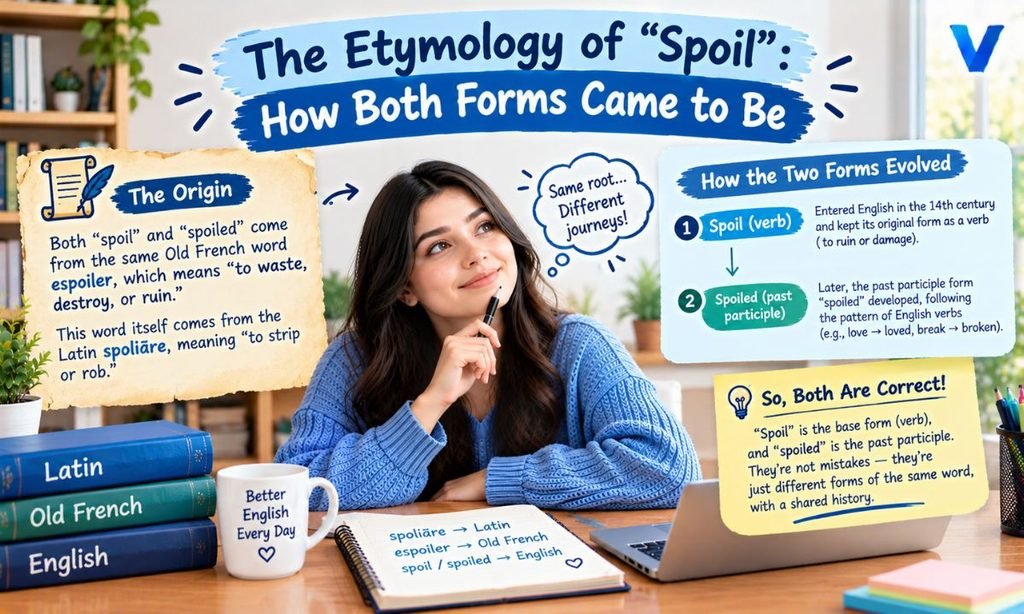
“Spoil” traces back to the Old French word espoillier, meaning to strip or plunder, which itself came from the Latin spoliare (“to rob” or “to despoil”). When the word entered Middle English, it followed the same irregular verb pattern as many other verbs of the time, which is how “spoilt” developed. As English grammar evolved toward regular “-ed” endings, “spoiled” gradually became the dominant form — first in America, and more slowly in Britain.
American English Preference: Why “Spoiled” Dominates
In the United States, “spoiled” is used across every context — as a verb and as an adjective. “Spoilt” is rarely seen in American publications, and most U.S. style guides, including AP Style and the Chicago Manual of Style, favor “spoiled” exclusively. If you’re writing for a U.S. audience, “spoiled” is always the safer, more expected choice.
Spoilt vs spoiled synonym
If you want to avoid the debate altogether, here are some synonyms depending on the meaning you intend:
- For “ruined”: ruined, wrecked, marred, damaged
- For “rotten”: rotten, decayed, gone bad, off
- For “overindulged”: pampered, coddled, indulged, mollycoddled
Does Tone or Formality Change Between Spoilt and Spoiled?
Not really — the tone stays the same. Neither word sounds more formal or more casual than the other. The choice is purely about regional spelling convention, not about register. That said, using “spoilt” in an American business document, or “spoiled” in a formal British publication, can look like an inconsistency to a careful editor, so audience matters more than tone here.
Real Usage Examples in Natural Context
- “The picnic was completely spoiled by the sudden downpour.” (US and UK)
- “I think the milk’s gone off — it’s spoilt.” (UK, informal)
- “Years of luxury had spoiled him for ordinary life.” (US)
- “The ballot was spoiled and couldn’t be counted.” (UK, common in election reporting)
- “She’s spoilt for choice with so many job offers.” (UK idiom — this one rarely appears as “spoiled” even in American writing)
What Dictionaries and Style Guides Actually Recommend
Major dictionary guidance
- Merriam-Webster (American): Lists “spoiled” as the standard form; “spoilt” is marked as a chiefly British variant.
- Oxford Dictionary (British): Lists both forms, noting “spoiled” as the more frequent verb form and “spoilt” as common in adjective use.
- Cambridge Dictionary: Confirms both spellings are correct, with “spoilt” flagged as mainly British.
Style guides
- AP Style (US journalism): Use “spoiled.”
- Chicago Manual of Style (US): Use “spoiled.”
- Oxford Style Manual (UK): Either form is acceptable; consistency within a document matters most.
Common Mistakes Writers Make
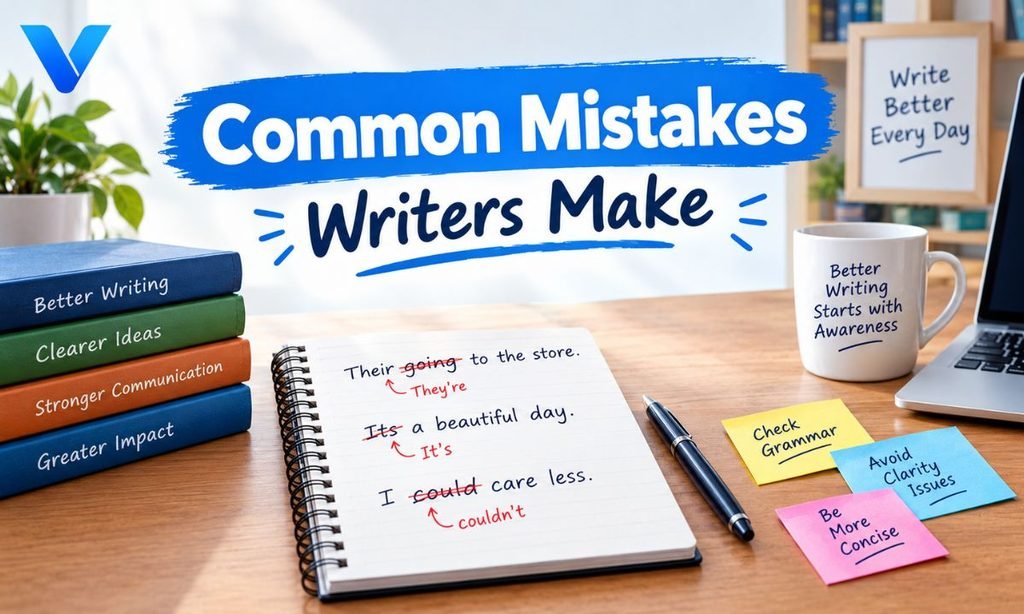
Frequent errors to avoid
- Switching between “spoilt” and “spoiled” within the same document.
- Using “spoilt” in formal American writing where it looks like a typo.
- Assuming one spelling is “wrong” — both are standard English.
- Forgetting that some fixed idioms (like “spoilt for choice”) rarely convert to the “-ed” form even in American English.
- Overusing dual-form verbs inconsistently (e.g., “burnt” but “learned” in the same piece).
Spoilt vs spoiled UK
In UK English specifically, remember the informal rule of thumb: use “spoiled” for the plain verb form, and reach for “spoilt” when describing a person, object, or outcome as an adjective — though both are broadly accepted either way.
Practical Usage Guide: When to Use Spoilt vs Spoiled
- Writing for a U.S. audience or publication? Use spoiled every time.
- Writing for a UK, Australian, or NZ audience? Either works, but spoilt fits naturally as an adjective.
- Writing academic, legal, or business content? Check the house style guide first.
- Writing fiction or dialogue set in Britain? “Spoilt” can add authentic regional flavor.
- Unsure of your audience? Default to spoiled — it’s understood everywhere.
Quick Reference Table
| Situation | Recommended Word |
| American audience (any use) | Spoiled |
| British adjective (“spoilt child”) | Spoilt |
| British verb (“the food spoiled”) | Spoiled |
| Global/mixed audience | Spoiled |
| Idiom “spoilt for choice” | Spoilt |
| Formal international business writing | Spoiled |
Practice Section: Test Yourself
Try filling in the blank with the form that fits best for a general international audience:
- The bad weather ______ our vacation plans.
- He’s a ______ only child who gets everything he wants.
- The leftover soup has ______ in the fridge.
- She was ______ for choice with three excellent job offers.
(Answers: 1. spoiled, 2. spoiled/spoilt depending on audience, 3. spoiled, 4. spoilt)
Consistency Beats Preference
At the end of the day, this isn’t really a grammar rule you need to memorize — it’s a style decision. Whichever form you pick, the golden rule is consistency. Don’t switch between “spoiled” and “spoilt” within the same article, email, or book. Pick one based on your audience, note it in your style guide if you have one, and stick with it.
FAQs
Q:Is it spoilt or spoiled on my birthday?
Either works. Americans typically write “spoiled on my birthday,” while British English speakers often say “spoilt on my birthday.”
Q:Is someone spoilt or spoiled?
Both are correct adjectives for an overindulged person. “Spoiled” is standard in American English, “spoilt” is common in British English.
Q:Is spoiled grammatically correct?
Yes, “spoiled” is grammatically correct everywhere and is the only accepted form in American English.
Q:Does spoiled mean rotten?
Yes, when referring to food, “spoiled” means it has gone bad or rotten and is no longer safe to eat.
Q:What is a better way to say spoiled?
Depending on context, try “ruined,” “rotten,” “pampered,” or “indulged” as alternatives.
Conclusion
“Spoilt” and “spoiled” are two branches of the same word, split mainly along regional lines rather than rules of grammar. Americans should stick with “spoiled” in all its forms, while British, Australian, and New Zealand writers can comfortably use “spoilt,” especially as an adjective. The real key to sounding polished isn’t picking the “correct” spelling — it’s picking one and using it consistently throughout your writing.









3 thoughts on “Spoilt vs Spoiled: Which Is Correct? A Complete Guide”