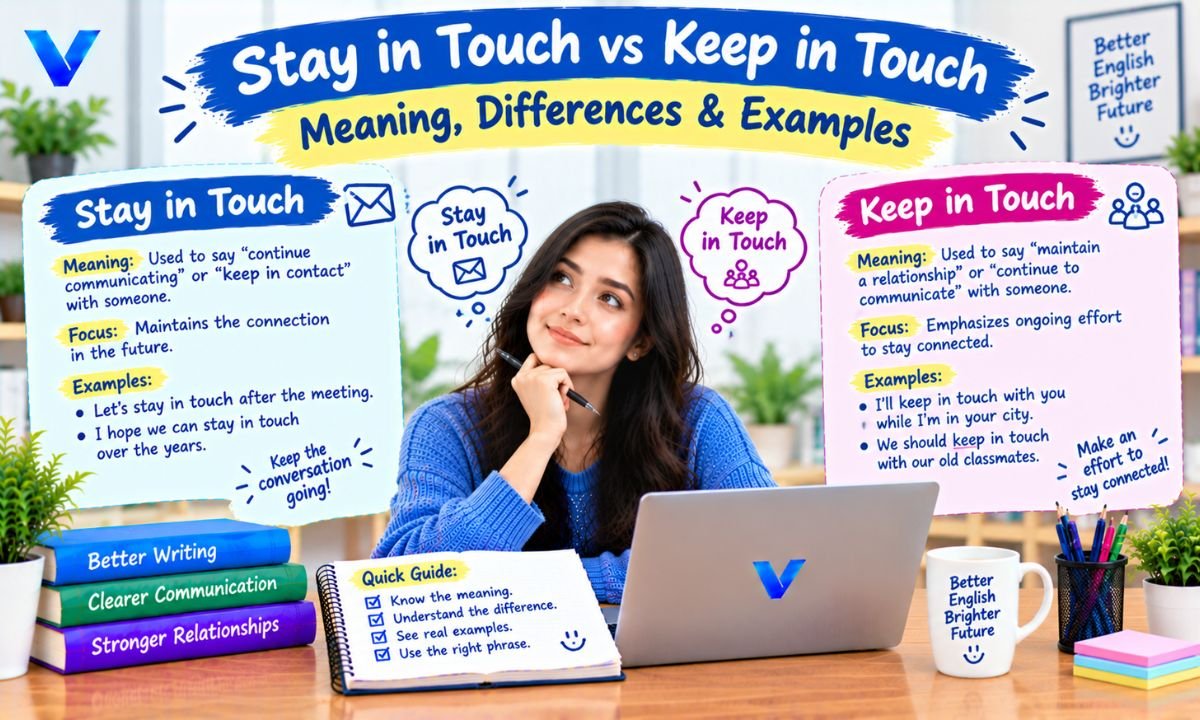
Have you ever ended an email with “let’s stay in touch,” then paused and wondered if “keep in touch” would have sounded better? You’re not alone. These two phrases show up everywhere — job interviews, farewell messages, networking events, and casual texts — yet most people use them without ever thinking about what each one actually signals.
The short answer: both phrases mean the same core thing — continuing communication with someone. But the tone, the implied effort, and the emotional weight behind them are different enough to matter, especially in professional writing. This guide breaks down exactly when to use each phrase, why native speakers instinctively pick one over the other, and how to avoid sounding either too formal or too vague.
“Stay in Touch” vs “Keep in Touch” Meaning
At their core, both expressions describe the intention to maintain contact with someone after a conversation, meeting, or relationship pauses. If someone says either phrase to you, they mean roughly the same thing: “I want us to remain connected.”
- Stay in touch implies a state — something that continues naturally, without a fixed plan.
- Keep in touch implies an action — something that requires ongoing effort to sustain.
That single grammatical distinction (state vs. action) is where nearly every other difference in tone, formality, and expectation comes from.
Read More:“I Sent” vs “I Have Sent” vs “I Had Sent” – Which One Is Correct?
The Shared Meaning: Where “Stay in Touch” and “Keep in Touch” Overlap
Before splitting hairs over nuance, it’s worth noting how much these two phrases actually share:
- Both express a desire to maintain a relationship or connection.
- Both are used as polite closings in emails, texts, and conversations.
- Both are grammatically correct and commonly interchangeable in casual speech.
- Neither phrase legally or socially obligates the other person to respond on a schedule.
In everyday conversation, swapping one for the other rarely causes confusion. The difference only becomes noticeable in contexts where tone and intent carry weight — like professional emails, farewells, or long-distance relationships.
Read More: Modeling vs Modelling: Which Spelling Is Correct?
“Stay in Touch” vs “Keep in Touch” Grammar
Grammatically, the two phrases follow the same sentence structure and can be used interchangeably in most cases:
| Element | Stay in Touch | Keep in Touch |
| Verb type | Linking/stative verb (“stay”) | Action verb (“keep”) |
| Implies | A continuing condition | An ongoing effort |
| Common structure | Stay in touch + with someone | Keep in touch + with someone |
| Formality level | Slightly casual, warm | Slightly more deliberate |
| Typical grammar mood | Suggestion, hope | Suggestion, request |
Both phrases can be used in the imperative (“Stay in touch!”), future tense (“I’ll keep in touch”), or as a shared decision (“Let’s stay in touch” / “Let’s keep in touch”).
“Stay in Touch” vs “Keep in Touch” Examples

Here’s how each phrase looks in real sentences:
Stay in touch examples:
- “It was so nice catching up — let’s stay in touch!”
- “Please stay in touch once you move abroad.”
- “We don’t talk every week, but we always stay in touch.”
Keep in touch examples:
- “Please keep in touch while you’re traveling, just so we know you’re safe.”
- “I’ll keep in touch about the project timeline.”
- “We agreed to keep in touch every couple of weeks.”
Notice how “keep in touch” pairs more naturally with a specific reason or expectation, while “stay in touch” works well as a general, open-ended sentiment.
Breaking Down “Stay in Touch”: Meaning, Implication, and Emotional Weight
“Stay in touch” carries a relaxed, affectionate tone. It suggests that the relationship itself matters more than the frequency of contact. When someone says it, they’re usually communicating:
- Genuine enjoyment of your interaction
- A hope that the connection continues naturally
- No pressure or fixed schedule attached
It’s the phrase you hear at the end of a heartfelt goodbye, a graduation, or a farewell party — moments where warmth matters more than logistics.
When It’s Most Appropriate
- Saying goodbye to a friend, classmate, or former coworker
- Ending a personal conversation on a warm note
- Situations where future contact is hoped for but not guaranteed
- Casual, emotionally sincere farewells
Breaking Down “Keep in Touch”: Meaning, Implication, and Social Pressure
“Keep in touch” leans slightly more intentional. It suggests an active effort — a mutual understanding that communication should continue, sometimes for a specific reason (a project, a shared plan, or ongoing collaboration).
Because “keep” is an action verb, the phrase subtly implies responsibility. It can feel like a soft request rather than just a hope, especially in professional or transactional contexts.
When It’s Most Appropriate
- Closing a professional email where follow-up is expected
- Networking situations where you want to signal reliability
- Situations involving a defined reason to reconnect (a job opportunity, a referral, a shared project)
- Family members checking in during travel or relocation
Frequency and Follow-Through: What Each Phrase Implies About Action

One of the most practical differences lies in what each phrase implies about how often — and how deliberately — people will actually communicate going forward.
Case Example
Two colleagues, Sara and Alex, wrap up a work conference.
- Sara says, “It was great meeting you — stay in touch!” Alex feels appreciated but isn’t expecting a message next week.
- Alex says, “Let’s keep in touch about future projects.” Sara now expects a follow-up email or LinkedIn message soon.
Same event, two different implied levels of commitment.
Quick Comparison: Implied Effort
| Aspect | Stay in Touch | Keep in Touch |
| Implied urgency | Low | Moderate |
| Expected frequency | Occasional, informal | Regular, semi-planned |
| Emotional tone | Warm, relaxed | Proactive, responsible |
| Best used for | Farewells, casual relationships | Professional or ongoing contacts |
Tone Changes Everything: How Context Alters Meaning
Neither phrase has a fixed meaning outside of context. The medium, relationship, and setting shift how each one lands.
Text vs Email vs In-Person
- In person or by voice, tone of voice does most of the work — a warm “stay in touch” and a rushed one send very different signals.
- In text messages, both phrases read casually; punctuation and emojis often soften “keep in touch” so it doesn’t sound demanding.
- In emails, word choice matters more since there’s no vocal tone to rely on — this is where the subtle difference becomes most noticeable.
Personal Relationships: Friends, Family, and Acquaintances
Among friends and family, both phrases are used loosely and interchangeably. “Stay in touch” tends to dominate emotional goodbyes, while “keep in touch” often appears when there’s a practical reason, like checking in during a trip.
Professional Settings: Networking, Colleagues, Clients
In business writing, phrase choice can subtly shape perception. “Keep in touch” tends to read as more proactive and reliable, while “stay in touch” can feel warmer but slightly less committal.
Clients and Partners
With clients or business partners, “keep in touch” is often the safer choice when ongoing collaboration or future business is expected, since it implies follow-through. “Stay in touch” works better after a deal has closed and no further action is pending.
Cultural and Regional Usage Differences
Both phrases are used across American, British, and other English-speaking regions without major differences in meaning. Some regional patterns worth noting:
- American English tends to favor “stay in touch” in casual farewells.
- British and Commonwealth English often use “keep in touch” a bit more frequently in both personal and professional contexts.
- Neither phrase is considered more “correct” — the difference is stylistic, not grammatical.
Non-Native English Speakers
For English learners, the safest approach is to treat both phrases as equivalent unless writing something formal, like a business email, where paying attention to implied commitment can help avoid sounding either too casual or too demanding.
Hidden Intent: What People Really Mean When They Say Each Phrase
Sometimes these phrases are used politely without much literal intent behind them — a way to end a conversation gracefully rather than a genuine plan to stay connected. Reading the underlying intent usually comes down to:
- Was there a specific reason mentioned for future contact?
- Did the person exchange contact information?
- Was the tone warm and genuine, or brief and automatic?
Stay in Touch Professionally
When used at the end of a professional interaction, “stay in touch” usually signals goodwill without obligation — a polite way to leave the door open rather than a firm commitment to follow up.
Choosing Words That Match Your Intent
If you genuinely want ongoing contact, back up either phrase with a concrete next step: exchanging numbers, connecting on LinkedIn, or naming a specific reason to reconnect. Words alone rarely guarantee follow-through — action does.
Stay in Touch vs Keep in Touch Synonym
If you’d rather avoid both phrases altogether, natural alternatives include:
- “Let’s not lose touch”
- “I’d love to hear from you again”
- “Let’s stay connected”
- “Don’t be a stranger”
- “Let’s catch up again soon”
Practical Decision Guide: Which One Should You Use?
Quick Rules
- Use “stay in touch” for warm, informal goodbyes with no specific follow-up planned.
- Use “keep in touch” when there’s a reason for ongoing communication, like work, travel, or a shared project.
- In professional emails where reliability matters, “keep in touch” often reads as more intentional.
- In personal farewells where warmth matters more than logistics, “stay in touch” feels more natural.
- When in doubt, either phrase is acceptable — tone and follow-through matter more than the word choice itself.
FAQs
Q:Do you say stay in touch or keep in touch?
Both are correct and widely used. “Stay in touch” feels more relaxed and personal, while “keep in touch” sounds slightly more intentional or professional.
Q:What does the phrase “stay in touch with” mean?
It means to continue communicating or maintaining a connection with someone, usually without a strict schedule attached.
Q:How can I say “keep in touch” in a formal way?
Try phrases like “I look forward to staying connected” or “Please don’t hesitate to reach out in the future.”
Q:How do you say “keep in touch” in different ways?
Alternatives include “let’s stay connected,” “let’s not lose touch,” “feel free to reach out,” and “I’d love to hear how things go.”
Q:How do I say I will stay in touch?
You can say “I’ll keep you posted,” “I’ll reach out soon,” or simply “I’ll stay in touch” — all convey the same intention.
Conclusion
“Stay in touch” and “keep in touch” aren’t rivals — they’re two shades of the same idea. One leans warm and open-ended; the other leans active and intentional. Neither is right or wrong, but choosing the one that matches your actual intent makes your communication clearer, whether you’re saying goodbye to a friend or closing out a professional email. The next time you’re about to type either phrase, pause for a second and ask: do I want this to feel like a hope, or a plan? That answer will pick the right words for you.










2 thoughts on “Stay in Touch vs Keep in Touch: Meaning, Differences & Examples”