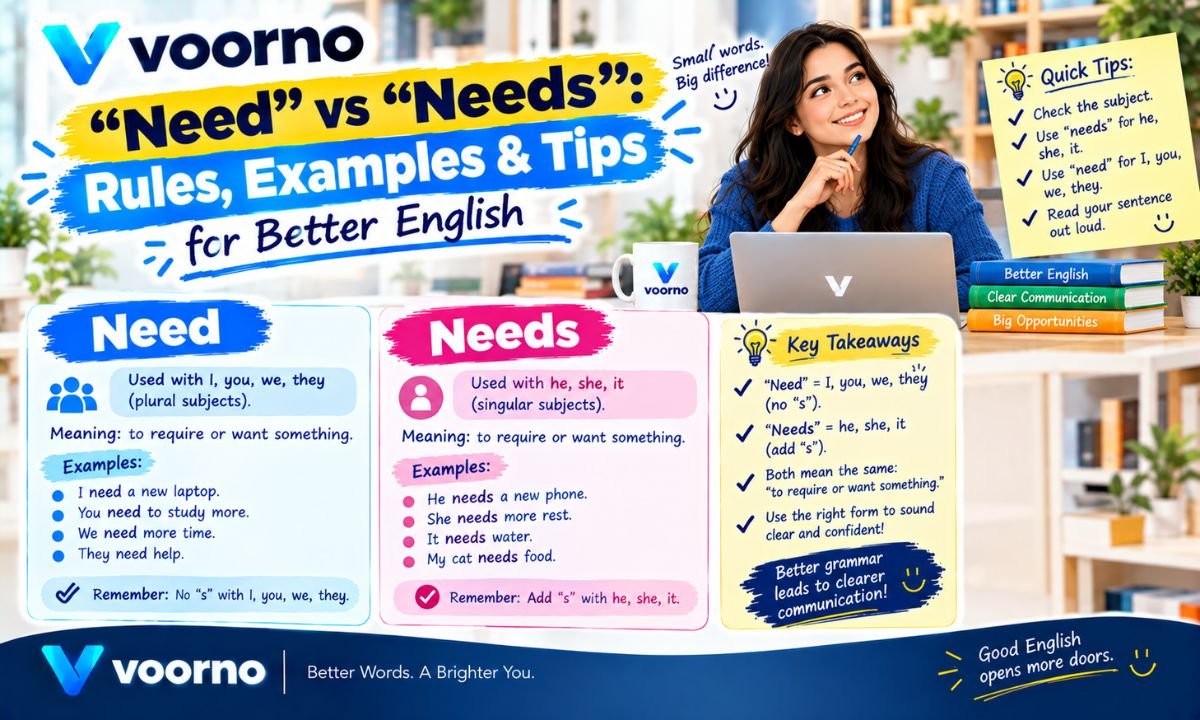
If you’ve ever typed a sentence, paused, and stared at it wondering “wait, is it need or needs here?” — you’re not alone. This is one of the most common grammar mix-ups in English, and it trips up native speakers just as often as learners.
The good news? The rule is short, logical, and easy to lock into memory once you see it laid out clearly. In this guide, you’ll learn exactly when to use need versus needs, why the rule exists, and how to avoid the small mistakes that quietly make writing look unpolished.
Need vs Needs: Quick Answer You Can Remember Instantly
Here’s the shortcut:
- Use need with I, you, we, they, and any plural noun.
- Use needs with he, she, it, and any singular noun (third-person singular).
That’s it. If your subject is “one person or thing,” add the -s. If it’s “more than one,” or it’s I/you/we/they, drop the -s.
Read More:Where Are You Headed or Where Are You Heading? Meaning, Difference & Correct Usage
| Subject Type | Correct Form | Example |
| I, you, we, they | need | They need more time. |
| Plural nouns | need | The kids need rest. |
| He, she, it | needs | She needs a break. |
| Singular nouns | needs | The car needs fuel. |
Grammar Breakdown of “Need”
Need is the base form of the verb. It’s used in the present tense with subjects that are plural, or with the pronouns I, you, we, and they.
- I need coffee before 9 a.m.
- You need to submit the form today.
- We need a bigger table.
- They need more practice.
- The students need clear instructions.
“John need” or “John needs”? John is a singular, third-person subject, so the correct form is needs: “John needs more practice.” Saying “John need” breaks subject-verb agreement and sounds noticeably off, even in casual speech.
“Anyone need” or “anyone needs”? Indefinite pronouns like anyone, someone, everyone, and everybody are grammatically singular, even though they can refer to a group of people. So the correct form is always needs: “Does anyone need assistance?” is technically a question form (using the base “need” after “does”), but in a statement, it’s “Anyone who needs help should ask.”
Read More:Chillin’: How to Relax, Recharge, and Enjoy the Moment
Grammar Breakdown of “Needs”
Needs is the third-person singular form of the verb, used with he, she, it, and singular nouns.
- He needs a new laptop.
- She needs more sleep.
- It needs charging.
- The engine needs maintenance.
- My sister needs advice.
Needs can also function as a noun, meaning requirements or necessities:
- “Our needs are simple: time, space, and support.”
- “The company must meet customer needs.”
As a noun, needs is usually plural, referring to multiple requirements, though the singular need (as in “there is a need for change”) also exists.
Subject-Verb Agreement Rule (The Real Core of the Problem)
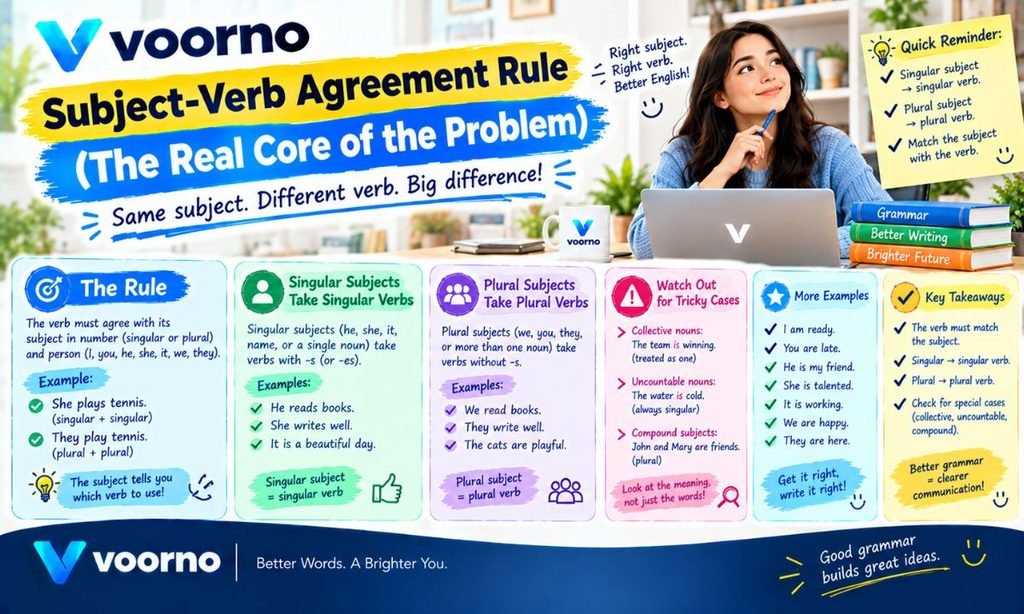
Every mix-up between need and needs comes down to one grammar rule: subject-verb agreement. The verb must match the number (singular or plural) and person of its subject.
Here’s the pattern in plain terms:
- Identify the subject of the sentence.
- Ask: Is it singular (he/she/it/one person or thing) or plural (they/we/multiple things)?
- Singular third-person → add -s → needs
- Everything else → keep the base form → need
Common mistake:
- ❌ “The manager need approval.” (Wrong — “manager” is singular)
- ✅ “The manager needs approval.”
- ❌ “My friends needs help.” (Wrong — “friends” is plural)
- ✅ “My friends need help.”
A quick trick: mentally replace the subject with he/she/it or they. If “he/she/it” fits, use needs. If they fits, use need.
British English vs American English Usage Differences
Here’s some reassuring news: there’s no spelling or grammar difference between British and American English when it comes to need vs needs. The subject-verb agreement rule applies identically on both sides of the Atlantic.
The only stylistic difference shows up in modal-style usage:
- British English occasionally uses “need” as a modal verb in formal or negative contexts: “You needn’t worry” or “Need I say more?”
- American English almost always treats need as a regular verb: “You don’t need to worry.”
Both are grammatically correct — it’s a matter of formality and regional style, not a hard rule.
Need vs Needs in a Sentence
Seeing the words in full sentences makes the pattern click faster than any explanation:
- I need to finish this report by Friday.
- She needs to leave early today.
- We need more volunteers for the event.
- The plant needs sunlight to grow.
- They need a new strategy.
- He needs to call the doctor.
- Everyone needs a little encouragement sometimes.
- You need a break — you’ve been working nonstop.
Common Mistakes with Need and Needs
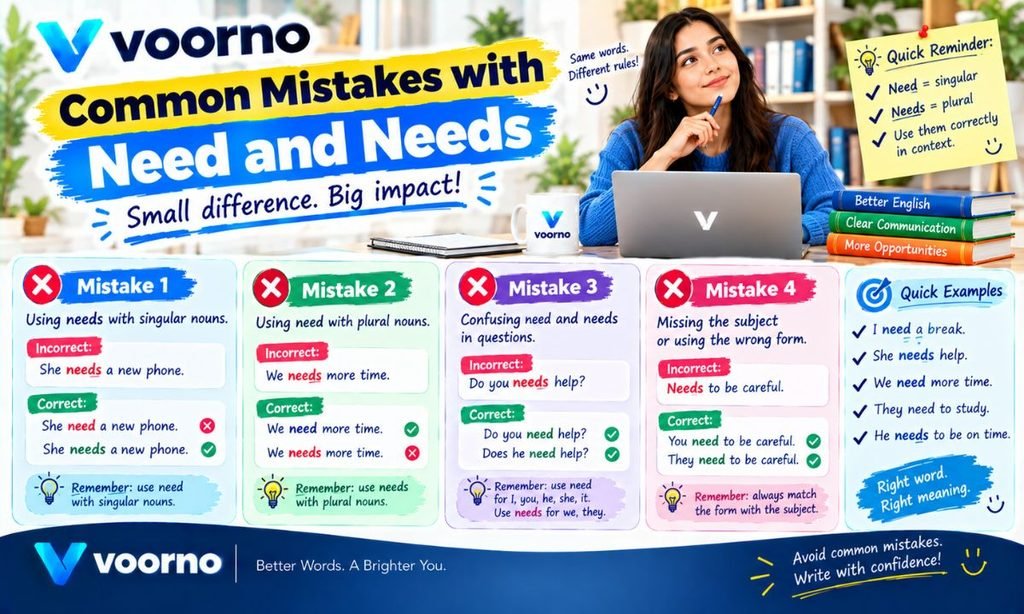
Even confident writers slip up occasionally. Here are the most frequent errors:
- Mismatched subject and verb: “The team need a new plan” instead of “The team needs a new plan.” (Collective nouns like team, staff, and group are usually treated as singular in American English.)
- Confusing indefinite pronouns: Treating everyone, anybody, or someone as plural. They’re singular, so pair them with needs.
- Overcorrecting compound subjects: “John and Sarah needs help” is wrong — compound subjects joined by “and” are plural, so it should be “John and Sarah need help.”
- Dropping the -s in questions incorrectly: “Does she need help?” is correct — after does, the verb returns to its base form, “need,” not “needs.”
- Using “needs” as a noun incorrectly: Writing “The needs is clear” instead of “The need is clear” or “The needs are clear.”
Need vs Needs in Everyday Examples
Daily life examples
- “I need to buy groceries before the store closes.”
- “My phone needs charging.”
- “We need to talk about the schedule.”
- “The baby needs a nap.”
- “You need to relax a little.”
Need vs needs examples
| Sentence | Subject | Correct Verb | Why |
| The dog ___ a walk. | dog (singular) | needs | Singular noun |
| My parents ___ advice. | parents (plural) | need | Plural noun |
| She ___ more time. | she (singular) | needs | Third-person singular pronoun |
| We ___ to leave now. | we (plural) | need | Plural pronoun |
| It ___ repair. | it (singular) | needs | Singular pronoun |
Grammar Patterns You Should Know
A few recurring patterns make this rule even easier to apply:
- After “does” or “doesn’t”: always use the base form → “Does he need help?” / “She doesn’t need reminders.”
- Modal-style negative (formal/British): “He needn’t attend” (no -s after modal “need”).
- Gerund pattern: “This needs fixing” or “The room needs cleaning” — both correct, using needs + verb-ing when the subject is singular.
- Infinitive pattern: “He needs to finish” vs. “They need to finish” — same rule applies before “to.”
Usage Trends: How People Use Need vs Needs Today
In modern everyday English — texting, social media, workplace emails — the subject-verb agreement rule for need/needs hasn’t changed, but a couple of trends are worth noting:
- The modal usage (“Need I say more?”, “You needn’t worry”) is fading in casual American English and is mostly seen in formal writing or British English.
- Collective nouns (team, company, staff) are increasingly treated as singular in American usage (“The team needs feedback”) while British usage sometimes treats them as plural (“The team need feedback”). Both are acceptable depending on the dialect and context.
- In professional writing, getting this rule right is often seen as a marker of polish — a small grammar slip like “the client need approval” can undercut an otherwise strong email or proposal.
Case Study: How Writers Fix “Need vs Needs” Errors
Original sentence:
“Each of the employees need to submit their timesheet.”
Problem:
At first glance, “employees” looks plural, so it seems like need should be correct. But the actual subject of the sentence is “each,” not “employees” — and each is singular.
Corrected version:
“Each of the employees needs to submit their timesheet.”
Why it matters:
This is one of the sneakiest traps in subject-verb agreement: a prepositional phrase (“of the employees”) sits between the subject and the verb, and writers instinctively match the verb to the nearest noun instead of the true subject. Recognizing the real subject — often a singular word like each, every, or one — is the key to avoiding this mistake.
Comparison Table: Need vs Needs
| Feature | Need | Needs |
| Used with | I, you, we, they, plural nouns | he, she, it, singular nouns |
| Verb form | Base form | Third-person singular form |
| Question form | Does + subject + need | N/A (need reverts to base) |
| Negative form | don’t need | doesn’t need |
| Noun usage | “a need for change” (singular noun) | “meeting customer needs” (plural noun) |
| Modal usage (formal) | “Need I ask?” | Not used as modal |
Final Summary: Which One Should You Use?
Ask yourself one question: Is the subject singular (he/she/it/one thing) or plural (they/we/more than one)?
- Singular third-person subject → needs
- Everything else → need
Once this becomes automatic, you’ll stop second-guessing yourself in emails, essays, and everyday conversation.
FAQs
Q:How can I use “needs” in a sentence?
Use needs when the subject is singular and third-person, such as “She needs more information” or “The printer needs ink.”
Q:When to use need vs needs?
Use need with I, you, we, they, or plural nouns. Use needs with he, she, it, or singular nouns.
Q:What are 5 simple sentences?
“I need water.” “He needs rest.” “They need help.” “It needs fixing.” “We need a plan.”
Q:Is “that needs” or “that need” correct?
“That needs” is correct because “that” refers to a single, specific thing and is treated as singular.
Q:Which is correct, “need” or “needs”?
Both are correct depending on the subject — need for plural/I-you-we-they subjects, needs for singular third-person subjects.
Conclusion
The difference between need and needs isn’t about memorizing exceptions — it’s about correctly identifying your subject and applying basic subject-verb agreement. Singular third-person subjects take needs; everyone and everything else takes need. Keep that one rule in mind, double-check tricky subjects like “each” or “everyone,” and you’ll use both words correctly without ever having to second-guess yourself again.










2 thoughts on “Need vs Needs: Rules, Examples & Tips for Better English”