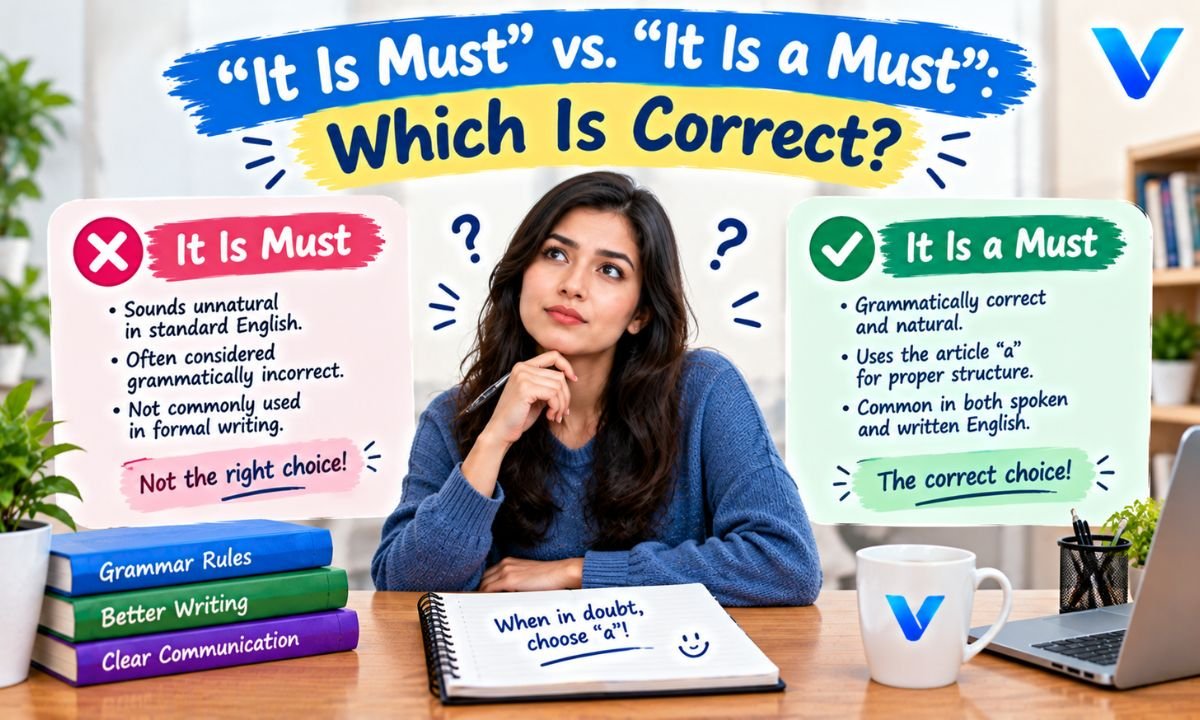
The phrases “It Is Must” and “It Is a Must” may look similar, but only one is generally correct in standard English. Understanding the difference is important for improving your grammar and communicating clearly in everyday conversations, academic writing, and professional settings. The phrase “It Is a Must” is used to describe something essential or necessary, while “It Is Must” is generally considered grammatically incorrect. In this guide, we will explore the meanings, grammatical rules, common mistakes, and practical examples to help you use these expressions correctly.
Opening Hook: Why This Tiny Grammar Difference Matters
One missing word. That’s all it takes to turn a confident sentence into one that sounds slightly off.
“It is a must” and “it is must” look almost identical, yet only one of them is correct standard English. The difference comes down to a single article — the little word “a” — and whether you include it changes how polished, professional, and native-sounding your writing feels.
This mix-up shows up everywhere: travel blogs, product descriptions, LinkedIn posts, and everyday emails. Native speakers rarely think twice about which version to use, but non-native speakers and even confident writers often trip over it because “must” doesn’t behave like a normal noun at first glance.
By the end of this guide, you’ll know exactly why “it is a must” is correct, why “it is must” isn’t, and how to use the phrase naturally in your own writing.
Read More:“Prompt Action” Explained: How to Act Quickly and Effectively
What “Must” Actually Means in English
The word “must” has two completely different jobs in English grammar, and confusing them is the root of this entire debate.
- As a modal verb, “must” expresses obligation, necessity, or strong certainty (“You must finish this today”).
- As a noun, “must” refers to a thing that is essential, required, or highly recommended (“A raincoat is a must in Seattle”).
Same spelling, same word — but two different grammatical roles. Once you separate these two identities, the correct usage becomes obvious.
Must as a Modal Verb (Grammar Rules That Matter)
When “must” works as a modal verb, it always sits directly before the base form of another verb. It never stands alone, and it never takes an article.
Examples:
- You must submit the report by Friday.
- She must be exhausted after that flight.
- Employees must wear safety gear on site.
Notice the pattern: must + base verb. There’s no “a” here because modal verbs aren’t nouns — they don’t get articles, plurals, or possessives.
Must as a Noun (Where Articles Become Essential)
When “must” functions as a noun, it means “something essential” or “a necessary item.” As a singular, countable noun, English grammar requires it to be preceded by an article — usually “a.”
Examples:
- Sunscreen is a must at the beach.
- A good Wi-Fi connection is a must for remote work.
- Comfortable shoes are a must on this hike.
This is exactly where the confusion begins. Writers correctly use “must” as a verb all day long, then unconsciously drop the article when “must” switches roles and becomes a noun.
Why “It Is a Must” Is Grammatically Correct
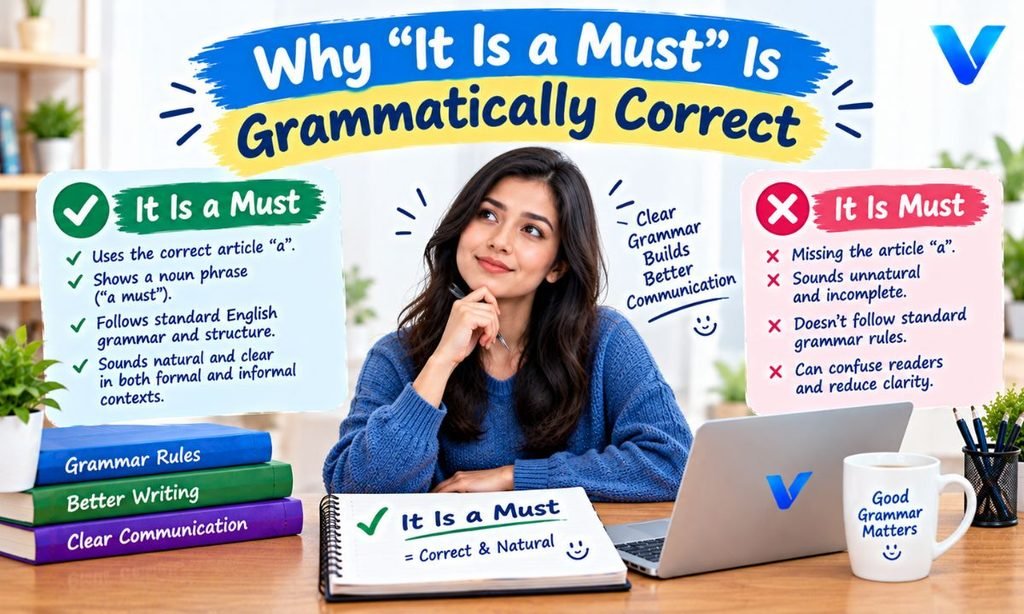
In the sentence “It is a must,” the word “must” is the noun, and “is” is the linking verb connecting the subject (“it”) to that noun.
English grammar has a simple, non-negotiable rule: a singular countable noun cannot stand alone in a sentence — it needs an article or determiner (a, an, the, this, that, etc.).
“Must” here behaves exactly like “necessity,” “requirement,” or “essential.” You would never say “It is necessity” — you’d say “It is a necessity.” The same logic applies to “must.”
It is must or it is a must grammar
Here’s the grammar breakdown in one line: “must” as a noun is countable and singular, so English requires the article “a” before it — making “it is a must” the only grammatically complete version.
Why “It Is Must” Is Grammatically Incorrect
“It is must” fails for a clear structural reason: it tries to place a bare noun directly after a linking verb, which English doesn’t allow for singular countable nouns.
It also creates a confusing hybrid — as if “must” were functioning as an adjective describing “it,” which isn’t a valid grammatical role for this word. English simply has no rule that permits this construction in standard usage.
You’ll sometimes see “it is must” in:
- Non-native speech patterns
- Fast, unedited typing
- Casual regional dialects
But in formal writing, academic work, business communication, or content meant for a broad audience, it reads as an error every time.
Native Usage Patterns You’ll Actually Hear
Native English speakers use “a must” constantly, almost as a fixed expression, especially when recommending or emphasizing importance.
Common native patterns include:
- “[Something] is a must for [audience/purpose]”
- “[Something] is an absolute must”
- “[Something] is a must-have”
- “[Something] is a must-see” / “must-visit” / “must-read”
You’ll rarely hear a native speaker say “it is must” in natural conversation — and when you do, it usually gets self-corrected mid-sentence, because it simply doesn’t sound complete.
Data Check: Search Trends & Usage Frequency
Search and usage data consistently show the same pattern: people frequently type the incorrect version while searching, but the correct version dominates real-world writing.
| Metric | “It is a must” | “It is must” |
| Grammatical status | Correct | Incorrect |
| Common in native speech | Yes, very common | Rare, usually a slip |
| Found in edited/published writing | Frequently | Almost never |
| Common in search queries | Yes | Yes (people searching to confirm the rule) |
| Typical context | Blogs, reviews, travel writing, marketing | Informal speech, quick typing, ESL usage |
This gap between search behavior and actual correct usage is common with tricky grammar points — people search the “wrong” phrase to check whether it’s right, then land on content confirming the correct form.
Common Situations Where “It Is a Must” Fits Perfectly

“It is a must” is most at home in writing that recommends, reviews, or ranks something as essential. It fits naturally in:
- Travel writing — “Visiting the old town is a must when in Prague.”
- Product reviews — “A backup battery is a must for long trips.”
- Career advice — “Networking is a must for early-career professionals.”
- Lifestyle and wellness content — “Hydration is a must during summer workouts.”
- Business and professional writing — “Clear documentation is a must for remote teams.”
Anywhere you’re telling readers “don’t skip this,” the phrase does the job cleanly and confidently.
Side-by-Side Examples (Correct vs Incorrect)
| Correct ✅ | Incorrect ❌ |
| Sunscreen is a must at the beach. | Sunscreen is must at the beach. |
| A passport is a must for international travel. | A passport is must for international travel. |
| Good communication is a must in leadership. | Good communication is must in leadership. |
| This app is a must for busy professionals. | This app is must for busy professionals. |
| Comfortable footwear is a must on this trail. | Comfortable footwear is must on this trail. |
The pattern is consistent: every “incorrect” example is missing the article “a” before the noun “must.”
It is a must synonym
If you want variety instead of repeating “a must,” reach for words like “essential,” “a necessity,” “indispensable,” “non-negotiable,” or “a requirement” — all of which follow the same article rule.
Case Study: Travel Writing and Editorial English
Travel and lifestyle publications rely heavily on “a must” because the phrase efficiently signals priority to readers without sounding preachy.
Look at how professional editorial content typically phrases it:
- “The night market is an absolute must for first-time visitors.”
- “Booking tickets in advance is a must during peak season.”
- “This hike is a must for anyone visiting the region.”
Editors and copywriters favor this structure because it’s short, confident, and instantly understood — exactly what strong recommendation-based content needs. You’ll almost never find “is must” surviving an editing pass, because professional style guides treat it as a basic article error.
Alternatives to “It Is a Must” (When Variety Helps)
Repeating “is a must” too often can feel repetitive, especially in longer content. Here are natural alternatives:
- It is essential — “Hydration is essential during exercise.”
- It is a necessity — “A reliable internet connection is a necessity.”
- It is indispensable — “Patience is indispensable in teaching.”
- It is non-negotiable — “Data backup is non-negotiable for businesses.”
- It is a requirement — “Prior experience is a requirement for this role.”
- It is mandatory — “Wearing a helmet is mandatory on-site.”
Mixing these into your writing keeps it engaging while preserving the same meaning.
Quick Grammar Rule You Can Memorize
Here’s the one-line rule to lock this in permanently: if “must” means “something essential” (a noun), it needs “a” in front of it.
If you’re using “must” to give an instruction or express obligation (a verb), it never takes an article and it’s always followed directly by another verb.
Is a must in a sentence
Quick example: “Learning basic grammar rules is a must for confident writing.” Here, “must” is a noun meaning “essential thing,” so it correctly takes the article “a.”
Quick Reference Table
| Form | Role of “Must” | Correct? | Example |
| It is a must | Noun | ✅ Yes | Sunscreen is a must in summer. |
| It is must | Attempted noun (missing article) | ❌ No | Sunscreen is must in summer. |
| You must go | Modal verb | ✅ Yes | You must go now. |
| You must a go | Modal verb + incorrect article | ❌ No | You must a go now. |
FAQs
Q:Which is correct: “is a must” or “is must”?
“Is a must” is correct. “Must” functions as a singular noun here, so English grammar requires the article “a” before it.
Q:What is the meaning of it is a must?
It means something is essential, necessary, or highly recommended and shouldn’t be skipped or ignored.
Q:What are other words for “is a must”?
Common alternatives include “is essential,” “is a necessity,” “is indispensable,” and “is non-negotiable.”
Q:What does “must” mean in slang?
In casual slang, “a must” often refers to a trend, product, or experience that’s considered extremely popular or highly recommended, like a “must-have” item.
Q:What is the opposite of “must”?
The opposite is usually “optional,” meaning something is not required or essential.
Conclusion
The rule behind “it is must” vs. “it is a must” is small but firm: when “must” acts as a noun meaning something essential, English grammar requires the article “a” before it. That’s why “it is a must” is correct, and “it is must” is not.
Understanding the two identities of “must” — modal verb and noun — makes this distinction easy to remember for good. The next time you want to recommend something strongly, you’ll know exactly how to phrase it: confidently, correctly, and naturally, as “a must.”








1 thought on “It Is Must vs. It Is a Must: Which Is Correct?”